

Section 21 was abolished on 1 May 2026, so every possession claim in England now runs on a ground in Schedule 2 to the Housing Act 1988. This is the decision page: your situation goes in, the ground that fits it comes out, with the notice period, the evidence a judge expects and the restrictions that catch landlords out.
Key takeaways
- Choose the ground from your reason for wanting the property back, not by reading Schedule 2 from the top.
- Mandatory grounds oblige the court to order possession; discretionary grounds leave the judge a reasonableness test and the power to refuse or suspend.
- Notice periods are set by section 8(4AA) in four bands — four months, two months, four weeks, two weeks — and the longest ground in a notice governs the whole notice. Grounds 7A and 14 sit outside the table.
- Ground 8 must be satisfied at the notice date and at the hearing, and any rent unpaid only because a Universal Credit housing payment has not yet reached the tenant is ignored.
- Grounds 1 and 1A are only available once the tenancy has run at least a year by the date in the notice, and using them blocks re-letting or re-marketing until twelve months after that date (sections 16E and 16M).
The short answer: start from your situation, not the ground list
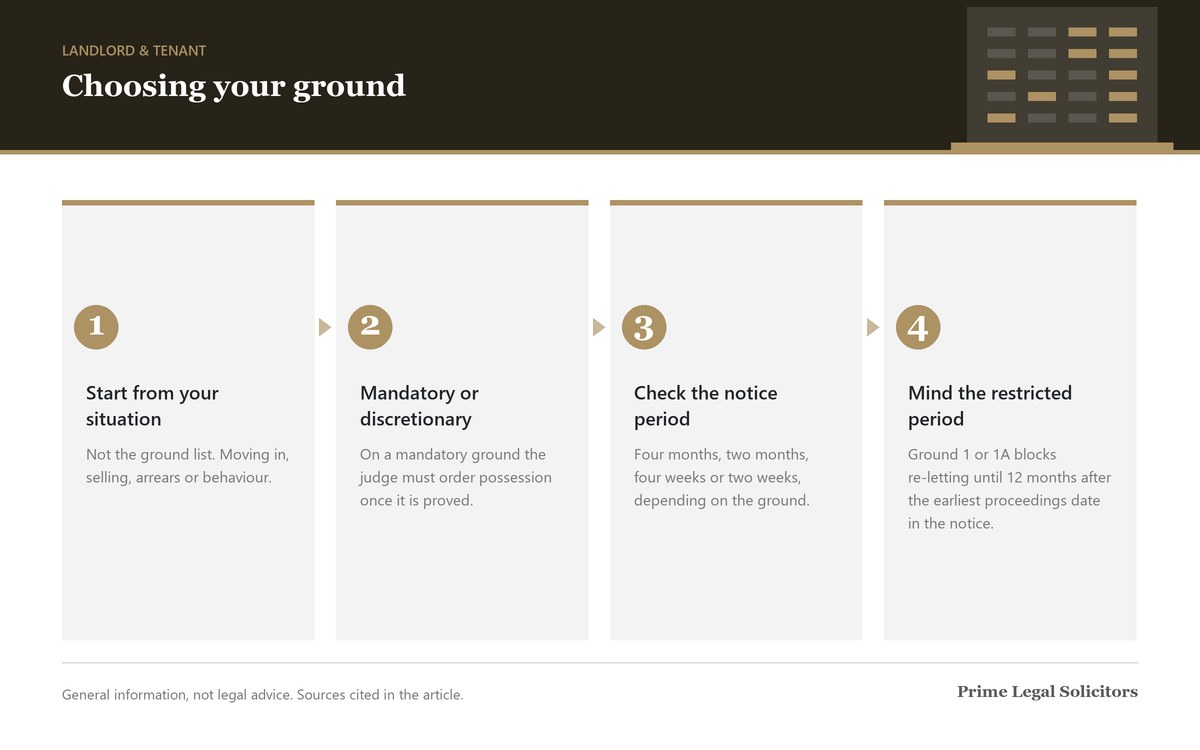
Work backwards. Decide in one sentence why you want the property back, then find the ground that matches that reason, then check whether the ground is mandatory or discretionary and how long the notice has to be. Reading Schedule 2 to the Housing Act 1988 from Ground 1 downwards is how landlords end up on a ground they cannot evidence.
Since 1 May 2026, when the Renters’ Rights Act 2025 (Commencement No.2) Regulations 2026 (SI 2026/421) came into force, there is one route to possession of a residential let in England: a section 8 notice citing a ground in Schedule 2, followed by a County Court claim if the tenant stays. Section 21 was abolished on that date and every existing assured shorthold tenancy became an assured periodic tenancy. You no longer get to decline to give a reason, so the choice of reason is the most consequential decision in the case.
The four questions that decide which section 8 ground to use
- Why do you want it back? Your own occupation, a sale, arrears, behaviour, or the purpose the letting was for. That answer narrows you to two or three grounds.
- Is the ground mandatory or discretionary? Mandatory means the judge must order possession once you prove the facts. Discretionary means the judge decides whether it is reasonable to do so, and may refuse.
- How long is the notice? Anything from immediate to four months, set by the section 8(4AA) table. The longest ground in your notice governs the whole notice.
- Can you prove it on paper? A ground you cannot evidence is worse than no ground, because it costs you a court fee and a hearing to find out.
This page takes you from your situation to a ground. The compliance failures that defeat an otherwise perfect notice are a separate and larger problem, covered in the notice section below, and the wider regime is in our Renters’ Rights Act checklist.
Your situation, and the ground that fits it
Find your row. The complete list, with every ground and notice period, follows below.
| Your situation | Ground(s) to consider | Notice period | Evidence the judge expects |
|---|---|---|---|
| You want to move in yourself, or house a close family member | Ground 1 (mandatory) | 4 months | Who is moving in and their relationship to you (spouse or partner, parent, grandparent, sibling, child or grandchild); why the move is genuine; that the tenancy will have run at least a year by the date in the notice |
| You want to sell, or grant a long lease | Ground 1A (mandatory) | 4 months | A signed agency agreement, conveyancing correspondence, or a decision minute if the owner is a company |
| Your lender is repossessing and needs vacant possession | Ground 2 (mandatory) | 4 months | The mortgage, the power of sale, and that the mortgage pre-dates the tenancy |
| Serious, sustained rent arrears | Grounds 8, 10 and 11 pleaded together | 4 weeks | A rent schedule from the first missed payment to the hearing date, updated on the morning of the hearing |
| Small or intermittent arrears, or chronic lateness | Grounds 10 and 11 (both discretionary) | 4 weeks | The payment history, plus what you did about it: letters, repayment offers, referrals |
| Antisocial behaviour, nuisance or criminality | Ground 14 (discretionary); Ground 7A if there is a relevant conviction or order | None: proceedings may begin as soon as the notice is served | A dated incident log, neighbour statements, police or council correspondence, and the conviction or order itself for 7A |
| The tenant has damaged the property or the furniture | Grounds 13 and 15 (discretionary) | 2 weeks | Dated photographs, the inventory, the check-in report, a schedule of works or quotes |
| Breach of a tenancy term other than rent | Ground 12 (discretionary) | 2 weeks | The clause breached, the breach itself, and your warning letters |
| You need to demolish or substantially redevelop | Ground 6 (mandatory) | 4 months | Planning permission or a building contract, and why the work cannot be done with the tenant in place |
| The tenant has died and the tenancy has passed under a will or intestacy | Ground 7 (mandatory) | 2 months | The death certificate, and proceedings begun within 12 months of the death (or, if the court allows, of when you learned of it) |
| The tenant was housed because they worked for you, and no longer does | Ground 5C (mandatory, formerly Ground 16) | 2 months | The employment contract, the tenancy, and the link between them; the date employment ended |
| The Home Office has told you the occupier has no right to rent | Ground 7B (mandatory) | 2 weeks | The Home Office notice |
| The tenancy was obtained by a false statement | Ground 17 (discretionary) | 2 weeks | The application or reference containing the statement, and proof it was untrue and induced the letting |
| You are a university or college letting to students, or you run a student HMO | Grounds 4 and 4A (mandatory) | Ground 4: 2 weeks; Ground 4A: 4 months | The institutional status, or for 4A the written student statement given before the tenancy and the 1 June to 30 September timing window |
| You can offer the tenant suitable alternative accommodation | Ground 9 (discretionary) | 2 months | The alternative property, its suitability on location, size, rent and security of tenure |
If you want to move back in or sell
Grounds 1 and 1A are the two that come closest to what section 21 used to do, and they are the two with the most conditions attached. Both are mandatory, both carry four months’ notice, and neither is available unless the tenancy has run at least a year by the date stated in the notice. Ground 1 covers you or a close family member occupying as an only or principal home; Ground 1A covers selling or granting a lease of more than 21 years. Pick the one that is true. Section 16E also makes it a breach to rely on any ground you do not reasonably believe you can make out.
If the rent is unpaid
Plead Grounds 8, 10 and 11 in the same notice. Ground 8 is mandatory but fragile. Grounds 10 and 11 are discretionary and survive a part-payment. All three sit in the four-week band, so pleading them together costs nothing in notice time — which is not true if you add a four-month ground to the same notice.
If there is antisocial behaviour or damage
Ground 14 is the workhorse: conduct causing or likely to cause nuisance or annoyance to people in the locality, or a conviction for illegal or immoral use of the property or for an indictable offence in the locality. It is discretionary and sits outside the notice bands, so proceedings may begin as soon as the notice is served. Ground 7A is mandatory but needs a qualifying trigger, such as a conviction for a serious offence, a court finding that an anti-social behaviour injunction was breached, or a closure order. A 7A notice must also be served promptly: generally within 12 months of the conviction or finding, or within three months of a closure order. Most behaviour cases are Ground 14 cases, won on the quality of the log rather than the strength of the language.
If the tenancy was for a specific purpose
A family of grounds exists for lettings made for a reason: ministers of religion, agricultural workers, employment-linked accommodation, supported and temporary housing, student lets, and the grounds that follow a superior lease ending. Several are open only to registered providers, local authorities or educational institutions. For a typical private landlord, the realistic choices are Grounds 1, 1A, 2, 6, 7, 7A, 7B, 8, 9, 10, 11, 12, 13, 14, 15 and 17, with 4A and 5C in particular situations.
Mandatory or discretionary: the choice that decides your case
This is the distinction landlords understand least and it matters more than the notice period.
On a mandatory ground, if you prove the facts the court must make a possession order. The judge has no power to refuse because the tenant has children, has been there fifteen years, or has nowhere to go. Those facts may affect the date the order takes effect, but not whether it is made.
On a discretionary ground, proving the facts only gets you to the starting line. The court then applies the reasonableness test: is it reasonable, in all the circumstances, to make an order? The judge weighs how the problem arose, what each side did about it, and the effect on the household. A judge who believes every word of your evidence can still refuse possession, or suspend the order on terms.
Two consequences follow. If a mandatory ground fits your facts, use it. And if you are on a discretionary ground, your own behaviour is in evidence: landlords who offered a repayment plan, answered repair reports and wrote things down do better on reasonableness than landlords who did not.
Ground 8 is mandatory, and it is fragile
Ground 8 requires the arrears to be at the statutory threshold both on the date the notice is served and at the hearing. The Renters’ Rights Act 2025 raised that threshold to three months’ rent where rent is paid monthly, or 13 weeks’ rent where it is paid weekly or fortnightly, so a pre-2026 template is wrong.
So a tenant who brings the balance below the threshold on the morning of the hearing defeats the mandatory ground outright. That is legitimate, and it happens often. Ground 8 also carries a Universal Credit disregard: any rent unpaid only because the tenant has not yet received a Universal Credit housing payment is ignored when working out the threshold. If the arrears are a benefits administration problem rather than a non-payment problem, Ground 8 may not be open to you at all, and getting the housing element paid direct is usually faster than a claim.
The complete grounds table
Schedule 2 to the Housing Act 1988 was rewritten on 1 May 2026. Grounds were inserted and renumbered, old Ground 3 (out-of-season holiday lets) was repealed, and old Ground 16 became Ground 5C. A checklist drafted before 2026 is wrong in ways no one notices until a judge does.
Notice periods come from the table in section 8(4AA) of the Housing Act 1988. They are the minimum gap between service of the notice and the earliest date you may begin proceedings. They are longer than the periods that applied before the Renters’ Rights Act: Ground 1 moved from two months to four (Ground 1A is new), and Ground 8 from two weeks to four weeks.
| Ground | What it covers | Mandatory or discretionary | Notice period |
|---|---|---|---|
| 1 | You or a close family member intend to occupy the property as an only or principal home | Mandatory | 4 months |
| 1A | You intend to sell the property or grant a lease of more than 21 years | Mandatory | 4 months |
| 1B | A rent-to-buy agreement has come to an end (registered providers only) | Mandatory | 4 months |
| 2 | A mortgage lender is exercising its power of sale and needs vacant possession | Mandatory | 4 months |
| 2ZA to 2ZD | The superior lease above your interest is ending, or a superior landlord has become the immediate landlord | Mandatory | 4 months |
| 3 | Repealed on 1 May 2026 (formerly out-of-season holiday lets) | — | — |
| 4 | The property was let as student accommodation by a specified educational institution in the 12 months before the tenancy began | Mandatory | 2 weeks |
| 4A | An HMO let to full-time students, needed for the next student let; the date in the notice must fall between 1 June and 30 September | Mandatory | 4 months |
| 5 | The property is held for occupation by a minister of religion | Mandatory | 2 months |
| 5A | The property is needed for an agricultural worker | Mandatory | 2 months |
| 5B | The property is needed for someone who meets an employment requirement (registered providers) | Mandatory | 2 months |
| 5C | The letting was made because of the tenant’s employment with you, which has now ended (formerly Ground 16) | Mandatory | 2 months |
| 5D | The tenant no longer meets an employment requirement in the tenancy (private registered providers only) | Mandatory | 2 months |
| 5E | The property is needed for occupation as supported accommodation | Mandatory | 4 weeks |
| 5F | Supported accommodation where support has ended, funding has ceased or the tenant’s needs have changed | Mandatory | 4 weeks |
| 5G | The tenancy was granted to discharge a local authority homelessness duty that has now ended | Mandatory | 4 weeks |
| 5H | “Stepping stone” accommodation let below market rent by a registered provider or charity | Mandatory | 2 months |
| 6 | Demolition or substantial redevelopment that cannot be done with the tenant in occupation | Mandatory | 4 months |
| 6A | Decant accommodation (relevant social landlords only) | Mandatory | 4 months |
| 6B | Possession is needed to comply with enforcement action taken against you | Mandatory | 4 months |
| 7 | The tenant has died and the tenancy has passed under a will or on intestacy | Mandatory | 2 months |
| 7A | Severe antisocial behaviour: a relevant conviction, breach of an injunction, or a closure order | Mandatory | Outside the bands — proceedings may begin once the notice is served |
| 7B | The Home Office has notified you that an occupier has no right to rent | Mandatory | 2 weeks |
| 8 | Serious rent arrears at the statutory threshold, both at the date of the notice and at the hearing | Mandatory | 4 weeks |
| 9 | Suitable alternative accommodation is available for the tenant | Discretionary | 2 months |
| 10 | Some rent is lawfully due and unpaid — any amount, however small | Discretionary | 4 weeks |
| 11 | Persistent delay in paying rent, whether or not anything is owed today | Discretionary | 4 weeks |
| 12 | Breach of an obligation of the tenancy other than payment of rent | Discretionary | 2 weeks |
| 13 | Deterioration of the property or common parts through the tenant’s waste or neglect | Discretionary | 2 weeks |
| 14 | Nuisance or annoyance in the locality, or a conviction for illegal or immoral use of the property or an indictable offence in the locality | Discretionary | Outside the bands — proceedings may begin once the notice is served |
| 14ZA | Conviction for an indictable offence committed during a riot | Discretionary | 2 weeks |
| 14A | Domestic abuse where one partner has left and is unlikely to return (social landlords) | Discretionary | 2 weeks |
| 15 | Deterioration of furniture through ill-treatment | Discretionary | 2 weeks |
| 16 | Renumbered as Ground 5C on 1 May 2026 | — | — |
| 17 | The tenancy was obtained by a false statement by the tenant or someone acting at their instigation | Discretionary | 2 weeks |
| 18 | Supported accommodation where the tenant has unreasonably refused to co-operate with support | Discretionary | 4 weeks |
Statutory tables can be amended: read section 8 on legislation.gov.uk on the day you serve rather than relying on any article, including this one. Checked 8 November 2026.
Choosing between two grounds that both fit
Three rules of thumb. Prefer a mandatory ground over a discretionary one where both are available on the same facts, because it removes the reasonableness argument entirely. Do not mix notice bands unless you mean to: where a notice relies on more than one ground (and neither 7A nor 14 is among them), the longest applicable period governs the whole notice, so adding Ground 1A to an arrears notice converts four weeks into four months. Plead in the alternative within the same band, which is why 8, 10 and 11 go together and why a behaviour notice often carries 14, 12 and 13.
If both arrears and a sale are in play: a worked example
Imagine a landlord of a single flat in Salford, let on a tenancy that began two years ago. The tenant is four months behind after losing a job, has started paying again, and the landlord has decided to sell. Two routes are open.
- Serve on Grounds 8, 10 and 11. Notice period four weeks, so the earliest claim is about a month away. Ground 8 is mandatory — but the tenant is paying, and if the balance drops below the threshold by the hearing date it falls away, leaving two discretionary grounds on facts a judge may think are better met by a suspended order than by eviction.
- Serve on Ground 1A. Notice period four months, so the earliest claim is about three months later than on route one. Ground 1A is mandatory and does not depend on what the tenant does with the arrears meanwhile. Against that: it needs evidence of a genuine intention to sell, and it triggers the re-letting and re-marketing bar described below.
Which is better depends on the objective. If the aim is the money, route one is faster and probably sufficient. If the aim is vacant possession for a sale, route two is slower but far more reliable. Serving both in one notice gives the worst of each: the four-month period applies to all of it, and by the time you can issue, the tenant may have paid the arrears below the Ground 8 threshold.
If the tenant pays off the arrears
Ground 8 goes. Grounds 10 and 11 survive, but the reasonableness test gets much harder — a tenant who has cleared the debt and pays on time is rarely evicted. Decide what you actually want before issuing: a money judgment, a suspended order and a paying tenant is often a better result than an empty flat and a void.
Getting the notice right, step by step
Many possession claims fail at the notice stage, months before anyone sees a judge, and the court’s first question is whether the notice is valid.
- Use the prescribed form. Section 8(3) requires the prescribed form, which is Form 3A of the assured tenancy forms on GOV.UK. A letter, an email in your own words, or the old Form 3 is not a valid section 8 notice.
- Name every ground, and particularise it. Under section 8(2) the court cannot make an order on a ground that is not in the notice unless it permits an alteration. Set out the full text of each ground, then the dates, sums and incidents. “Rent arrears” is not particulars; a schedule of rent due, rent paid and running balance is.
- Calculate the date from the longest band that applies, then add a margin. A date that is even one day too early can make the notice invalid.
- Diarise the 12-month longstop. The notice must state that proceedings will not begin before a specified date and not later than 12 months from service (section 8(3)(c)). Wait out the anniversary while the tenant promises to pay, and the notice dies.
- Serve it in a way you can prove. Hand delivery with a dated photograph and a witness, or a certificate of service, beats a posted letter you cannot evidence.
- Audit compliance before you serve. Deposit protection matters most. Where a deposit was taken, the court can only make a possession order if it is protected in an authorised scheme and the prescribed information was given, unless it has been returned. The only exceptions are orders on Grounds 7A and 14 (Housing Act 2004, section 215).
The evidence to gather before you serve
Assemble the ground-specific documents first, because the notice commits you to them. For arrears, the rent schedule. For a sale, the agency agreement or conveyancer’s file. For your own occupation, something beyond assertion. For behaviour, a dated log with times and what was heard or seen, plus police or council correspondence. For damage, the inventory, the check-in report and dated photographs.
The two twelve-month clocks on Grounds 1 and 1A
There are two separate 12-month periods attached to these grounds, and they are easily confused.
The protected period at the start. Neither ground is available unless the tenancy began at least a year before the date stated in the notice as the earliest date for proceedings. With four months’ notice, that means the earliest a notice can be served is roughly eight months into the tenancy. If you are buying a tenanted property intending to move in or resell, that period is part of your purchase timetable.
The restricted period at the end. Having used Ground 1 or 1A, you cannot then re-let or re-market the property for twelve months. Section 16E of the Housing Act 1988, inserted by the Renters’ Rights Act 2025, prohibits granting a tenancy of 21 years or less, granting a licence to occupy for money, and marketing or authorising anyone else to market the property for letting or occupation during “the restricted period”. The length is not in section 16E itself; it is defined in section 16M(3) to (7).
The timing catches people out. The restricted period starts on the day the notice is served and ends twelve months after the earliest date for possession proceedings stated in the notice. With a four-month notice, that is roughly sixteen months in all. It does not depend on when the order is made or when the tenant actually leaves, and it applies whether or not the tenancy continues. Where a claim was filed without such a notice, it runs for twelve months from the date the claim was filed. Exceptions are in section 16F, and breaches can lead to a financial penalty or, in some cases, prosecution.
The practical reading: if you tell a court you are selling, you have to sell. A landlord who gets possession on Ground 1A and has the property back on the rental market two months later has built an enforcement file against themselves, and the advert is the evidence. If the sale falls through, take advice on the section 16F exceptions before re-marketing, not afterwards.
What goes wrong when landlords choose badly
- Choosing a discretionary ground when a mandatory one fits. Pleading Ground 10 alone on facts that would support Ground 8 hands the judge a discretion they did not need to have.
- Mixing bands by accident. Adding one four-month ground to a four-week notice is the single most expensive drafting error on this topic, and it is invisible until someone counts.
- Relying on Ground 8 alone. A part-payment the week before the hearing ends the claim. Always plead 10 and 11 alongside it.
- Treating the arrears figure as fixed. The schedule has to run to the hearing date. A figure that stops three months ago invites an adjournment.
- Serving Ground 1 or 1A too early, before the tenancy will have run a year by the date in the notice, or confusing that rule with the section 16E restricted period.
- Using a pre-2026 template. Old Ground 3 no longer exists, Ground 16 has moved, and every notice period in a pre-2026 precedent is too short.
Said plainly for tenants reading this: most of these are defences. If the notice is on the wrong form, cites a ground that was not particularised, gives short notice, is out of time, or relies on Ground 8 where the arrears include unpaid Universal Credit housing costs, those are points to raise. Shelter and Citizens Advice both give free advice, and free legal advice is usually available at court on the day of a possession hearing.
What to do next
- Write down why you want the property back, in one sentence, before you open Schedule 2.
- Match the reason to a ground using the routing table, then check the complete table for the notice period and whether it is mandatory.
- Check the restrictions: the one-year rule on Grounds 1 and 1A, the timing window on Ground 4A, and whether the ground is open to a private landlord at all.
- Gather the ground-specific evidence first. If you cannot evidence it today, choose a different ground or wait.
- Audit your paperwork, starting with deposit protection and the prescribed information, then your safety certificates and the rest of the tenancy file.
- Complete the current Form 3A, particularise every ground, count the notice period from the longest band, and serve it provably.
- Diarise two dates: the earliest date you may issue, and the 12-month longstop.
- Take advice before serving if the case is contested, the arrears are substantial, or there is any compliance gap. Our landlord and tenant solicitors review notices before service, and our published fees set out what that involves. For business premises, different rules apply entirely and our commercial lease solicitors deal with those.
One closing point, said as much for tenants as for landlords. The system that replaced section 21 was not built to stop landlords recovering their property. It was built to make them say why. If the reason is genuine and the paperwork is straight, the grounds are there.
Frequently asked questions
Which Section 8 ground should I use?
Start from your reason, not the list. Moving in or housing family is Ground 1; selling is Ground 1A; serious arrears is Ground 8 with 10 and 11 in the alternative; behaviour is Ground 14, or 7A where there is a qualifying conviction or order. Then check whether the ground is mandatory, how long the notice must be, and whether you can evidence it on paper today.
What is the difference between mandatory and discretionary grounds?
On a mandatory ground the court must order possession once you prove the facts, whatever the tenant’s circumstances. On a discretionary ground the court asks whether it is reasonable to order possession, weighing how the problem arose, what each side did about it and the effect on the household. A judge may accept all your evidence and still refuse, or suspend the order on terms.
How much rent arrears before I can evict?
For the mandatory Ground 8, at least three months’ rent must be unpaid if rent is paid monthly, or 13 weeks’ rent if it is paid weekly or fortnightly. The Renters’ Rights Act 2025 raised these figures. The threshold must be met both when the notice is served and at the hearing. Ground 10 needs only some rent lawfully due and unpaid, but it is discretionary.
Can I evict a tenant to sell the property?
Yes, on Ground 1A, which is mandatory and carries four months’ notice. Three conditions bite: the tenancy must have run at least a year by the date stated in the notice, you need evidence of a genuine intention to sell or grant a lease of more than 21 years, and once you have used it you cannot re-let or re-market the property until twelve months after that date under section 16E.
How long is a Section 8 notice period?
It depends entirely on the ground. The section 8(4AA) table sets four bands: four months, two months, four weeks and two weeks. Grounds 7A and 14 sit outside them and allow proceedings to begin as soon as the notice is served. Otherwise, where a notice cites several grounds, the longest applicable period governs the whole notice.
Can I use more than one ground?
Yes, and on arrears you usually should: Grounds 8, 10 and 11 together, because they share the same four-week band. The warning is about mixing bands. Adding a four-month ground such as 1A to a four-week arrears notice makes the entire notice a four-month notice. Plead in the alternative within a band, and think hard before crossing one.
What happens if the tenant pays off the arrears?
The mandatory Ground 8 falls away, because the threshold has to be met at the hearing as well as at service. Grounds 10 and 11 survive a part-payment, but they are discretionary, and a tenant who has cleared the debt and is paying on time is rarely evicted. A suspended order plus a money judgment is the common and often sensible outcome.
Can a judge refuse possession on a mandatory ground?
Not on the merits. If the facts are proved and the notice is valid, the order must be made. What a judge can do is postpone the date it takes effect, and can refuse the claim altogether if the notice is defective, the ground was not properly particularised, the notice period was short, or the deposit was not protected and the prescribed information not given.
What is the restricted period after using Ground 1 or 1A?
It starts when the notice is served and ends twelve months after the earliest date for proceedings stated in the notice. During it you cannot re-let the property, grant a licence to occupy it for money, or market it for letting. The prohibition is in section 16E of the Housing Act 1988 and the twelve-month duration in section 16M(3) to (7). Exceptions are in section 16F.
Sources
- Housing Act 1988, s.8 (notice of proceedings and the s.8(4AA) periods)
- Housing Act 1988, Schedule 2 (grounds for possession)
- Housing Act 1988, s.16E (restriction on re-letting and re-marketing)
- Housing Act 1988, s.16M (definition of the restricted period)
- Housing Act 2004, s.215 (deposit protection and possession orders)
- The Renters’ Rights Act 2025 (Commencement No.2) Regulations 2026 (SI 2026/421)
- GOV.UK — Implementing the Renters’ Rights Act 2025: our roadmap
- GOV.UK — Evicting tenants in England
- GOV.UK — Assured tenancy forms (Form 3A)
Please note: This article is general information about the law in England as at 8 November 2026. It does not cover Wales, where different rules apply. It is not legal advice and does not create a solicitor-client relationship. Speak to a solicitor before making a decision. Prime Legal Solicitors is authorised and regulated by the Solicitors Regulation Authority, SRA No. 834471.
Author

Suits You Media Dev