
Three years is the general rule for a personal injury claim in England and Wales. But the clock does not always start at the accident, for a child it does not start until they turn 18, and for someone who lacks capacity it may never start at all. Here is how limitation really works, and how a standstill agreement can buy time when the investigation is not finished.
Key takeaways
- The general personal injury claim time limit in the UK is three years, under section 11 of the Limitation Act 1980, and it is measured to the date court proceedings are started with a claim form — not to the date you notify an insurer or instruct a solicitor.
- Where you did not know at the time that you were significantly injured or who was responsible, section 14 starts the three years from your date of knowledge, including knowledge you could reasonably have obtained.
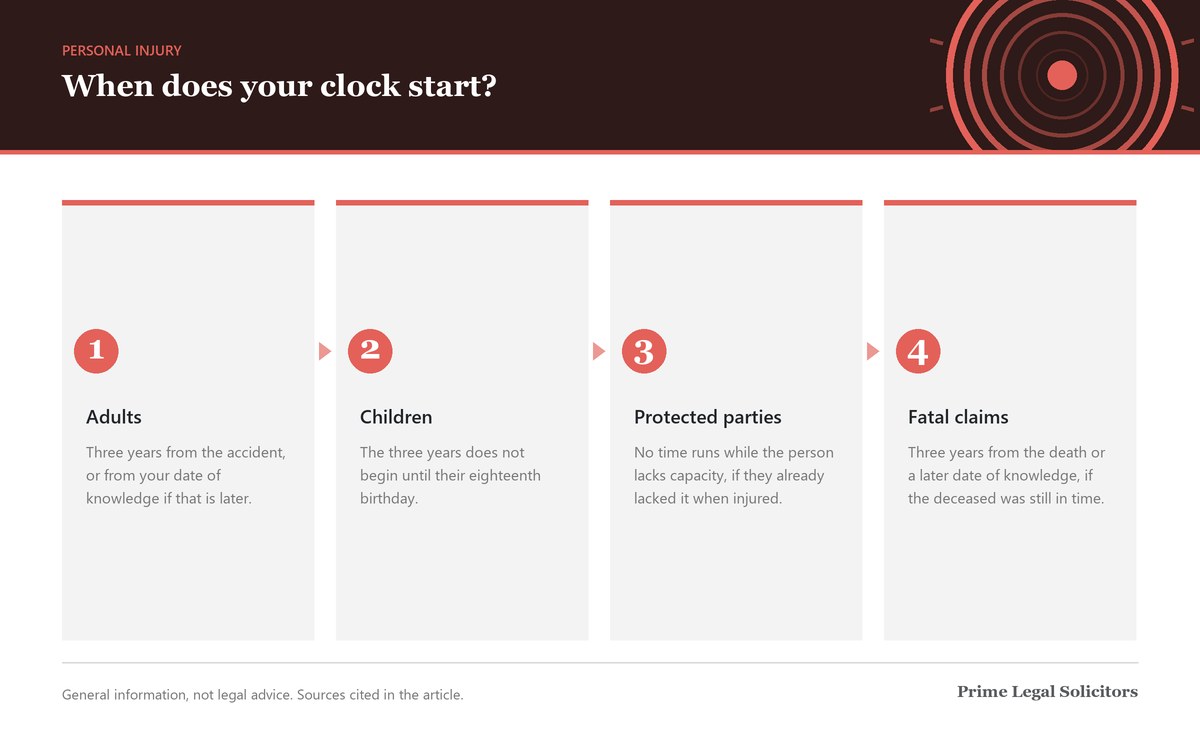
- For a child the clock does not start until their eighteenth birthday, so the claim must be brought by their 21st birthday; for a protected party who lacked capacity when the cause of action accrued, no limitation period runs while that incapacity continues.
- In a fatal case, section 12 gives a fresh three years from the date of death, or from a dependant’s later date of knowledge — but only if the deceased’s own period had not already expired.
- A standstill agreement can pause the limitation position by contract where the investigation is not finished, but it has to be properly drafted and signed before the deadline passes.
- If the deadline has gone, section 33 gives the court a discretion to let the claim proceed. It is an exception, not a safety net, and no one can promise it will be granted.
The short answer: three years, from when?
In England and Wales you have three years to bring a personal injury claim, under section 11 of the Limitation Act 1980. The three years runs from the date of the accident, or from the later date you first knew your injury was significant and that someone else may be responsible. Children and protected parties are different.
“Bring a claim” has a narrow meaning, and getting it wrong is how people lose good cases. It does not mean notifying an insurer, using an online portal, instructing a solicitor or sending a letter of claim. It means court proceedings being started with a claim form. Strictly, the claim is brought on the date the court receives the claim form, if that is earlier than the date the court issues it — but do not plan around that margin. Everything else can be in hand and the deadline can still pass.
| Who you are | When the clock starts | Deadline | Statutory basis |
|---|---|---|---|
| An adult injured in an accident, who knew at the time | The date of the accident | Three years from the accident | Limitation Act 1980, s.11 |
| An adult whose injury, or its cause, only became clear later | Your “date of knowledge” | Three years from the date of knowledge | Limitation Act 1980, ss.11 and 14 |
| A child — under 18 when the cause of action accrued | The 18th birthday | The 21st birthday | Limitation Act 1980, s.28 |
| A protected party who lacks capacity to conduct the claim | No clock runs while the incapacity continues | No deadline runs during incapacity; three years from the date capacity returns, if it does | Limitation Act 1980, s.28 |
| A dependant or the estate, where the injured person has died | The date of death, or the dependant’s (or personal representative’s) date of knowledge if later | Three years from that date — but only if the deceased was still in time when they died | Limitation Act 1980, ss.11(5) and 12; Fatal Accidents Act 1976 |
| Someone whose deadline has already passed | Not applicable | The claim proceeds only if a court exercises its discretion to disapply the limit | Limitation Act 1980, s.33 |
The deadline is a cliff edge, not a target
Limitation is a hard cut-off. If three years passes without a claim form being issued, the defendant acquires a complete defence, however badly you were hurt and however plainly the other side was at fault. Work out your date today and treat it as the last possible day rather than the plan.
Work out which clock applies to you
Find your situation in the left-hand column. The right-hand column is what to do this week.
| Your situation | The standard rule | The exception that may apply | What to do now |
|---|---|---|---|
| Road collision, or a work accident from one identifiable incident | Three years from the accident | Rarely any — knowledge is immediate | Diarise the date; request CCTV and the accident book entry in writing within days |
| Symptoms that built up gradually, or a condition diagnosed long after the exposure or treatment | Three years from the date of knowledge | s.14, including constructive knowledge of what you could reasonably have found out | Find the first dated medical note linking the condition to its cause, and request your full records |
| Injury to a child | No clock until the 18th birthday | s.28 suspends time throughout childhood | Act anyway. Evidence decays, and a court must approve any settlement |
| Injured person lacks capacity to conduct litigation | No clock while the incapacity continues | s.28 — but only if the incapacity existed when the cause of action accrued | Take advice urgently if capacity was lost after the event |
| The injured person has since died | Three years from death or the dependant’s knowledge | s.12 gives nothing if the deceased’s own three years had already run out | Check the deceased’s own deadline before anything else |
| Your three years has already gone | The claim is time-barred | s.33 discretion, or a standstill agreement if you got one in time | Take advice anyway — and do it this month, because delay is the main factor against you |
Date of knowledge: when the clock really starts
For a collision or a fall, the date of knowledge is normally the accident date, because you knew at once that you were hurt and who hurt you. For a great many other injuries it is not that simple, and section 14 exists to deal with them.
Your date of knowledge is the date you first knew all four of these things:
- that the injury was significant — serious enough that you would reasonably have thought it worth suing a defendant who admitted responsibility and could pay;
- that it was attributable, wholly or partly, to the act or omission you say was negligent;
- the identity of the defendant; and
- where you blame someone else — an employer responsible for an employee, say — that person’s identity and the facts making the defendant liable for them.
Two points catch people out. The first is that knowledge of the law is irrelevant. Section 14 is about knowing the facts, not about realising you could sue. You cannot extend your deadline by saying nobody told you a claim was possible.
The second is constructive knowledge. You are fixed with knowledge of facts you could reasonably have discovered, including facts obtainable from expert advice it was reasonable for you to seek. If a sensible person in your position would have asked a GP or requested their records, the clock can start from around the time that enquiry would have produced an answer.
A worked example: counting from knowledge, not from the negligence
Imagine a hypothetical joiner exposed to hardwood dust from 1996 to 2004. He develops a cough in 2019 and blames smoking. In March 2022 a respiratory consultant tells him the pattern looks occupational and writes that in a clinic letter. He does nothing until October 2026.
The exposure ended twenty-two years ago, which feels fatal to the claim. It is not the question. The question is when he first knew the condition was significant and attributable to the dust — on these facts, likely the March 2022 consultation. That puts his deadline in March 2025: gone by more than eighteen months, and the claim now has to be run under section 33. Had he taken advice in 2023 he would simply have been in time.
Change one fact and the answer changes. If the 2022 letter said only that the cause was unclear, and the occupational link was first put to him in 2025, his date of knowledge is arguably 2025 and he is in time. The dated documents matter more than anyone’s memory of the conversation.
If you are claiming for a child
A child’s limitation period does not run while they are under 18. Under section 28, the three years starts on the eighteenth birthday, so the claim must be brought by the twenty-first birthday.
That does not make waiting sensible. A claim brought when a child is seven, with school records and witnesses still available, is far stronger than the same facts reconstructed at twenty. The three years after eighteen is a backstop, not a plan.
If nobody brought a claim while the child was young
Nothing is lost legally. The young adult can bring the claim themselves between eighteen and twenty-one, in their own name, without a litigation friend. What they face is an evidential hole: the accident book destroyed, the supervisor moved on, the pothole filled a decade ago. Start with records that still exist — GP and hospital notes, school accident records, old photographs.
How a claim is run while the child is still under 18
A child cannot conduct proceedings. An adult acts as their litigation friend — usually a parent, sometimes another relative, or the Official Solicitor where nobody suitable is available. The litigation friend gives instructions, signs documents, and must conduct the claim in the child’s best interests.
Two further features apply under CPR Part 21. Any settlement must be approved by the court at a short hearing where a judge checks the figure is reasonable; an insurer cannot settle with a parent over the phone, and an unapproved settlement does not bind the child. And the money is normally held by the court until the child turns eighteen, unless the court directs a payment out for a specific need.
If the injured person lacks mental capacity
Section 28 also protects an adult who lacks the mental capacity to conduct legal proceedings — in court language, a protected party. Capacity is assessed on the Mental Capacity Act 2005 test: whether the person can understand, retain and weigh the relevant information and communicate a decision. It is decision-specific, so someone can lack capacity to run litigation while managing the rest of their life well.
While that incapacity continues, no limitation period runs at all. There is genuinely no deadline. If capacity is later regained, three years runs from that point. For someone with a severe brain injury who never recovers it, a claim can in principle be brought many years later.
One restriction does real damage in practice. Section 28 protects a person who was already under a disability when the cause of action accrued. If you had capacity at the time of the accident and lost it afterwards, the ordinary three years is not suspended — though the loss of capacity weighs heavily if the court is later asked to exercise its section 33 discretion. A head injury where capacity fails days after a collision needs advice in weeks, not years.
A protected party also acts through a litigation friend, and any settlement needs court approval. Where damages are substantial and the person cannot manage the money themselves, the court will usually direct that it is managed by a deputy appointed by the Court of Protection.
If someone has died
When someone dies from an injury, two claims can arise: an estate claim for what the deceased went through before death, and a dependency claim under the Fatal Accidents Act 1976 for the financial and domestic support the family has lost.
Section 12 governs the timing of the dependency claim, in two stages:
- If the deceased’s own three-year period had not expired by the date of death, a fresh three years runs from the date of death, or from the dependant’s date of knowledge if later.
- If the deceased’s own period had already expired, the dependency claim cannot be brought at all, unless the court exercises its section 33 discretion.
Where there is more than one dependant, dates of knowledge are considered individually under section 13, so one family member can be in time while another is not.
The estate claim has its own rule. Under section 11(5), if the deceased died while still in time, the estate has three years from the date of death or from the personal representative’s date of knowledge, whichever is later.
Two warnings. An inquest does not pause limitation. Inquests are often adjourned for a year or more where there is a police investigation, and families reasonably assume nothing can be done until the coroner has finished. The coroner’s timetable has no effect on the date your claim must be issued, and nor does a prosecution. If a driving prosecution is running alongside your claim, the two run on separate timetables.
Industrial disease and delayed diagnosis
Illnesses caused by work rarely announce themselves. Asbestos-related disease can emerge decades after exposure. Noise-induced hearing loss creeps up so gradually people put it down to age. Vibration injury, occupational asthma and repetitive strain all develop slowly, often after the job has ended and sometimes after the employer has ceased to exist.
In all of these the date of knowledge does the work — usually the date of a diagnosis or a clinician’s comment linking condition to cause, not the date of exposure.
- Get the link in writing. A dated note connecting the condition to an exposure cuts both ways: it supports the claim and it fixes the date.
- Request medical and occupational health records early. They take weeks to arrive and usually explain the timeline better than memory does.
- A dissolved employer is not the end of it. Claims are pursued against the insurer who covered that employer at the time, and historic policies can be traced.
The same delayed-knowledge problem runs through medical negligence claims, where the question is often when you first knew the outcome was attributable to the treatment rather than to the underlying illness. That is a genuinely fine line. For accident at work claims arising from one identifiable incident, the ordinary three years from the accident almost always applies.
Standstill agreements: pausing the clock by agreement
A standstill agreement is what practitioners reach for when the deadline is close but the investigation is not finished.
A standstill agreement is a contract between the claimant and the prospective defendant — usually their insurer — under which the defendant agrees that an agreed period will not count towards limitation, or agrees not to rely on a limitation defence for that period. It is used where both sides can see that issuing proceedings immediately would waste money: the medical evidence is not ready, a disclosure request is outstanding, or the parties are close to settling. It is common in clinical negligence and professional negligence work. No defendant is obliged to agree to one, so if the answer is no, the claim form still has to be issued in time.
A standstill agreement is not something to arrange yourself
These agreements are construed strictly, and the consequences of getting the wording wrong are terminal: if the agreement does not do what you thought, the limitation period has expired and there is no remedy. An email saying “we agree not to take a limitation point for now” is not good enough. It needs to be drafted by a solicitor and signed by both sides before the limitation period expires — not after. Do not rely on an informal understanding, a telephone assurance, or an insurer’s promise to “keep the file open”.
What a properly drafted standstill agreement has to settle
- Who is bound. An agreement with one insurer does not bind a second defendant, a contribution claim, or another employer in a disease case with several exposures.
- Which claims are covered, defined by incident and cause of action, so a claim added later is not outside it.
- Exactly when it starts and ends, with the end expressed as a date and not as an event like “the conclusion of negotiations”.
- How it is ended — usually written notice, with a notice period long enough to issue proceedings within it.
- Whether time is suspended or the deadline extended. Different mechanisms, different final dates.
- What happens to accrued defences. If the period had already expired before signature, the agreement should say what the defendant is giving up, or it may give up nothing.
If a standstill cannot be agreed in time, the orthodox answer is to issue protective proceedings: get the claim form issued inside the limitation period, then use the four months allowed for service to finish the investigation. The rules on extending time for service are strict and the court’s power to extend after it has run is very limited, so take advice rather than chances.
If the deadline has already passed: section 33
If the three years has gone, the claim is not automatically over. Section 33 gives the court a discretion to disapply the limitation period where it would be equitable to allow the claim to proceed, weighing the prejudice to you against the prejudice to the defendant.
The court is directed to consider, among anything else relevant:
- the length of the delay and your reasons for it;
- the effect of the delay on the reliability of the evidence;
- the defendant’s conduct, including the response to any reasonable request for information;
- the duration of any disability you were under after the cause of action arose;
- how promptly and reasonably you acted once you knew you might have a claim; and
- the steps you took to get medical or legal advice, and what you were told.
Two things deserve bluntness. Section 33 is an exception, not a safety net, and the burden of persuading the court sits with you. And the defendant’s ability to defend fairly carries real weight: if the vehicle was scrapped, the site rebuilt, the CCTV overwritten and the supervisor has died, the application is much harder. No one can tell you a section 33 application will succeed, and be wary of anyone who does.
A short delay with a clear explanation, against a defendant who has held the papers throughout and lost nothing, is a very different application from a six-year delay with no explanation. Where a solicitor missed the deadline there is also a separate question about the advice you were given. Take advice quickly, because further delay is the one factor you are still adding to.
Five mistakes that lose otherwise good claims
- Counting from the diagnosis instead of the date of knowledge. Often different dates, sometimes by years. Constructive knowledge can start the clock before anyone says “negligence” to you.
- Assuming a portal claim or a letter of claim stops the clock. It does not. Only starting court proceedings does. Claims are lost every year while the parties are in active correspondence.
- Treating a child’s claim as not urgent. The deadline is years away; the evidence is not. By the eighteenth birthday the records that proved liability may well have been destroyed.
- Relying on section 33 as a plan. It is a discretion weighted against delay, often argued as a preliminary issue before the court looks at the merits.
- Letting evidence decay inside the limitation period. A claim issued at two years and eleven months, with no CCTV and no witnesses, can be in time and still unprovable.
Why waiting costs you even inside the limit
Being in time is the floor, not the goal. Claims brought early are better evidenced, resolve faster, and involve far less argument about what actually happened.
What decays, and how quickly
- CCTV and dashcam. Many systems overwrite footage within weeks. If footage exists, someone has to ask for it in writing within days.
- Witnesses. Memory fades, people change jobs and move. One statement taken at four weeks is worth several taken at four years.
- The scene. Potholes get filled, spillages cleaned, machinery replaced. Dated photographs are irreplaceable.
- Records. Accident books, RIDDOR reports, maintenance, training and inspection records and rotas are all kept for limited periods only.
An evidence checklist to start today
- Photographs of the scene, the hazard and any visible injuries, with the original dates preserved.
- Names and contact details for everyone who saw what happened.
- The accident book entry or incident report, and your own copy.
- Correspondence, texts or emails about the accident, including anything the other side said at the time.
- GP, hospital and physiotherapy attendance details, plus receipts and payslips — travel, prescriptions, treatment, lost earnings.
- A short diary: pain levels, what you cannot do, missed work, help needed.
None of this decides what a claim is worth. It decides what can be proved, and what cannot be proved cannot be recovered. When a settlement does arrive, what reaches you is a different figure again, because fees, deductions and any benefits recovery come off first.
What to do next
- Fix your date. Write down the accident date, or your best view of your date of knowledge, and add three years. Acting for a child, the date is the twenty-first birthday. Diarise it with a reminder six months before.
- Preserve evidence this week. Requests for CCTV and records are urgent in a way nothing else in a claim is.
- Get the injury recorded medically. A record created near the event is the backbone of the claim.
- Decide whether you need a solicitor at all. If you were hurt as an adult driver or passenger in a road traffic accident that was not your fault, and the injury is minor, you may be able to claim through the Official Injury Claim service, which is free and designed to be used without legal help. That is a real option, and we would rather tell you about it than not.
- Take advice early if the date is unclear or close. A standstill agreement, if one is available, must be in place before the deadline.
- If you are already out of time, still take advice. Section 33 exists, and so does the question of whether you were advised properly.
Our personal injury solicitors can tell you which date applies to your facts and whether the claim needs us at all. If your deadline is weeks rather than months away, contact the team today rather than reading further.
Different rules apply outside England and Wales, and in the air or at sea
Scotland and Northern Ireland have their own limitation regimes. An accident abroad may be governed by the law of the country where it happened. Claims arising from international air travel or sea passenger transport are governed by international conventions with their own, generally shorter, windows. Do not assume the England and Wales rules apply to any of these — take advice straight away, because the window can be considerably tighter than you expect.
Checked 1 November 2026 against the Limitation Act 1980 and the Civil Procedure Rules as they currently stand. These rules are a framework, not advice on your own facts.
Frequently asked questions
How long do I have to make a personal injury claim?
Three years is the general rule in England and Wales, under section 11 of the Limitation Act 1980. It runs from the accident, or from your date of knowledge if that is later. The deadline is the date court proceedings are started with a claim form — not the date you report the accident, use a claims portal or instruct a solicitor. Children, protected parties and fatal claims follow different rules.
When does the three year time limit start?
Usually on the date of the accident. Where you did not know at the time that you were significantly injured, or did not know the injury was connected to someone’s act or omission, section 14 moves the start to your date of knowledge. You are also treated as knowing facts you could reasonably have discovered, including through medical advice it was reasonable for you to seek.
Can a child make a personal injury claim?
Yes. A claim can be brought at any time during childhood by an adult acting as the child’s litigation friend, and any settlement must be approved by the court under CPR Part 21. The limitation clock does not start until the child’s eighteenth birthday, so the claim must be brought by their 21st birthday. Bringing it early is usually better, because the evidence decays long before the deadline.
What happens if I miss the limitation deadline?
The defendant gains a complete limitation defence, so the claim will normally fail however strong it is on the facts. Section 33 of the Limitation Act 1980 lets the court disapply the deadline where it is equitable to do so, weighing your reasons for the delay against the prejudice to the defendant. It is a discretion that has to be argued for, and nobody can promise it will be granted.
How long do I have to claim for medical negligence?
The same three-year period applies, but the start date is far more often in dispute. The question is when you first knew the outcome was attributable to the treatment rather than to the underlying illness. That is a fine line, and constructive knowledge can start the clock earlier than you think. Take advice on the date rather than assuming it runs from the operation.
What is the date of knowledge?
It is the date you first knew that your injury was significant, that it was attributable to the act or omission you complain of, and who the defendant is. Knowing the law is irrelevant — the test is about facts. You are also fixed with constructive knowledge of facts you could reasonably have discovered, so delay in asking questions does not extend the deadline.
What is a standstill agreement?
It is a contract between a claimant and a prospective defendant, usually negotiated with their insurer, under which the defendant agrees not to rely on a limitation defence for a defined period while the claim is investigated or negotiated. It has to be drafted precisely and signed before the limitation period expires. An informal email or a telephone assurance is not a standstill agreement.
Is the time limit different for an accident at work?
No. A work accident arising from one identifiable incident carries the ordinary three years from the date of the accident. The difference is practical: accident books, training records, maintenance logs and RIDDOR reports are kept for limited periods, so evidence usually disappears long before the deadline. Industrial disease claims are the exception, because the date of knowledge often starts the clock much later.
Does a claim through the Official Injury Claim portal stop the clock?
No. Submitting a claim through the portal, notifying an insurer or sending a letter of claim does not stop the limitation clock. Only starting court proceedings with a claim form does that. Claims are lost every year while the parties are in active and apparently constructive correspondence, so diarise the deadline independently of whatever stage the claim has reached.
Do different rules apply if the accident happened abroad?
Often, yes. An accident abroad may be governed by the law of the country where it happened, and claims arising from international air travel or sea passenger transport fall under international conventions with their own, generally shorter, windows. Scotland and Northern Ireland have their own limitation regimes. Do not assume the England and Wales rules apply to any of these without advice.
Sources
- Limitation Act 1980, s.11 (actions for personal injuries)
- Limitation Act 1980, s.12 (fatal accident claims)
- Limitation Act 1980, s.14 (date of knowledge)
- Limitation Act 1980, s.28 (extension of limitation for disability)
- Limitation Act 1980, s.13 (fatal claims with more than one dependant)
- Limitation Act 1980, s.33 (discretionary exclusion of the time limit)
- Civil Procedure Rules, Part 21 (children and protected parties)
- Civil Procedure Rules, Practice Direction 7A (when a claim is brought)
- Official Injury Claim service
Author

Suits You Media Dev