

Ten years of lawful residence in the UK can lead to indefinite leave to remain. Two calculations decide most of these applications: how many days you spent abroad, and whether there was ever a gap between one grant of permission and the next.
Key takeaways
- Appendix Long Residence is in force as at 14 October 2026 and still provides for settlement after ten years spent lawfully in the UK. HC 584, effective 8 October 2026, amended only the LR 6.2 variation mechanics.
- Absences are tested three ways: no more than 180 days in any rolling 12-month period (CR 3.1), no more than 548 days in total where that total was reached before 11 April 2024 (CR 3.3(a)), and no single absence over 184 days starting before that date (CR 3.3(b)).
- Count days, not trips. Two ordinary holidays that fall inside the same rolling twelve months are added together, and that is how most self-prepared applications breach the limit.
- A gap in leave has two separate effects: the days of overstaying never count towards the ten years (LR 3.2), and continuity itself may be broken under CR 4.1. Both have to be checked.
- English at B1 is enough only for applications made before 26 March 2027. From that date Appendix Long Residence requires B2 (LR 13.1).
- A consultation on reforming the settlement rules closed on 12 February 2026. As at 14 October 2026 no outcome has been published and no Statement of Changes has been laid.
The short answer: what the ten-year route requires
If you have lived in the UK lawfully for ten continuous years, you can apply for indefinite leave to remain under Appendix Long Residence. You need ten years of lawful residence, absences inside the limits in Appendix Continuous Residence, the English language and Life in the UK requirements, and no suitability problem. The 10 year long residence rule does not care which visas made up the decade, provided each of them counted.
Two calculations decide most of these applications, and neither is the paperwork: how many days you spent outside the UK, counted properly, and whether there was ever a gap between one grant of permission and the next.
Rules checked: 14 October 2026
The ten-year long residence route is current law. Appendix Long Residence is in force today, and the GOV.UK page carrying it was last updated on 8 October 2026. Statement of Changes HC 584, effective 8 October 2026, amended only the mechanics in LR 6.2 for varying an application to another route. It did not close, delete or restrict the route.
The Rules are amended by Statement of Changes several times a year, so check the paragraph numbers against Appendix Long Residence before relying on them, or ask our long residence solicitors.
| Requirement | What it means | Evidence | Common failure |
|---|---|---|---|
| Ten years lawful residence (LR 3.1, LR 11.1) | A qualifying period of ten years spent lawfully in the UK with permission | Every grant of permission: visas, biometric cards, eVisa records, decision letters | A short period with no permission, which pushes the ten-year date back |
| Continuous residence (LR 4.1, LR 12.1) | The requirement in Appendix Continuous Residence, met for the whole qualifying period | A day-by-day absence schedule with tickets and passport stamps | Two trips inside the same rolling twelve months, together over 180 days |
| Permission that counts | Immigration bail, temporary admission and temporary release do not count (LR 3.2, LR 11.2); nor does time as a Visitor, Short-term Student, Seasonal Worker or on the Ukraine Scheme | The route named on each grant | Counting early visitor or seasonal work time towards the ten years |
| English language | B1 speaking and listening before 26 March 2027; B2 on or after (LR 13.1) | A secure English language test, a degree taught in English, or an exempt nationality | Booking a B1 test for an application submitted after the B2 date |
| Knowledge of life in the UK | The Life in the UK test, unless an exemption applies (LR 14.1) | The unique reference number from your Life in the UK test pass | Losing the reference; the pass does not expire, but you must prove it |
| Suitability | No refusal under Part 9 (LR 2.1, LR 10.1) | Full disclosure of convictions, cautions and immigration breaches | Omitting an old caution, adding a deception issue to the original problem |
What counts as lawful residence
Lawful residence means time in the UK with permission. The ten years can be stitched together from any number of routes – student, skilled worker, dependent partner, Tier 1, discretionary leave – and the switches do not matter, provided there was permission on every day you count.
Four things do not count: time as a Visitor, Short-term Student, Seasonal Worker or on the Ukraine Scheme; time on immigration bail, temporary admission or temporary release (LR 3.2, LR 11.2), which catches people who waited on an asylum or human rights claim without a grant of leave; overstaying between two periods of permission, which has its own section below; and time in prison or under a deportation order, which CR 2.1 excludes from lawful presence altogether.
Time on section 3C leave – the leave that continues automatically while an in-time application is undecided – is lawful residence, and most ten-year histories contain several stretches of it. How section 3C works, and what it means for your right to work and rent, is worth checking with our immigration appeals solicitors if an application is refused.
If part of your ten years was on a student visa
Time on a Student visa, the old Tier 4 and earlier student categories counts in full. Students are the largest group using this route, having arrived to study, switched into work, and only later realised the decade was nearly complete. The difficulty is rarely the student years. It is the summers: long vacations at home add up fast against the 180-day limit, and nobody keeps boarding passes from 2017.
The absence limits, and how to count them
Absences are assessed under Appendix Continuous Residence, which the Long Residence rules apply across the whole qualifying period. There are three separate tests and an application has to survive all of them.
- The rolling test (CR 3.1). You must not have been outside the UK for more than 180 days in any 12-month period. The window moves: it is not your visa year and not a calendar year, so the question is whether any twelve consecutive months anywhere in the decade contain more than 180 days abroad. Where the relevant permission was granted before 2018, CR 3.2 applies the limit to consecutive twelve-month periods instead, which is a different and generally more forgiving calculation.
- The historic aggregate test (CR 3.3(a)). For Long Residence you must not have spent more than 548 days outside the UK in total during the qualifying period, where that total was reached before 11 April 2024.
- The historic single-absence test (CR 3.3(b)). Nor more than 184 days at any one time, where that absence started before 11 April 2024.
The second and third tests are remnants of the old long residence rule, preserved for absences that happened under it. If your decade straddles 11 April 2024 – and for anyone applying now it will – you run the old tests over the early years and the rolling test over all of them.
Count days, not trips
The commonest error in a self-prepared application is counting trips. Six trips sounds modest; six trips of thirty days is 180 days, and two either side of a New Year may sit in the same rolling twelve months as a third. Build a schedule with a row for every departure and return, work out the whole days outside the UK for each, then test every twelve-month window across the decade. Check the current caseworker guidance on how the days you flew out and back are treated.
| Absence or period | Counts towards the limit? | What to record | Source |
|---|---|---|---|
| Any ordinary trip abroad – holiday, work travel, family visit | Yes, every whole day outside the UK | Departure and return dates, with tickets | CR 3.1 |
| Two or more trips inside the same rolling twelve months | Yes, added together against the 180-day limit | All the dates, so every window can be tested | CR 3.1 |
| More than 548 days abroad in total, reached before 11 April 2024 | Breaks continuous residence | A running total across the period | CR 3.3(a) |
| A single absence over 184 days beginning before 11 April 2024 | Breaks continuous residence | The start date, which is what the test turns on | CR 3.3(b) |
| Absence caused by a crisis, natural disaster, conflict or pandemic, or by compelling and compassionate circumstances such as life-threatening illness | May be disregarded | Travel bans, cancellations, medical evidence, a dated explanation | CR 3.4 |
| Time as a Visitor, Short-term Student, Seasonal Worker or on the Ukraine Scheme | Lawful, but not qualifying time | The route named on the grant | Appendix Long Residence |
| Immigration bail, temporary admission or temporary release, or overstaying between grants | Does not count towards the ten years | Bail notices; expiry of the old permission and date of the new application | LR 3.2, LR 11.2 |
| Time in prison, or under a deportation order or removal directions | Not lawful presence at all | Dates and the disposal, which also go to suitability | CR 2.1, CR 4.1 |
If you were outside the UK for more than 180 days in one 12-month period
Do not assume the application is hopeless, and do not assume it is fine. CR 3.4 allows certain absences to be disregarded, and the categories are narrower than people hope: crises, disasters and pandemics, compelling and compassionate circumstances such as life-threatening illness, and specified research activity. A long business posting is not in the list. If your overrun falls in an exception, assemble the evidence before you apply, because an administrative review cannot take in new material afterwards.
What breaks continuous residence
CR 4.1 sets out when continuous residence is broken: imprisonment or detention, a deportation order or removal directions, removal or deportation, leaving voluntarily after a refusal once permission had expired, exceeding the absence limits, or having no permission at all – subject to the exceptions the rule lists.
A break is not the same as a failure to accumulate. Where continuity breaks the clock restarts: you are not ten years in, you are at the start of a new period. That is the difference between applying next year and applying in 2036, which is why it is worth an honest answer before you spend a fee.
Work out whether your residence still counts as continuous
| Your situation | Does continuity survive? | What to do next |
|---|---|---|
| All trips short; no twelve-month window over 180 days; total well under 548 | Yes, on the absence tests | Move on to checking for gaps in permission |
| One twelve-month window exceeds 180 days because of two trips | Broken, unless a CR 3.4 exception applies | Test the reason against CR 3.4, or recalculate from a later start date |
| A single absence over 184 days beginning before 11 April 2024 | Broken on CR 3.3(b) | Take advice on when a fresh qualifying period began |
| A short period with no permission, with permission either side | The days do not count; continuity turns on the CR 4.1 exceptions | Verify the exact dates and read the gaps section below |
| Several months with no permission and no pending application | Very likely broken | Treat the later grant as a new period; take advice on alternatives |
| Part of the decade was visitor, short-term student or seasonal worker time | Continuity may survive, but those days are not qualifying | Recount excluding them; your ten-year date is later than you think |
| A custodial sentence during the decade | Broken, and suitability is in issue too | Specialist advice before any application |
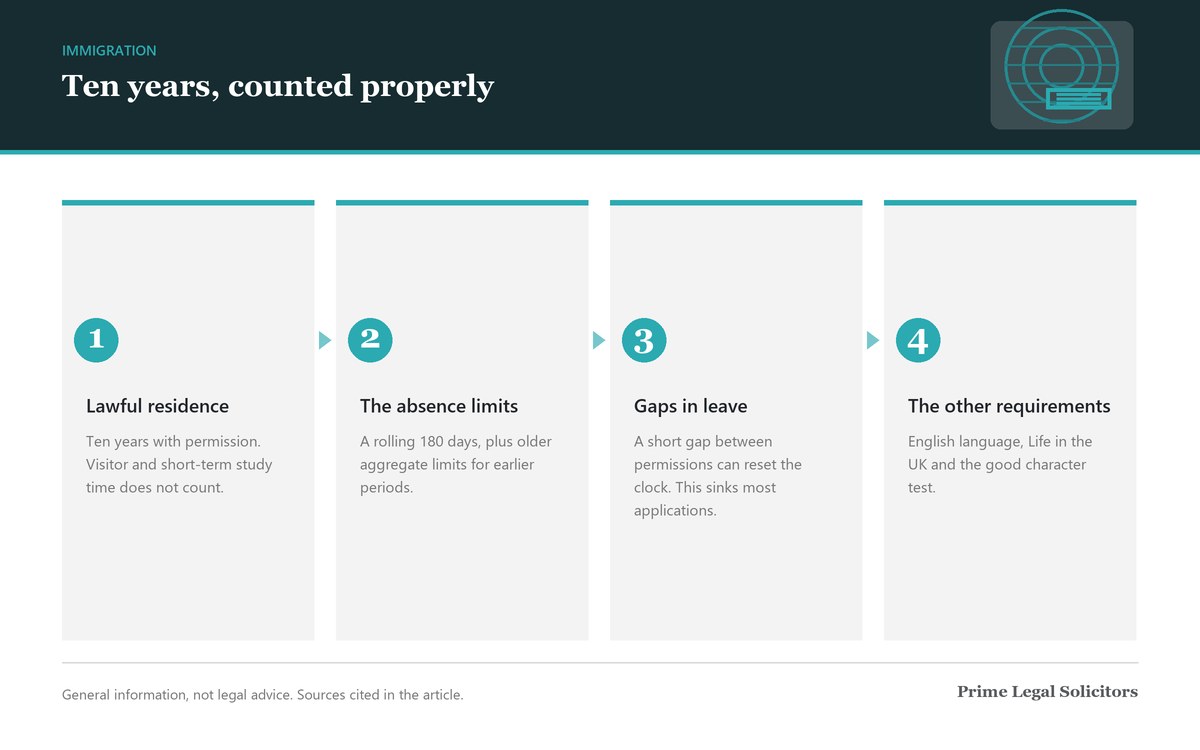
Gaps in leave: the problem that sinks most applications
A gap in leave is any period when you had no permission and no pending in-time application. People acquire them innocently: a courier delay, a failed payment, a sponsor who filed late, an application rejected as invalid months later. The rules do not care much why.
Two consequences follow, and they are different from each other. First, the days do not count: LR 3.2 and LR 11.2 exclude overstaying between periods of permission from the qualifying period, so eight days without permission means your ten years completes eight days later. Second, continuity may be broken: CR 4.1 breaks continuous residence where the applicant had no permission, subject to the exceptions in the rule. Whether a short, book-ended gap survives depends on that exception wording as it reads on the date you apply.
What the caselaw actually decided
The gap question produced a run of Court of Appeal decisions under the old paragraph 276B, replaced by Appendix Long Residence for applications made on or after 11 April 2024. They are still worth knowing.
Hoque v Secretary of State for the Home Department is the leading authority on “book-ended” gaps – overstaying with lawful leave on both sides. The Court of Appeal held that such a gap could be disregarded in deciding whether residence was continuous, but that the overstaying itself did not count towards the ten years. That is the distinction that still catches people: the gap may be forgiven and the days are still lost. Afzal v Secretary of State for the Home Department returned to the same ground, on how the disregard worked where the application curing the gap came shortly after the earlier leave expired.
Both were decided on rules that no longer apply directly, so do not cite them as if they govern a current application. Cite them for the principle LR 3.2 carries forward: overstaying between periods of permission is not qualifying residence.
If you have a gap in leave of a few days
Get the dates exactly right, to the day, from the decision letters rather than from memory: when the old permission expired, when the new application was submitted, when it was decided. Recalculate your ten-year date by adding the gap and treat that later date as the earliest you should apply. If the gap is long, or there is more than one, the real question is whether a different route is better – a conversation for an immigration solicitor rather than a decision to make alone.
A worked example: ten years, six trips and one short gap
Imagine someone whose Student visa permission began on 1 September 2016, who switched to a work route in 2019 and is now considering applying. They had also visited for six weeks in 2015, which does not count. Their trips abroad, in whole days outside the UK:
| Trip | First full day abroad | Last full day abroad | Days outside the UK |
|---|---|---|---|
| 1 | 13 December 2016 | 2 January 2017 | 21 |
| 2 | 3 July 2018 | 26 August 2018 | 55 |
| 3 | 4 November 2020 | 11 February 2021 | 100 |
| 4 | 21 June 2021 | 5 September 2021 | 77 |
| 5 | 2 March 2023 | 14 April 2023 | 44 |
| 6 | 7 January 2025 | 3 March 2025 | 56 |
| Total days outside the UK | 353 | ||
Test one, the rolling 180 days. No single trip comes close. The window that matters contains trips 3 and 4: from 4 November 2020 to 3 November 2021 there are 100 + 77 = 177 days outside the UK, inside the limit by three days. Had trip 4 run to eighty days, or had they come home from trip 3 four days later, that window would have exceeded 180 days and continuity would have broken – on two ordinary trips neither of which looked risky. No other twelve-month window contains two trips, because trips 4 and 5 are eighteen months apart.
Tests two and three, the historic limits. The total reached before 11 April 2024 is 21 + 55 + 100 + 77 + 44 = 297 days, inside 548; and the longest single absence beginning before that date is trip 3, at 100 days, inside 184.
Now the gap. Their student permission expired on 30 September 2019 and the work application was submitted on 9 October 2019. For eight days – 1 to 8 October 2019 – they had no permission and no pending application. Those eight days are not qualifying residence under LR 3.2, so the qualifying period is not ten years from 1 September 2016. Ten years of lawful residence completes eight days later, on 9 September 2026.
That is the point of the arithmetic. An application submitted on 1 September 2026, on what felt like the tenth anniversary, would have been eight days short – the fee and the Immigration Health Surcharge paid, and a refusal on a technicality of the applicant’s own making. Do not assume there is a grace period for applying early. This is a hypothetical illustration: your own dates will produce a different answer, and nobody can tell you what the Home Office will decide on your facts.
English, Life in the UK and good character
The English language requirement is the one with a date on it. Under LR 13.1, an application made before 26 March 2027 needs English at level B1 in speaking and listening; one made on or after 26 March 2027 needs level B2. That is a real step up and it is already in the rules, not a proposal. If you are near the ten-year mark with B1, the difference between applying in February 2027 and April 2027 is the difference between a test you have passed and one you have not sat.
You can meet it with an approved secure English language test, a degree taught in English, or an exempt nationality. The Life in the UK test is separate and must be passed unless an exemption applies under LR 14.1; keep the unique reference number, because the pass does not expire but you cannot prove it without the number.
On suitability, disclosure matters more than the underlying issue. An old, minor, properly disclosed matter is a question for the caseworker. The same matter left off the form is a credibility problem that can outlast the application and affect any later application for British citizenship.
Evidence: ten years of it
This route asks you to prove a decade. Start gathering early: Home Office record requests take time, and the holes in your own records will be in the early years.
- Every grant of permission: visa vignettes, biometric residence cards, eVisa and UKVI account records, grant and refusal letters.
- Every passport covering the period, expired ones included, with all stamped pages.
- An absence schedule: one row per trip, with dates, destination, reason and the proof.
- Proof of presence between trips: tenancies, council tax, utility bills, bank statements, payslips, P60s, GP registration, school letters.
- English language and Life in the UK evidence at the level that applies to your application date.
- Disclosure material: certificates of conviction, caution details, a written chronology of any immigration breach.
- A Home Office records request if your own documents do not cover the period.
If you cannot find evidence of your early years
Missing documents are not automatically fatal, but the burden is yours. A records request will usually establish the grants of permission; the harder gap is proving you were here between trips in, say, 2017. HMRC employment histories, GP notes and tenancy files are often retrievable when personal paperwork is not. Build that evidence first and apply second.
Common mistakes: where long residence applications go wrong
- Counting trips instead of days. Nobody intends to exceed 180 days. They do it by adding two trips they thought of as separate.
- Using the wrong twelve months. The CR 3.1 window is not your visa year, so checking visa years in turn can miss the window that breaches.
- Assuming a short gap is forgiven. Even where a book-ended gap survives, the days are excluded from the qualifying period.
- Applying on the anniversary. If there was any gap or non-qualifying time, your ten-year date is later than the anniversary of arrival.
- Counting non-qualifying routes. Visitor, Short-term Student, Seasonal Worker and Ukraine Scheme time builds nothing.
- Booking the wrong English test. B1 is enough only for applications made before 26 March 2027.
- Holding evidence back. Material that would have answered the caseworker’s concern cannot be introduced on administrative review afterwards.
- Letting section 3C leave lapse. An application made after your permission expires attracts no section 3C protection.
Making the application, step by step
- Fix your ten-year date. Build the absence schedule, identify every gap, calculate when the qualifying period completes. Everything else follows from it.
- Run the three absence tests across the decade – rolling 180 days, the 548-day aggregate, and the 184-day single absence.
- Deal with any CR 3.4 exception by gathering evidence now rather than planning to explain later.
- Sit the tests – Life in the UK, and English at the level that applies to your intended application date.
- Apply online for long residence settlement on GOV.UK while you still hold permission, and before your leave expires, so that section 3C leave protects you.
- Pay the fee and the Immigration Health Surcharge. We do not publish these figures because they change by statutory instrument without notice: take them from GOV.UK on long residence on the day you apply, and see our published fees for what legal help costs.
- Enrol biometrics and upload evidence in the order the application asks, with the absence schedule as a covering index.
- Do not travel while the application is pending if you rely on section 3C leave, because leaving the UK ends it.
If you are refused
There is no general right of appeal against a refusal of settlement on this route. The challenge is usually an administrative review, confined to caseworking errors and unable to consider evidence you did not already submit, or a judicial review where the decision was unlawful rather than simply unwelcome. The deadlines are short and run from the date on the notice, not the date you opened it. Our immigration appeals team can tell you which of the three routes is open to you and whether your leave continues while you challenge.
Sometimes a fresh application with the missing evidence is the better answer, particularly where the refusal turned on a recalculated ten-year date that will be met within months. Nobody can tell you an application or challenge will work; a solicitor can tell you which option is realistic on your facts.
Proposed changes: what is and is not settled
Status of reform proposals – reviewed 14 October 2026
A government consultation on reforming the settlement rules closed on 12 February 2026. As at 14 October 2026, no government response or outcome has been published and no Statement of Changes to the Immigration Rules has been laid to give effect to any such reform. The Statements of Changes collection lists only HC 1691, HC 259 and HC 584 for 2026, none of which alters the length of the qualifying period.
We give no implementation date, because none exists, and we do not describe proposals as rules. If you read elsewhere that the qualifying period has been extended, check it against a Statement of Changes before acting on it.
What we can tell you is what the rules say today, checked against Appendix Long Residence as it stood on 14 October 2026. The sensible response to uncertainty is not to wait: if your qualifying period is complete and your evidence is in order, the application available under the rules in force is the one in front of you.
Settlement also changes your position beyond immigration. It is when most people should think about what would happen to their estate without a will. If you want the arithmetic run with you first, contact the team.
Frequently asked questions
What is the 10 year long residence rule?
It is the settlement route in Appendix Long Residence. If you have spent a qualifying period of ten years lawfully in the UK with permission, met the continuous residence requirement in Appendix Continuous Residence, passed the English language and Life in the UK requirements and raised no suitability issue, you can apply for indefinite leave to remain. The route was current law when this page was checked on 14 October 2026.
How many days can I be absent under long residence?
Three limits apply. You must not have been outside the UK for more than 180 days in any rolling 12-month period (CR 3.1). For Long Residence applications you must also not have spent more than 548 days abroad in total where that total was reached before 11 April 2024, nor more than 184 days in a single absence that started before that date (CR 3.3).
What breaks continuous residence?
CR 4.1 breaks continuity where you were imprisoned or detained, where a deportation order or removal directions were in force, where you were removed or deported, where you left voluntarily after a refusal with your permission expired, where you exceeded the absence limits, or where you had no permission at all, subject to the exceptions the rule sets out. A break restarts the clock rather than pausing it.
Does a gap in leave stop a long residence application?
Not always, but it always costs you time. A period of overstaying between two grants of permission is excluded from the qualifying period by LR 3.2, so an eight-day gap means your ten years completes eight days later. Separately, CR 4.1 may treat the gap as breaking continuity altogether. Get the exact dates from your decision letters and take advice before applying.
Does time on a student visa count towards long residence?
Yes. Time on a Student visa, the old Tier 4 and earlier student categories is lawful residence and counts in full towards the ten years. What does not count is time as a Visitor, a Short-term Student, a Seasonal Worker or on the Ukraine Scheme. Long student vacations spent abroad are the usual problem, because they add up against the 180-day limit.
What evidence do I need for long residence?
Every grant of permission across the decade, all passports covering the period, and a day-by-day absence schedule with boarding passes or tickets behind it. Add proof that you were here between trips: tenancies, council tax, bank statements, payslips, P60s, GP and school records. If your own paperwork does not cover the early years, request your Home Office records before you apply.
Can I apply before the ten years is up?
Do not plan on it. Your ten-year date is ten years of lawful residence, which is later than the anniversary of your arrival if there was ever a gap in permission or any non-qualifying time. Work out the real date first, check the current caseworker guidance on applying early, and do not assume any grace period exists. Applying short of the qualifying period risks a refusal.
When does the B2 English language requirement start?
LR 13.1 requires English at level B1 in speaking and listening where the application is made before 26 March 2027, and at level B2 where it is made on or after that date. The requirement is already written into Appendix Long Residence, so it is not a proposal. If you are close to the ten-year mark with a B1 pass, your application date matters.
What happens if my long residence application is refused?
There is usually no right of appeal on this route. The options are an administrative review, which is limited to caseworking errors and cannot take in new evidence, or a judicial review where the decision was unlawful. Both have short deadlines running from the date on the notice. A fresh application can be the better answer where the refusal turned on a recalculated ten-year date.
Author

Suits You Media Dev