
Motoring offences
Using a Mobile Phone While Driving: Penalties, Exceptions and Defences
Using a hand-held phone while driving means 6 points and a £200 fine, and new drivers lose their licence. What counts, the exceptions, what happens next and possible defences.
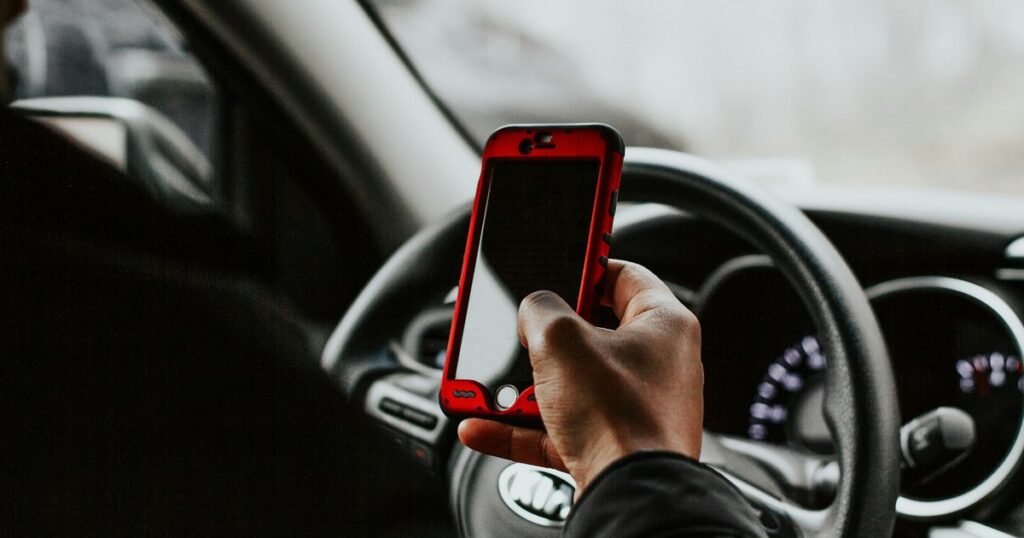
Using a hand-held phone while driving carries 6 penalty points and a £200 fine. If the case goes to court, the fine can reach £1,000, or £2,500 for a lorry or bus, and you can be banned. If you passed your test in the last two years, 6 points is enough to lose your licence. Since 2022 the offence covers almost any use of a phone held in your hand, even when you are stopped at traffic lights. This guide explains what counts, the exceptions, what happens after you are caught, and when it is worth defending.
Key takeaways
- It is illegal to hold and use a phone, sat nav, tablet or any device that can send or receive data while driving. That includes texting, calls, photos, browsing and scrolling a playlist, online or offline.
- The law still applies when you are stopped at lights, queuing in traffic, or supervising a learner driver.
- The fixed penalty is 6 points and £200. In court, the maximum fine is £1,000, or £2,500 for goods vehicles and buses, and the court can disqualify you.
- New drivers who reach 6 points within two years of passing lose their licence and must retake both tests. For other drivers, a phone offence can take you to 12 points and a totting-up ban.
- There are four narrow exceptions, and the evidence can sometimes be challenged. Take advice before accepting a fixed penalty if your licence is at risk.
What the law says
The offence comes from regulation 110 of the Road Vehicles (Construction and Use) Regulations 1986, made an offence by section 41D of the Road Traffic Act 1988. Until March 2022, it only covered using a phone for “interactive communication”, such as calls and texts. That left a loophole: drivers who were filming, taking photos or choosing music argued they were not communicating. The 2022 amendment closed it. The test is now simple: were you holding the device and using it while driving?
The rule covers any device that can send or receive data, not just phones. Tablets, sat navs and some smartwatches can all be caught. It also covers any use, whether the device is online or offline, or in flight mode.
“Driving” is wider than many people think. You are still driving if you are stopped at traffic lights, queuing in a jam, or sitting in a car whose engine has cut out automatically at a stop. You are also treated as driving for this purpose if you are supervising a learner. The only safe place to use a hand-held phone is when you are safely parked. Our guide to careless and dangerous driving explains the more serious charges that can follow when phone use causes a collision.
What counts, and what does not
| Situation | Legal? | Why |
|---|---|---|
| Texting, calling, browsing or taking a photo with the phone in your hand | No | Holding and using a device while driving |
| Changing music or checking a map on a phone in your hand at red lights | No | Stopped at lights still counts as driving |
| Using a phone in a windscreen or dashboard mount by voice or a single tap | Yes, if you stay in full control | Not held. But you can still be prosecuted for not being in proper control |
| Bluetooth headset or the car’s built-in system | Yes, if you stay in full control | Hands-free use is allowed |
| Calling 999 or 112 in an emergency when it is unsafe or impractical to stop | Yes | A specific exception |
| Contactless payment at a drive-through, with the car stationary | Yes | A specific exception |
| Using a phone app to park the car remotely | Yes | A specific exception |
| Using the phone while safely parked with the engine off | Yes | You are not driving |
Hands-free use is not a free pass. A phone in a holder must not block your view of the road. If the police think you were distracted, for example by watching a video on a mounted screen, you can be prosecuted for not having proper control, which carries 3 points, or for careless driving, which carries 3 to 9 points.
The penalties
| Route | Points | Fine | Ban |
|---|---|---|---|
| Fixed penalty notice, accepted | 6 | £200 | No, unless you reach 12 points |
| Court: car or motorcycle | 6 | Up to £1,000 | Discretionary |
| Court: lorry or bus | 6 | Up to £2,500 | Discretionary |
| New driver within two years of passing | 6 | As above | Licence revoked under the New Drivers Act 1995 |
| Driver who reaches 12 points within three years | 6 | As above | At least six months for totting up, unless exceptional hardship is shown |
The endorsement code is CU80, and it stays on your record for four years from the date of the offence. Insurers ask about it, and premiums usually rise. If you drive for work, your employer’s policy may also require you to report it. Drivers who rely on their licence for their job should read our guide to exceptional hardship before deciding anything.
New drivers: why 6 points can end your licence
Under the New Drivers Act 1995, if you get 6 or more points within two years of passing your first driving test, the DVLA revokes your licence. A single phone offence is enough.
Revocation is not a ban. It happens automatically, and the court has no power to stop it once the points are imposed. You must apply for a new provisional licence and pass both the theory and practical tests again. For a young driver who needs to drive for work or college, that can mean months off the road and thousands of pounds in lessons, tests and insurance.
The only ways to avoid revocation are to avoid the points altogether, by successfully defending the charge or by persuading the court not to endorse because of special reasons. That is why new drivers should take advice before accepting a fixed penalty. Our motoring solicitors deal with these cases regularly.
What happens after you are caught
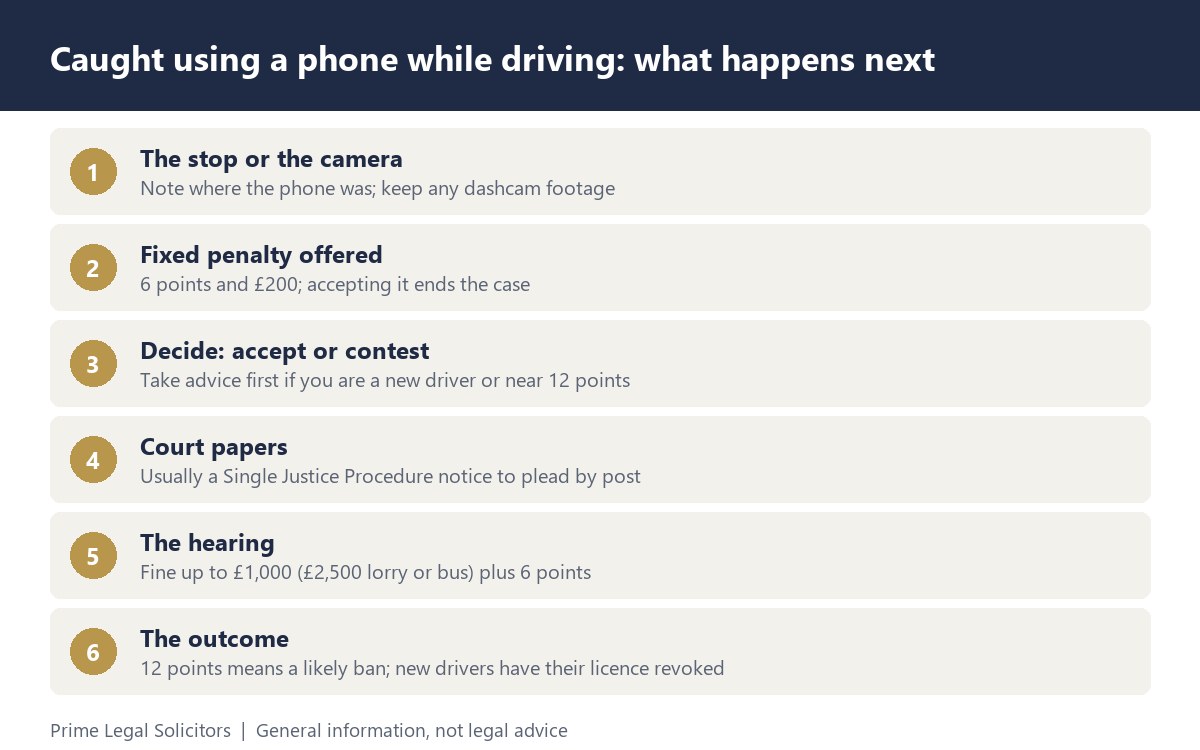
1. The stop or the camera
Most cases start with a police officer seeing you holding a phone. Some forces now also use camera systems that photograph drivers’ hands. Note what you were doing and where the phone was, and keep any dashcam footage.
2. The offer of a fixed penalty
You may be offered a fixed penalty at the roadside or by post: 6 points and £200. Accepting it is the end of the matter, with no court appearance. Not accepting it means the case goes to court.
3. The decision: accept or contest
This is the point to take advice, particularly if you are a new driver, already have points, or have a defence. Once you pay a fixed penalty, the points are endorsed and you cannot argue the case later.
4. The court papers
If the case goes to court, you will usually receive a Single Justice Procedure notice. You can plead guilty by post with mitigation, or plead not guilty and have the case heard in open court.
5. The hearing
For a guilty plea, the court fixes the fine and endorses 6 points. It may also consider a discretionary ban. For a not guilty plea, the prosecution must prove you were holding and using the device while driving. Our Manchester solicitors attend magistrates’ courts across the North West.
6. The outcome
If convicted, the points go on your licence. If they take you to 12, the court must consider a totting-up ban. If you are a new driver, the DVLA will revoke your licence once the points are endorsed.
Possible defences
Many phone cases are straightforward, but not all. These are the arguments that can succeed when the facts support them.
- You were not holding it. The phone was in a mount, in a pocket or on the seat. The prosecution must prove the device was held.
- You were not using it. Holding a phone to move it out of the way, without using it, is arguably not “use”. The facts need care.
- You were not driving. For example, you were safely parked with the engine off.
- An exception applies. A genuine 999 call when it was unsafe to stop, a contactless payment at a drive-through, or remote parking.
- Mistaken identification. The officer saw something else in your hand, such as a wallet or a vape. Phone records showing no activity at the time can help.
- Special reasons. Even if guilty, you can ask the court not to endorse points because of special reasons connected with the offence, such as a genuine emergency. If accepted, no points means no revocation.
Phone records, dashcam footage and the officer’s notes are often decisive, and gathering them can involve disbursements such as record requests. Ask for the prosecution evidence early. A weak case is better identified before you plead.
Worked example: a new driver caught at red lights
Jamal, 19, passed his test 14 months ago, near Bolton, and drives to work at a warehouse outside Rochdale. At a red light, he picks up his phone to change the music. A police officer on foot sees him and offers a fixed penalty.
If Jamal accepts, he gets 6 points and the £200 fine. Because he is within two years of passing, the DVLA revokes his licence. He must apply for a provisional licence, rebook theory and practical tests, and pay for lessons. With current waiting times for practical tests, he could be off the road for months. His job, which starts before the first bus runs, is at risk.
Jamal takes advice. The facts give him no realistic defence. Being stopped at lights still counts as driving, and changing music is use. So his solicitor focuses on what can be done. His solicitor checks whether any special reasons argument exists, such as a genuine emergency. None does. Going to court would only risk a higher fine than the £200 fixed penalty, with the same 6 points. So Jamal accepts the fixed penalty and plans for revocation: he books his theory test straight away and arranges a lift-share in the meantime.
The lesson is the one most new drivers learn too late. For you, a phone offence is not a £200 fine. It is losing your licence. If you are in Rochdale or elsewhere, take advice before deciding how to respond.
What goes wrong
| Mistake | Consequence | Better approach |
|---|---|---|
| Paying the fixed penalty without checking your points | New drivers lose their licence; others may reach 12 points | Check your record on the DVLA’s view-driving-licence service first |
| Ignoring the court papers | The case can be decided in your absence, with a higher fine | Respond by the deadline on the notice |
| Arguing that you were “only stopped at lights” | That is not a defence, and it can cost you credit for a guilty plea | Take advice on whether any real defence exists |
| Admitting more than happened at the roadside | Your own words become the main evidence | Be polite and accurate, and do not guess |
| Not keeping phone records or dashcam footage | Evidence that might help is lost | Save it straight away |
If your situation is different
If you drive for a living
Professional drivers face the same 6 points, but the stakes are higher. If a phone offence would take you to 12 points, you may be able to argue exceptional hardship to avoid a ban. Our motoring defence fees page explains what that costs.
If the phone use caused a collision
Expect a more serious charge, such as careless or dangerous driving, or worse if someone was hurt. If you were injured by a driver on their phone, you may have a claim. Our guide to road traffic accident claims explains how phone evidence is used.
If you were a passenger or supervising a learner
Passengers can use their phones. A supervising driver, however, is treated as being in charge of the car, so the hand-held rule applies to them too.
If you are an employer
Employers can also be prosecuted if they require or permit staff to use hand-held phones while driving, for example by expecting drivers to answer calls on the road. A clear driving-at-work policy protects both sides. Our workplace safety guide covers employers’ wider duties.
Costs and how we can help
Our published motoring fees start from £600 to £900 for a guilty plea with written representations, and from £1,200 to £2,200 for a totting-up case with an exceptional hardship argument. Contested trials are priced on the facts. All our fees are on our pricing page.
We advise on whether to accept a fixed penalty, prepare mitigation, run exceptional hardship and special reasons arguments, and defend phone charges at trial. For a free initial consultation, call 0330 341 4757 or contact us online. If you have received court papers, have them with you when you call.
Frequently asked questions
How many points do you get for using a phone while driving?
6 penalty points, with a £200 fixed penalty. If the case goes to court, the fine can be up to £1,000, or £2,500 for a lorry or bus, and the court can ban you.
Can I use my phone at traffic lights?
No. Stopped at lights or in a queue still counts as driving. You can only use a hand-held phone when you are safely parked.
Can I use my phone as a sat nav?
Yes, if it is in a holder, does not block your view, and you do not hold it. You must still stay in full control of the car.
Will I lose my licence for a phone offence as a new driver?
If you passed within the last two years, yes. 6 points is enough for the DVLA to revoke your licence, and you will have to pass both tests again.
Can I get a driver awareness course instead of points?
Courses are offered at the police’s discretion for some offences, but hand-held phone use normally leads to points. Do not assume a course will be available. Our Huddersfield office can check what you have been offered.
How long do phone offence points stay on my licence?
The CU80 endorsement stays on your driving record for four years from the date of the offence. The points count towards totting up for three years.
Is it worth getting a solicitor for a phone offence?
If you are a new driver, are close to 12 points, have a possible defence, or drive for a living, usually yes. For a simple first offence with no licence risk, many drivers accept the fixed penalty. Our Yorkshire and other offices can advise quickly.
Please note: This article is general information about the law of England and Wales as at November 2026. It is not legal advice and does not create a solicitor-client relationship. Speak to a solicitor before making a decision. Prime Legal Solicitors is authorised and regulated by the Solicitors Regulation Authority, SRA No. 834471.
Services and fees
Talk to a motoring defence solicitor
A full cost estimate before any work starts. Payment plans are available.
Fees are a guide and exclude disbursements. See all our fees
Keep reading
More motoring guides

You Have Had a Single Justice Procedure Notice. What Now?
An SJP notice gives you 21 days and three real options. What each one means, how the fine is worked out, and why the section 172 request matters more than most people think.
 Hassan Ansari
Totting Up: Keeping Your Licence at 12 Points
Twelve penalty points normally means a disqualification of at least six months. A court can shorten it, or impose none, but only on proof of exceptional hardship, and the bar is higher than most people expect.
Hassan Ansari
Careless or Dangerous Driving? Why the Charge Matters
The line between careless and dangerous driving decides whether you face points and a fine in the magistrates' court, or an obligatory disqualification, an extended retest, and a possible Crown Court trial.
Hassan Ansari
Speak to a solicitor
Talk to our motoring defence team
Your first consultation is free. Meet us in person, or talk by phone or video call.
Book a free consultation- Phone0330 341 4757
- WhatsApp07918 328638 (opens WhatsApp)
- Emailinfo@
primelegalsolicitors .co.uk - Opening hoursMonday to Friday, 9am to 5.30pm
Our offices
Prime Legal Group Ltd is authorised and regulated by the Solicitors Regulation Authority, SRA number 834471 (opens in a new tab)