

Legal fees are what you pay your solicitor for their own work. Disbursements are payments the firm makes to someone else on your behalf, such as a court, HM Land Registry or the Home Office, and passes on to you at cost. The difference matters for VAT, for comparing quotes and for knowing which part of a bill can change.
Key takeaways
- Legal fees pay for the solicitor’s own work. They are charged as a fixed fee or by the hour, with VAT at 20% normally added. Our published fees are shown this way.
- Disbursements are third-party costs, such as court, Land Registry, Office of the Public Guardian and Home Office fees, searches, experts, barristers and Stamp Duty Land Tax.
- A true disbursement is passed on at the exact amount paid, with no VAT added by the firm. HMRC sets eight conditions that must all be met.
- Firms offering certain services must publish prices, likely disbursements and VAT under the SRA Transparency Rules.
- Compare quotes on the total of fees, VAT and disbursements. Our page on usual disbursements lists typical items.
The short answer
A solicitor’s bill usually has two parts. The legal fee, sometimes called profit costs, is the charge for the firm’s own work: advice, drafting, correspondence and attending court. Disbursements are sums the firm pays to third parties to move your matter forward, then recovers from you.
The firm sets its own fees. It does not set disbursements. A court fee is the same whichever firm you instruct. So the legal fee is the part to compare, and disbursements are the part to check for completeness. The SRA Code of Conduct requires solicitors to give clients the best possible information about pricing and the likely overall cost, at the start and as the matter goes on.
What legal fees cover
- Fixed fees. One agreed price for a defined piece of work, such as a will or an undefended divorce, provided the work stays within the agreed scope.
- Hourly rates. Time charged at a rate that reflects the experience of the person doing the work. This suits unpredictable matters, such as contested financial remedy proceedings.
Some matters use a fixed fee for each stage. Personal injury claims often run under a conditional fee agreement, explained in our guide to no win no fee. VAT at 20% is normally added to legal fees, because they are the firm’s own taxable supply. A fee of “£450 + VAT” costs £540.
What disbursements are
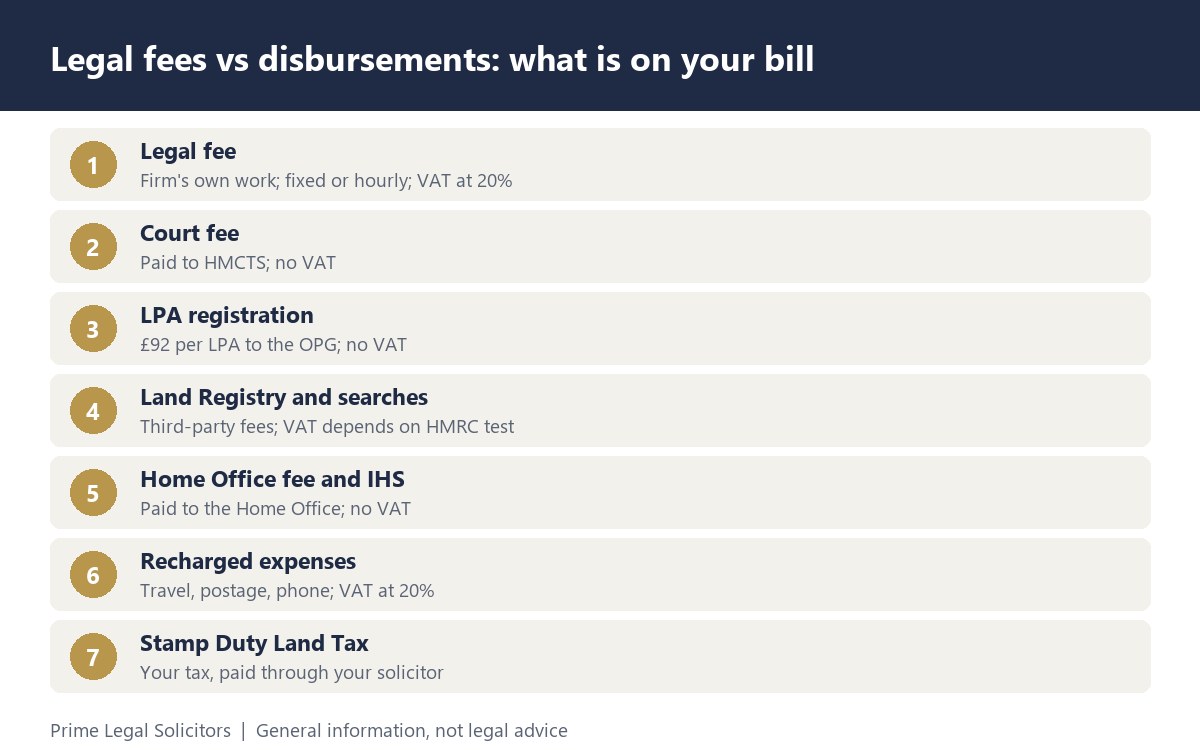
A disbursement is a payment the firm makes, as your agent, to a third party for something you need. Common examples are:
- Court fees paid to HM Courts and Tribunals Service. GOV.UK lists the divorce application fee as £628.
- Probate application fee of £526 where the estate is over £5,000, according to GOV.UK, plus £2 for each extra copy ordered with the application.
- Office of the Public Guardian fee of £92 to register each lasting power of attorney.
- HM Land Registry fees, official copies of title and property searches.
- Home Office fees and the Immigration Health Surcharge, which GOV.UK lists as £1,035 a year for most applicants and £776 a year for students, under-18s and Youth Mobility Scheme applicants.
- Barristers’ fees, expert reports and translations.
- Stamp Duty Land Tax, a tax you owe that is paid through your solicitor.
The firm cannot reduce these. It can estimate them accurately and pay them on time. If you are unsure which apply to you, ask us first.
| Feature | Legal fees | Disbursements |
|---|---|---|
| Who receives it | The law firm | A third party, such as a court or the Home Office |
| Who sets it | The firm | The third party, or a fee scale set by law |
| VAT | Normally 20% added | None added by the firm if it is a true disbursement |
| Comparable between firms? | Yes | No. It is the same whoever you use |
| Can it change? | If the scope changes or hourly work grows | If the third party changes its fee or new items are needed |
Are disbursements subject to VAT?
It depends on whether the payment is a true disbursement. HMRC sets the test in paragraph 25.1 of VAT Notice 700. All of these conditions must be met:
- The firm acted as the client’s agent when paying the third party.
- The client received and used the goods or services.
- The client was responsible for paying for them.
- The client authorised the payment.
- The client knew a third party would provide them.
- The outlay is itemised separately on the invoice.
- Only the exact amount paid is recovered.
- The goods or services are clearly additional to the firm’s own supply.
If every condition is met, the cost passes on without VAT added by the firm. Court, Office of the Public Guardian and Home Office fees carry no VAT themselves. Our LPA solicitors therefore pass the £92 fee on at face value.
If a condition is not met, the cost is a recharged expense. It forms part of the firm’s own service and carries VAT at 20%. HMRC says the firm’s own travel, phone calls and postage usually fall into this group. Its examples also treat bank transfer fees, and a personal search the solicitor uses to give advice, as part of the solicitor’s supply. Some third parties, such as VAT-registered experts and barristers, add VAT to their own invoices. A good quote shows which items include VAT.
Worked examples from our published prices
The fees below are “from” figures on our pricing page. Your quote will depend on your circumstances. Official fees are as listed on GOV.UK in November 2026.
| Matter | Legal fee (from) | Typical disbursements |
|---|---|---|
| Single lasting power of attorney | £450 + VAT | Registration fee of £92 per LPA, no VAT |
| Probate | £750 + VAT | Application fee of £526 for estates over £5,000; copies of the grant |
| Divorce or dissolution | £750 + VAT | Court fee of £628, unless you qualify for help with fees |
| Commercial lease | £950 + VAT | Land Registry search £3.00; bankruptcy search £2.00; official copies £3.00 each; full commercial searches approx. £462.00; registration fee £40.00 to £455.00; notice of transfer fee £50.00 to £100.00; SDLT if payable |
| Spouse or partner visa | £1,000 + VAT | Home Office fee; Immigration Health Surcharge of £1,035 a year; translations if needed |
For one LPA, the fee from £450 plus £90 VAT comes to £540. Add the £92 registration fee and the total is £632. For probate applications, the £526 court fee is fixed by law whatever the legal fee. In a commercial lease, there are many small disbursements, but SDLT can exceed the legal fee and is only known once the rent and term are agreed.
What the SRA Transparency Rules require
The current SRA Transparency Rules, in force from 11 April 2025, require firms to publish cost information for these services to individuals:
- residential conveyancing: sales, purchases, mortgages and remortgages;
- uncontested estate administration (probate);
- immigration applications and First-tier Tribunal appeals, excluding asylum;
- summary-only road traffic offences dealt with at a single magistrates’ court hearing;
- employees’ employment tribunal claims for unfair or wrongful dismissal.
For businesses, the list covers defending unfair or wrongful dismissal claims, debt recovery up to £100,000 and licensing applications for business premises. Publicly funded work is excluded.
The firm must publish the total cost, or an average or range. It must also show the basis of its charges, the experience of those doing the work, likely disbursements and their cost, whether VAT applies, and what the price includes and excludes. Our motoring defence fees follow this format.
Payments on account and client money
Firms often ask for money up front, mainly to cover disbursements. This is a payment on account. Under the SRA Accounts Rules, money held for fees or unpaid disbursements before a bill is sent is client money, normally kept in a client account separate from the firm’s own funds. The firm must send a bill or written notice of its costs before taking client money for its fees.
Ask what the payment covers and when each item will be paid. In immigration matters, the Home Office fee and surcharge are usually the largest sums. Our immigration application team confirms them in advance.
How to compare solicitors’ quotes
- Add everything up: fee, VAT and every disbursement.
- Check the scope. A fixed fee may cover one stage only, or exclude hearings.
- Check VAT. Is the price “+ VAT” or “including VAT”?
- Look for gaps. If one quote lists a court fee and another does not, the cheaper one may be incomplete.
- Ask who does the work. A lower hourly rate can mean more hours.
Our guide to choosing a solicitor covers other questions to ask.
If your case costs more than the estimate
An estimate is not a fixed price. Costs rise when the other side does not co-operate, more evidence is needed or a further hearing is listed. Your solicitor must keep you updated on likely costs, so an increase should not first appear on a bill. Ask why it has risen, and consider agreeing a cap or a point at which work stops. If you think a bill is too high, use the firm’s complaints policy. If that does not resolve it, you can go to the Legal Ombudsman, and you may be able to ask the court to assess the bill.
Costs in court cases
In most civil claims, the general rule under the Civil Procedure Rules is that the loser pays the winner’s costs. Recovery is rarely complete. Costs assessed on the standard basis are usually less than you paid, and small claims carry very limited recoverable costs. Court fees and some expert fees are often recoverable. Other costs stay with you.
In financial proceedings on divorce, the general rule is that each side pays its own costs, unless a party’s conduct justifies an order. See our guide to family lawyer costs. In personal injury, some costs can come out of the award, as explained in compensation deductions.
Legal aid
Legal aid is public funding for legal costs, available only for certain types of case and subject to eligibility tests. In family law it is mainly available for protection from domestic abuse or forced marriage, for advice on finances, children or divorce after an abusive relationship, where a child may be taken into care, and for family mediation. It may not cover every cost. You may have to contribute, and to pay some back if you win money or property. Ask whether a firm holds a legal aid contract before you instruct it.
Frequently asked questions
What is the difference between legal fees and disbursements?
Legal fees are the solicitor’s charges for their own work, set as a fixed fee or hourly rate, with VAT normally added. Disbursements are payments to third parties on your behalf, such as court or Land Registry fees, passed on at cost. See our fee guide.
What are disbursements in solicitors’ terms?
Third-party costs the firm pays as your agent. Examples include court fees, the probate fee, the LPA registration fee, Land Registry fees, searches, Home Office fees, barristers’ and experts’ fees, translations and Stamp Duty Land Tax.
Are disbursements subject to VAT?
A true disbursement meeting all eight conditions in VAT Notice 700, paragraph 25.1, is passed on with no VAT added by the firm. Costs that fail the test, such as the firm’s own postage or travel, carry VAT at 20%. Our disbursements page explains how we show this.
Why do I pay disbursements in advance?
Many third parties will not act until paid. A court will not issue a divorce application without the fee. Money paid in advance is held as client money until it is used.
Can a solicitor make a profit on disbursements?
Not on a true disbursement. HMRC’s conditions require the firm to recover only the exact amount paid. Any charge for arranging the payment is part of the firm’s own fee.
Do I get disbursements back if my matter stops?
Unspent money should normally be returned from client account. A disbursement already paid, such as a search or court fee, usually cannot be recovered from the third party.
Are court fees the same at every firm?
Yes. They are set by HM Courts and Tribunals Service. People on low incomes may qualify for help with fees, which our divorce solicitors can check.
Can I recover disbursements from the other side?
In many civil claims, a winner can recover court fees and some other disbursements under a costs order. In divorce finances, each side usually pays its own. For a quote that shows every item, contact our team or call 0330 341 4757.
Please note: This article is general information about the law in England and Wales as at November 2026. It is not legal advice and does not create a solicitor-client relationship. Speak to a solicitor before making a decision. Prime Legal Solicitors is authorised and regulated by the Solicitors Regulation Authority, SRA No. 834471.
Author

Suits You Media Dev