
Most guides to personal injury compensation explain how an award is valued. Few explain what actually reaches your bank account. A contributory negligence reduction, benefits recovered by the Compensation Recovery Unit, the success fee, the insurance premium and any interim payments can all come off, and the order they come off in is what makes the final figure surprising.
Key takeaways
- In most injury claims, the figure you settle for and the figure you receive are different numbers. Up to five things can sit between them: a contributory negligence reduction, recovered benefits, the success fee, the insurance premium and unrecovered costs, and interim payments already made to you.
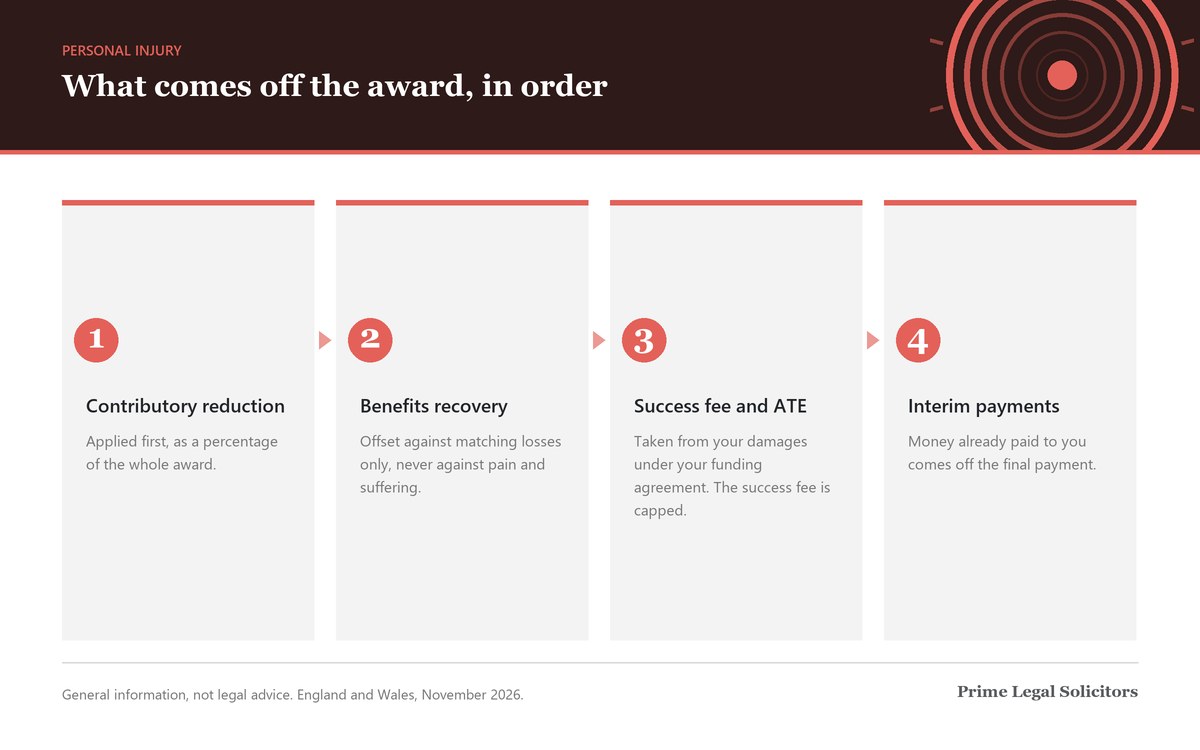
- The order matters. The contributory reduction comes first, then recoverable benefits, then the success fee, then the premium and any costs shortfall. Interim payments come off last.
- In most personal injury cases, the success fee you pay cannot exceed 25 per cent of your damages for pain, suffering and loss of amenity plus past financial losses, net of recovered benefits. Future losses are outside the cap, and the cap is a ceiling, not a price.
- Recovered benefits can only be offset against matching heads of loss and never against damages for pain and suffering. A contributory negligence finding does not reduce the amount the Compensation Recovery Unit takes back.
- If you are an adult driver or passenger with a simple road traffic claim, where the injury is worth up to £5,000 and the whole claim up to £10,000, you can use the free Official Injury Claim service without a solicitor and keep the whole settlement.
- Before you accept any settlement, ask for a written statement showing the gross award, each deduction and the net figure. If anything is unclear, contact our team.
The short answer: the award and the payment are different numbers
The figure your claim settles for is not the figure that reaches your bank account. Up to five things sit between them: a contributory negligence reduction, benefits recovered by the Compensation Recovery Unit (CRU), your solicitor’s success fee, insurance premiums and unrecovered expenses, and any interim payments you have already received.
Not every claim has all five. A claim with no fault on your side, no benefits paid and no interim payment may only have the success fee and the premium to account for. But you should know which ones apply to you before you sign a funding agreement, not when the money arrives.
| Deduction | What it is | Who receives it | Is it limited? |
|---|---|---|---|
| Contributory negligence reduction | A percentage cut to the whole award because you were partly responsible for your injury | Nobody. The award is simply lower | No fixed limit. It is the percentage agreed or decided by the court |
| Benefits recovery (CRU) | Certain benefits paid to you because of the injury, repaid by the compensator and offset against matching parts of your claim | The Compensation Recovery Unit, paid by the compensator | Yes. Only matching heads of loss, never pain and suffering, and only for a set period |
| Success fee | An extra charge your solicitor makes under a no win no fee agreement for taking the risk of losing | Your solicitor, from your damages | Yes. Capped at 25 per cent of specified damages in most personal injury cases |
| After the event (ATE) insurance premium | The cost of a policy covering you if the claim fails | The insurer, usually paid from your damages on success | No general cap. Your agreement should say how it is worked out |
| Unrecovered disbursements and costs shortfall | Expert, court and records fees, and solicitor’s charges, that the other side does not pay | Your solicitor, from your damages, if your agreement allows it | Only by the terms of your agreement |
| Interim payments | Money paid to you on account before the claim ends | Nobody. You have already had it | Not a deduction, but it comes off the final payment |
Ask for the net figure in writing
Before you accept any settlement, ask your solicitor for a written statement showing the gross award, each deduction separately, and the sum that will be paid to you. No deduction should come as a surprise at the end. If you are comparing firms, our guide to choosing a solicitor lists other questions worth asking.
What the award is made of
You need to understand the parts of an award first, because different deductions come off different parts.
- General damages are for the injury itself: pain, suffering and loss of amenity. They are valued from the medical evidence, using the brackets in the current edition of the Judicial College Guidelines. Older editions still circulate online, so be wary of figures taken from them.
- Special damages are for the money the injury has cost you: lost earnings, treatment, travel, care and equipment. They include future losses where the injury is lasting.
- Tariff damages apply to whiplash injuries lasting up to two years caused by road traffic accidents. Instead of the Judicial College brackets, general damages come from a fixed table in the Whiplash Injury Regulations 2021. The amounts went up by around 15 per cent for accidents on or after 31 May 2025.
We do not publish a compensation calculator, and we will not value a claim before there is medical evidence. Any figure given before a doctor has examined you is a guess. Our guide to how compensation works covers valuation. This article covers what happens to the figure once you have it.
The success fee, and the cap on it
Most personal injury claims are funded by a conditional fee agreement, better known as a no win no fee agreement. If the claim fails, you pay your solicitor nothing for their time. If it succeeds, the other side pays most of your solicitor’s basic charges, and your solicitor also charges a success fee, which comes out of your damages.
That last part is the one people miss. “No win no fee” describes what happens if you lose. It does not mean winning costs nothing. Since April 2013, in almost all personal injury claims, the success fee cannot be recovered from the other side. You pay it from your award.
It is not unlimited. The success fee is worked out as a percentage uplift on your solicitor’s basic charges, but in a personal injury case the amount you pay is capped by the Conditional Fee Agreements Order 2013. For a claim at first instance, it cannot exceed 25 per cent of:
- your general damages for pain, suffering and loss of amenity, and
- your damages for past financial losses, after deducting any benefits repaid to the CRU.
Three points follow from that. Future losses are outside the cap, so in a large claim with significant future care or earnings loss, the success fee is a much smaller share of the total. The cap is worked out after benefits recovery, which is one reason the order of deductions matters. And the cap is a ceiling, not a price: a firm can charge less, and you can ask before you sign. Our published fees set out how we charge.
ATE insurance, disbursements and the costs shortfall
Three smaller items can also come out of the award, and together they can add up.
After the event insurance
An ATE policy protects you if the claim fails. Most injury claimants already have some protection through qualified one-way costs shifting (QOCS). Under QOCS, a losing claimant normally does not pay the defendant’s costs out of their own pocket. That protection has limits:
- it can be lost entirely if the claim is found to be fundamentally dishonest, or is struck out as having no reasonable grounds or as an abuse of process, and
- if you fail to beat a defendant’s Part 36 offer, the defendant’s costs from that point can be taken out of your damages, interest and costs.
ATE insurance covers those gaps and usually covers your own expert and court fees if you lose. Since April 2013, the premium generally cannot be recovered from the other side. The one exception is the part covering expert reports in clinical negligence claims, which matters in medical negligence claims. Ask three things: is the premium only payable if you win, is it a fixed sum or a percentage, and what exactly does it cover?
Disbursements
Medical records charges, expert fees, court fees and search fees are paid out as the claim goes on. Most are recovered from the other side if you win, but not always in full. On the small claims track, only limited items such as court fees and a capped amount for expert fees can be recovered. Whatever is not recovered may be taken from your damages if your agreement says so.
Fixed costs and the shortfall
In many claims, the amount the other side pays towards your legal costs is fixed by the court rules rather than based on the work done. If that fixed amount is less than your solicitor’s charges, your agreement may allow the difference to come from your damages. Ask which costs rules apply to your claim, and get the answer in writing.
Benefits recovery: the Compensation Recovery Unit
This is the deduction people are least often warned about, and it can be one of the largest. It applies whether the claim follows a road accident or an accident at work.
If you have received certain benefits because of your injury, the Compensation Recovery Unit, part of the Department for Work and Pensions, issues the compensator with a certificate of recoverable benefits. Under the Social Security (Recovery of Benefits) Act 1997, the compensator repays that amount and can then deduct it from matching parts of your compensation.
The deduction rules protect you more than people expect:
- Only like heads of loss. Benefits such as Universal Credit and Employment and Support Allowance come off lost earnings. Attendance Allowance and the daily living part of Personal Independence Payment come off the cost of care. Mobility benefits come off loss of mobility.
- Never from pain and suffering. Damages for pain, suffering and loss of amenity cannot be reduced. If a matching head of loss is used up, the rest is not taken from your other damages.
- A limited period. Benefits are recoverable for up to five years from the day after the accident or injury, or until the claim is settled, if sooner.
- No reduction for contributory negligence. If your damages are cut by a third because you were partly to blame, the certificate is not. The full amount still comes off your matching heads of loss.
If you have a certificate and are unsure what it means for you, speak to us.
NHS treatment and ambulance charges are also recovered from the compensator, but on top of your compensation, so they do not reduce what you receive.
If you receive means-tested benefits
A lump sum can affect means-tested benefits. For Universal Credit, personal injury compensation is ignored for 12 months after you receive it, and indefinitely if it is held in a personal injury trust. Other means-tested benefits have similar rules, so raise this before you settle.
Interim payments and contributory negligence
Interim payments
Where the other side has admitted liability, or the court is satisfied you would win a substantial sum, you can ask for a payment on account of your damages. It can help pay for treatment, adaptations or lost earnings while the claim continues. Interim payments are common in serious injury claims, where a claim can take years.
An interim payment is an advance, not an addition. Every penny comes off the final award. This causes real upset at the end of long claims, when the final payment looks much smaller than the settlement figure. It is your money, paid earlier, but it has to be in the calculation.
Tell your solicitor about anything you have already received: payments made directly by an insurer, rehabilitation paid for by the other side, and vehicle or property payments that may or may not form part of the injury claim.
Contributory negligence
If you were partly responsible for your injury, your damages are reduced by the share of responsibility the court considers fair under the Law Reform (Contributory Negligence) Act 1945. The reduction applies to the whole award, general and special damages alike, and it comes first.
Think in percentages rather than pounds. At a 25 per cent finding you recover three-quarters of your assessed damages. At 50 per cent, half. On a larger claim, a few percentage points are worth a great deal, which is why insurers raise it early.
Common arguments include not wearing a seat belt or helmet, stepping into the road without looking, and ignoring safety instructions or equipment at work. That last one comes up often in workplace accident claims. The question is how far your conduct contributed to the injury, which is not always the same as how far it contributed to the accident.
The order it happens in, step by step
Each step works on the figure left by the one before, so a deduction that sounds small on its own comes off an already reduced number.
- The award is assessed, including any future losses.
- Any contributory negligence reduction is applied to the whole of it.
- Recoverable benefits are offset against the matching heads of loss, in full, with no reduction for contributory negligence.
- The success fee under your no win no fee agreement is deducted, within the cap worked out on the damages left after the CRU offset.
- The ATE premium and any costs shortfall are deducted, if your agreement allows it.
- Interim payments are subtracted, leaving the final payment.
A worked example, in units
These figures are illustrative only, not a guide to any claim’s value. Treat the assessed award as 100 units, made up of 60 units of general damages and 40 units of past lost earnings and care.
- Contributory negligence at 25 per cent removes 25 units. General damages fall to 45 and past losses to 30. You are at 75.
- Recoverable benefits of 10 units of earnings-replacement benefit come off the lost earnings. You are at 65.
- The success fee comes to 13 units. The cap here is 25 per cent of 65 units, or 16.25, so it is within the limit. You are at 52.
- ATE and unrecovered disbursements come to 4 units. You are at 48.
- An interim payment of 20 units was made earlier. The final payment is 28 units, although you have received 48 in total.
Without the contributory finding, every later step works on a bigger number. On a claim that is mostly future loss, the success fee is a much smaller share, because future losses are outside the cap. That is why the statement of deductions has to be produced for your claim. If your claim has not started yet, our guide to starting a claim explains the first steps.
Which funding route fits your claim
Most of the deductions you face are decided when you choose how to fund the claim, often in the first phone call and before anyone knows what it is worth. Take your time at that stage.
| Route | When it fits | Who pays the legal costs | What comes out of your damages |
|---|---|---|---|
| Official Injury Claim service, no solicitor | Adult road traffic claim, injury worth up to £5,000, total claim up to £10,000, not a cyclist, motorcyclist or pedestrian | There are no legal costs. The service arranges the medical report | Nothing. You keep the whole settlement |
| Conditional fee agreement with a solicitor | Disputed liability, lasting injury, future loss, work, public place, disease or clinical claims, or a child claimant | The other side pays most of your solicitor’s basic charges if you win | The success fee, the ATE premium and any unrecovered costs your agreement allows |
| Legal expenses insurance you already have | Check motor, home and bank account policies first. Many include this cover | The insurer, up to the policy limit, often using its own panel firm | Often nothing, but check whether a success fee is still charged |
| Trade union legal scheme | Injuries at work if you are a member, and sometimes family members too | The union scheme | Often nothing, which makes it worth checking first |
When you do not need a solicitor
The Official Injury Claim service is run by the Motor Insurers’ Bureau on behalf of the Ministry of Justice. It is for adult drivers and passengers injured in road traffic accidents on or after 31 May 2021, where the injury is worth up to £5,000 and the whole claim up to £10,000. It is designed to be used without a solicitor.
We would rather be honest about this than take on a claim that does not need us. If your claim is a simple road traffic one, the facts are clear, your injuries are minor and short-lived and you are comfortable with forms, you may not need a solicitor. The service is free, the medical report is arranged through it, and you keep the whole settlement. A solicitor running a claim like that would usually have to take a share of your damages, because the legal costs cannot be recovered from the insurer.
That is because of the small claims limits for injury claims. Below these figures, legal costs are generally not recoverable from the other side. As at November 2026, under Part 26 of the Civil Procedure Rules, the limits for the injury part of the claim are:
- £5,000 for road traffic accident injuries.
- £1,000 for road traffic claims by children, pedestrians, cyclists, motorcyclists, horse riders and wheelchair or mobility scooter users, among others.
- £1,500 for other injury claims, such as accidents at work and public liability claims.
In each case, the whole claim must also be worth no more than £10,000 to stay on the small claims track. A cyclist knocked off by a car falls under the lowest limit, so legal costs become recoverable at a much lower value.
When legal advice usually earns its place
- Liability is disputed, or you are told you were partly to blame.
- You are a child, pedestrian, cyclist or motorcyclist. Different limits apply, and a child’s settlement needs court approval.
- The injury is not getting better, needs surgery, or is expected to last more than a year or two.
- There is a real future loss, such as work you cannot go back to or care you now need. Brain injury claims are a clear example.
- It was not a road traffic accident. Work, public place, disease and clinical claims cannot use the Official Injury Claim service.
- Someone has died, the injury is life-changing, or there is a large benefits certificate.
What goes wrong
- Signing a funding agreement without reading the success fee clause. It is the biggest deduction you can control, and you can ask about it before you sign.
- Assuming benefits will not be recovered. People plan around a settlement without knowing a certificate exists, then find a large offset at the end.
- Not mentioning payments already received. Interim and insurer payments all come off the final figure.
- Using a solicitor for a claim that suits the online service. On a low-value, straightforward road traffic claim, a deduction from damages buys you very little.
- Rejecting a Part 36 offer without advice. If you reject a defendant’s formal offer and do not beat it at trial, you will usually pay their costs from the date the offer expired, taken from your damages.
- Leaving it too late. None of this matters if you miss the deadline. Check your claim time limit first.
What to do next
Documents to ask for before you sign
- The conditional fee agreement, with the success fee percentage stated and explained.
- A written costs estimate separating what comes from your damages and what the other side pays.
- The ATE policy terms, the premium, and whether it is only payable if you win.
- Confirmation of which costs rules apply to your claim, and any expected shortfall.
- A promise of a statement of deductions before you are asked to accept a settlement.
Then, in order
- Check whether you already have cover through a motor, home or bank account policy, or a union. It takes ten minutes and can remove most of the deductions on this page.
- Decide honestly whether you can run the claim yourself through the Official Injury Claim service.
- Ask about the CRU certificate early, not at settlement.
- Ask for the net figure in writing before you accept anything.
If you want a view on which category your claim falls into, our personal injury solicitors will tell you, including when you do not need us. A different kind of settlement, the one offered when a job ends, works in a completely different way. Our guide to settlement agreements covers it.
Frequently asked questions
What comes out of a personal injury settlement?
Up to five things: a reduction for contributory negligence if you were partly to blame, benefits recovered by the Compensation Recovery Unit, your solicitor’s success fee, an after the event insurance premium and any unrecovered costs, and interim payments already made to you. Not all of them apply to every claim.
How much of my compensation will I actually receive?
It depends on which deductions apply and on the make-up of your award, so no general guide can tell you. Ask for a written statement of deductions showing the gross figure, each deduction and the net sum payable to you before you accept anything.
What is the Compensation Recovery Unit?
It is part of the Department for Work and Pensions. If you received certain benefits because of your injury, it issues the compensator with a certificate of recoverable benefits, and the compensator must repay that amount. It can only be deducted from matching parts of your claim, such as lost earnings, and never from damages for pain and suffering.
Is there a cap on no win no fee success fees?
Yes. In most personal injury claims, the success fee you pay cannot exceed 25 per cent of your general damages for pain, suffering and loss of amenity plus your past financial losses, after benefits recovery. Future losses are not included. The cap is a maximum, so a firm can charge less. Our published fees show how we charge.
Do I have to repay benefits out of my compensation?
Not directly. The compensator repays the benefits to the CRU and then deducts that amount from matching parts of your damages, so you receive less. A contributory negligence finding reduces your damages but not the certificate, so the deduction takes a bigger share of a reduced award.
What is ATE insurance?
After the event insurance covers you if your claim fails, including the other side’s costs where your costs protection does not apply, and usually your own expert and court fees. Most injury claimants also have qualified one-way costs shifting. Ask whether the premium is only payable if you win, and what the policy covers.
Do I need a solicitor for a small whiplash claim?
Often not. If you are an adult driver or passenger injured in a road traffic accident, your injury is worth up to £5,000 and the whole claim up to £10,000, the Official Injury Claim service is designed for you to use yourself. It is free, the medical report is arranged through it, and you keep the whole settlement. For anything more complex, our personal injury solicitors can help.
Can my compensation be reduced if it was partly my fault?
Yes. Your damages are reduced by your share of responsibility, and the reduction applies to the whole award. It comes before every other deduction. The question is how far your own conduct contributed to the injury, which is not always the same as how far it contributed to the accident.
Why is my final payment smaller than the settlement figure?
Usually because of interim payments. Money paid on account during the claim is an advance, so it comes off the final payment. Benefits recovery, the success fee and the insurance premium explain the rest. None of it should be a surprise if you asked for a statement of deductions first.
Could my insurance or union membership cover the claim?
Quite possibly. Many motor and home insurance policies include legal expenses cover, some bank accounts do too, and trade union schemes often take nothing from your damages. Check before you sign anything, because it can remove most of the deductions described here.
Please note: This article is general information about the law in England and Wales as at 10 November 2026. It is not legal advice and does not create a solicitor-client relationship. Speak to a solicitor before making a decision. Prime Legal Solicitors is authorised and regulated by the Solicitors Regulation Authority, SRA No. 834471.
Author

Suits You Media Dev