

A settlement agreement only binds you if you have taken independent advice on it, which is why your employer is offering to pay for that advice. An Acas COT3 needs no advice at all. Here is how to read the document in front of you, and the money behind it.
Key takeaways
- A settlement agreement is void unless the conditions in s.203(3) Employment Rights Act 1996 are met, including advice from a relevant independent adviser who is named in the document. That is why employers contribute to your legal fees.
- An Acas COT3 settles a dispute under a different gateway, s.203(2)(e) ERA 1996, and requires no independent legal advice at all. Almost no one writing about settlement costs mentions it.
- The £30,000 exemption in s.403 ITEPA 2003 applies only to genuine termination compensation. Post-employment notice pay is carved out by s.402D and taxed in full, as HMRC confirms at EIM13505 (updated 11 September 2026).
- Ask for a written schedule showing every element, how each is taxed and the net figure — then read the tax indemnity, which usually transfers any shortfall to you.
- The reference wording, confidentiality and restrictive covenants often matter more than the last few thousand pounds, particularly if you are moving to a competitor.
- The Acas Code of Practice on settlement agreements points to a minimum of ten calendar days to consider written terms, and your tribunal deadline runs throughout.
The short answer: what you are signing, and why you need a solicitor
A settlement agreement is a contract in which you give up named legal claims against your employer, usually for a payment. It does not bind you unless you have taken advice on it from an independent adviser — a statutory condition, not a formality — which is why your employer offers to pay for that advice. Two documents can end an employment dispute, and they are not the same: a settlement agreement, and an Acas COT3.
The condition is in s.203 Employment Rights Act 1996. Section 203(1) makes void any contract that tries to stop you bringing a tribunal claim, unless the conditions in s.203(3) are met:
- the agreement is in writing;
- it relates to particular proceedings or complaints, not to claims in general;
- you have received advice from a relevant independent adviser on the terms and effect of the agreement, and in particular on your ability to bring a tribunal claim;
- that adviser carries insurance or professional indemnity cover for the advice;
- the agreement identifies the adviser by name;
- the agreement states that the statutory conditions are met.
A relevant independent adviser under s.203(3A) is a qualified lawyer, a certified trade union officer or a certified advice centre worker, and under s.203(3B) cannot be anyone employed by or acting for your employer. If those boxes are not ticked the waiver does not work: you could sign, bank the money and still claim. Employers know that, which is why the process looks the way it does.
Before you read anything else
Do not sign. Do not email to say you accept. Do not resign in the meantime. And do not assume the negotiation protects you – the tribunal deadline running in the background keeps running while you talk, and it does not pause because an offer is on the table.
Why your employer pays for your advice
The agreement is worth nothing to the employer without your independent advice, so employers almost always agree a contribution to your legal fees: a fixed sum written into the document, usually paid direct to your solicitor against an invoice, plus VAT. There is no legal duty to pay it. There is simply no workable agreement without it.
- Advice on the terms and effect of the agreement — the statutory advice s.203 requires, and a view on what the document does to you.
- Negotiation is separate work. Pushing back on the figure, the reference or a covenant takes time the standard contribution may not cover. Some employers increase it when negotiations happen; some do not.
- The contribution is usually not taxed in your hands where it genuinely pays your legal costs in connection with the termination: s.413A Income Tax (Earnings and Pensions) Act 2003 provides an exception for certain legal costs paid direct to the adviser.
We do not publish a figure for this work here, because the honest answer depends on scope. Our published fees set out how we charge, and we say at the start whether we expect the employer’s contribution to cover the work.
If the contribution looks too small for what you need
Say so early, in writing. A request to increase the contribution because the draft raises specific points – an unclear bonus clause, a widened covenant, a missing reference schedule – is normal, and usually easier to agree than more money in the ex gratia element.
Settlement agreement or COT3? The difference that matters
Almost nobody writing about settlement costs mentions the alternative, and it is the one route where you may not need to pay for advice at all. A COT3 is a settlement recorded by an Acas conciliator, and it takes effect under a different gateway: s.203(2)(e) ERA 1996 puts agreements reached through a conciliation officer outside the general prohibition, and s.144(4) Equality Act 2010 makes the same exception for discrimination complaints settled with a conciliator’s assistance. The consequence is blunt. A COT3 does not require you to take independent legal advice. It can be concluded in a call with a conciliator and confirmed by email, with no named adviser and no certificate.
| Settlement agreement | COT3 | |
|---|---|---|
| Who is involved | You and your employer, each usually with solicitors | You, your employer and an Acas conciliator |
| Independent legal advice | Required — s.203(3) ERA 1996, adviser named in the document | Not required — s.203(2)(e) ERA 1996; s.144(4) Equality Act 2010 |
| Who normally pays for advice | The employer contributes, by agreement | Often nobody; Acas conciliation is free |
| When it is typically used | Before any claim, or alongside a negotiated exit | During early conciliation, or once an ET1 has been lodged |
| Effect on claims | Waives the specific claims listed, and only those | Waives whatever its wording covers — often drafted broadly, as “all claims arising from the employment” |
| Typical length and detail | Long: warranties, covenants, confidentiality, reference schedule, tax indemnity | Short, sometimes a few paragraphs |
| Enforcement if the money is not paid | Breach of contract — usually the civil courts | Breach of the COT3 — a contract claim |
| Tax treatment of the payments | Identical analysis — the label on the document does not change the tax | Identical analysis |
Two warnings. “No advice required” is not “no advice needed”: a short COT3 can waive more than a long settlement agreement, because the breadth of the waiver is a drafting question. And neither document can validly waive everything – accrued pension rights sit outside both. If your employer has suggested going through Acas, that is often good news for your costs, and still worth one conversation before you confirm the wording.
What the offer is actually made of
A settlement offer is almost never one number. It is several payments with different legal characters, taxed and negotiated differently. Break yours into parts before deciding whether it is good.
Notice pay
If you are not working your notice there will usually be a payment in lieu: money for a period you were contractually entitled to be paid for. It is pay, not compensation, and the tax rules treat it accordingly – see the next section, because this is where most disappointment comes from.
Ex gratia or compensation payment
The part paid as compensation for losing the job rather than for work done. “Ex gratia” means as a favour: the employer is not admitting it owed the money. This is usually the negotiable element.
Statutory and enhanced redundancy pay
If you are being made redundant with the qualifying service, statutory redundancy pay is an entitlement, not a concession. Many policies promise an enhanced payment on top, and custom can make a discretionary policy contractual. Check both before treating an offer as generous.
Holiday, bonus, shares and benefits
Untaken holiday in the current leave year is money already earned. Bonus and commission depend on the scheme rules: read what they say about leavers. Unvested share options are the most commonly overlooked thing in any offer, and an agreement will often waive them in one line. For medical cover, life assurance, a car allowance and pension contributions during notice, get the end date for each in writing – with an ongoing medical need, the date cover ends can matter more than a few hundred pounds in the headline.
Gross to net: working the money out
You will read that the first £30,000 of a settlement is tax free – a threshold unchanged since 2018 and confirmed current as at October 2026. It is true of one category of payment and false of most of the rest, and the gap between those two statements is the commonest reason a settlement lands smaller than expected.
The rule is in s.403 Income Tax (Earnings and Pensions) Act 2003: a payment to which the section applies counts as employment income only to the extent that it exceeds £30,000. HMRC’s Employment Income Manual repeats it at EIM13505, last updated on 11 September 2026, and in the same breath records the carve-out: the threshold does not apply to post-employment notice pay, which is taxable in full.
Post-employment notice pay, or PENP, is a statutory calculation in s.402D ITEPA 2003. It works out the notice element of what you are being paid, from your basic pay and the unworked notice period, and taxes it as general earnings whatever the agreement calls it. Labelling notice money “compensation” does not make it tax free; that is the point of the provision.
So the order of operations, as at October 2026: identify earnings (notice, holiday, bonus, commission, anything contractually owed) and tax them in full; run the PENP calculation on any unworked notice; then apply the £30,000 exemption in s.403 ITEPA 2003 to what genuinely remains as compensation for loss of employment. Statutory redundancy pay is tax free but counts towards the threshold. Above it, income tax is due on the excess and the employer pays Class 1A National Insurance; employee National Insurance is not charged on the termination award itself.
A worked example, with hypothetical figures
Imagine Priya, on £48,000 with three months’ contractual notice and a payment in lieu clause. She is offered a “package of £45,000”: payment in lieu of notice £12,000; accrued holiday £1,108; bonus £3,000; ex gratia compensation £28,892.
- The notice, holiday and bonus – £16,108 in total – are earnings, taxed in full under general principles, with National Insurance.
- Because the full contractual notice is being paid under the clause, the PENP calculation in s.402D ITEPA 2003 produces nothing further to tax.
- The ex gratia £28,892 sits under the £30,000 threshold in s.403 ITEPA 2003, so no income tax is charged on it.
Now change one thing. Suppose the employer offers no payment in lieu and describes £40,000 of the package as “compensation for loss of office”. A reader applying “the first £30,000 is tax free” would expect £10,000 to be taxable. In fact the PENP calculation strips out the notice element, here around £12,000, and taxes it as earnings, leaving £28,000 to use the s.403 ITEPA 2003 exemption. The headline is the same; the net is not, and it is not negotiable, because the carve-out is statutory.
Ask for the net figure in writing
Ask for a schedule showing each element, how each is taxed, the PENP calculation if there is one, and the net amount payable. Then read the tax indemnity clause, which usually makes you responsible for further tax HMRC later charges. We do not advise on your personal return – for that, speak to an accountant or check the HMRC guidance below – but nobody should sign a tax indemnity without seeing the arithmetic it covers.
| Element of the offer | Taxable? | Negotiable? | What to check |
|---|---|---|---|
| Ex gratia compensation for loss of employment | Only above £30,000 under s.403 ITEPA 2003 | Usually the main negotiable element | That it is genuinely compensation and not disguised notice pay |
| Payment in lieu of notice / PENP | Taxable in full as earnings, with National Insurance — the s.403 ITEPA 2003 threshold does not touch it | Rarely — it is a contractual entitlement | That the full contractual notice is paid, and the PENP figure |
| Statutory redundancy pay | Free of tax, but counts towards the £30,000 threshold in s.403 ITEPA 2003 | No — it is a statutory right | Complete years, your age bands, and the week’s pay used |
| Enhanced contractual redundancy pay | Usually treated as part of the termination payment | Sometimes, where the policy is discretionary | Whether policy or custom has made it contractual |
| Accrued untaken holiday | Taxable as earnings | No — already earned | Leave year dates and the days counted |
| Bonus, commission, share options | Taxable as earnings | Sometimes | Scheme leaver rules, and whether the agreement waives them |
| Payment for accepting new restrictive covenants | Taxable as earnings | Sometimes | Whether you are being asked to accept wider restrictions than your contract already imposes |
| Employer contribution to your legal fees | Usually not taxed in your hands — s.413A ITEPA 2003 | Often, where negotiation is needed | The amount, whether VAT is included, and the scope covered |
| Agreed reference | Not a payment | Very often | That the wording is annexed as a schedule, not merely promised |
The clauses that cost more than the money
The waiver of claims
It should list the specific claims you are giving up, because s.203(3)(b) requires the agreement to relate to particular complaints. Look at what it carves out: accrued pension rights, unknown personal injury claims and the right to enforce the agreement itself are commonly preserved. If yours excludes nothing, ask why.
Reference
Ask for the agreed wording to be attached as a schedule, with an obligation to give that reference and no other. A promise of “a reference” is worth very little, and a reference dispute six months later is unwinnable without the wording on paper.
Confidentiality and non-derogatory comments
Expect a clause stopping you discussing the terms or circumstances. Check it lets you tell your spouse or partner, your advisers and HMRC, and that it is mutual. It cannot stop you making a protected disclosure to a regulator, reporting a crime, or co-operating with an investigation.
Restrictive covenants
Post-termination restrictions limit what you can do after you leave — working for a competitor, approaching clients, recruiting colleagues. Some agreements restate your contract. Some quietly widen it, or revive covenants that would have been hard to enforce. If you are moving to a competitor, this clause is probably worth more to you than the last few thousand pounds.
Warranties, clawback and the tax indemnity
You will be asked to warrant things: that you have not started other employment, returned all property, issued no claim, sometimes that you know of no undisclosed claim. A clawback clause lets the employer recover the money if a warranty proves false, so check each one is actually true of you. The tax indemnity sits alongside them and usually transfers the risk of further tax to you.
Payment date
Fix a date — a set number of days after signature or after the employment ends, whichever is later. “In the next convenient payroll run” is not a date.
What is negotiable, and how to ask
What moves depends on your bargaining position, which comes from the claims you would otherwise bring. So the first question is not “how much?” but what the claim would be worth at tribunal — that arithmetic sets a floor under any sensible discussion. We cannot tell you an offer will improve, and no solicitor honestly can. What normally gets discussed:
- the ex gratia element;
- the reference wording, and an agreed internal announcement;
- the employer’s contribution to your legal fees;
- the termination date, which drives notice, benefits and continuous service;
- the scope of confidentiality, and the width of any covenant;
- outplacement support, keeping a laptop or phone, and the treatment of unvested shares.
How to ask: in writing, through your solicitor, within a protected conversation under s.111A ERA 1996 or marked without prejudice. Section 111A lets employer and employee discuss ending the employment on agreed terms without it being used in an ordinary unfair dismissal claim — but it is narrower than it sounds. It does not cover discrimination or automatically unfair dismissal, and it falls away where there has been improper behaviour. Do not assume a conversation is protected because someone said the words.
The documents to send your solicitor
- the draft agreement, and the covering email with any deadline in it;
- your contract, including the notice and payment in lieu clauses, plus any variation letters;
- the staff handbook or the relevant policy — redundancy, bonus, sickness;
- twelve months of payslips, and your most recent P60;
- bonus, commission or share scheme rules;
- any disciplinary, grievance or redundancy correspondence, and a short dated chronology in your own words.
Which to do: sign, negotiate or refuse
Most people arrive here wanting permission to do one of three things. This is how the choice usually looks: a framework, not advice on your facts, and deliberately without figures.
| Your position | What the offer usually represents | Where the pressure sits | Usual approach |
|---|---|---|---|
| A strong claim with documents behind it, and time left on the deadline | An opening position | On the employer — litigation risk, cost and management time | Negotiate, with reasons in writing, while protecting the tribunal deadline |
| An arguable claim, but the evidence depends on what witnesses say | A discount for uncertainty on both sides | Shared | Negotiate on terms as much as money — reference, covenants, termination date |
| A weak claim, or service below the qualifying period, and a decent offer | More than a tribunal would be likely to provide | On you | Usually sign, after checking the clauses rather than the number |
| No claim at all, but you want a clean exit | A commercial payment for certainty | On you | Sign, having fixed the reference and the leaving date |
| You want the job, not the money | An attempt to avoid a process | On the employer, if the process would be hard to run fairly | Refuse, in writing, and engage with whatever process follows |
| Deadline close, nothing agreed | Irrelevant to the deadline | Entirely on you | Notify Acas, or present the ET1, and keep negotiating afterwards |
If you refuse
Nothing happens automatically. The agreement is voluntary, so your employment continues on its existing terms unless a fair process ends it. The employer may run a redundancy, performance or disciplinary process instead, and that can end in dismissal. You keep your right to claim, subject to time limits that keep running, and the offer may be withdrawn or reduced. Refusing is a real option and sometimes the right one, particularly where an offer ignores clear contractual entitlements — but refuse with the deadline in your diary.
Where you may not need a solicitor beyond the statutory advice
If the offer is straightforward, your entitlements are plainly covered and you are happy with the terms, the statutory advice is all you need and the employer’s contribution will normally cover it. A union will often provide that advice to a member at no cost. If the route is an Acas COT3, there is no advice requirement at all, and Acas and Citizens Advice answer settlement questions for free. It is a bad use of your money to pay for negotiation you do not want.
What goes wrong, and when
- Signing before the reference wording is agreed. Once the document is signed you have nothing left to trade, and a bare promise of “a reference” is what you are holding. Get the wording in a schedule.
- Missing the covenants. Readers focus on the money and sign a wider non-compete than their contract contained. If you have a job offer in the same sector, read this clause first, not last.
- Assuming the whole payment is tax free. The £30,000 threshold in s.403 ITEPA 2003 touches only genuine termination compensation. PENP, holiday, bonus and notice are taxed as earnings, and the tax indemnity means the shortfall is yours.
- Letting the tribunal deadline run while negotiating. Negotiation does not pause anything. Work out the deadline at the start of the process, not the end, and notify Acas if it is getting close — doing so does not take the settlement off the table.
- Treating the deadline in the covering email as law. The Acas Code of Practice on settlement agreements says a minimum of ten calendar days should normally be allowed to consider written terms and take advice. A 24-hour ultimatum is a negotiating tactic, and pointing at the Code is a reasonable answer to it.
- Forgetting what a large payment does elsewhere. A sum arriving at once affects tax year planning, benefits and sometimes your will — our wills and probate solicitors see this often.
From offer to signed: the steps, in order
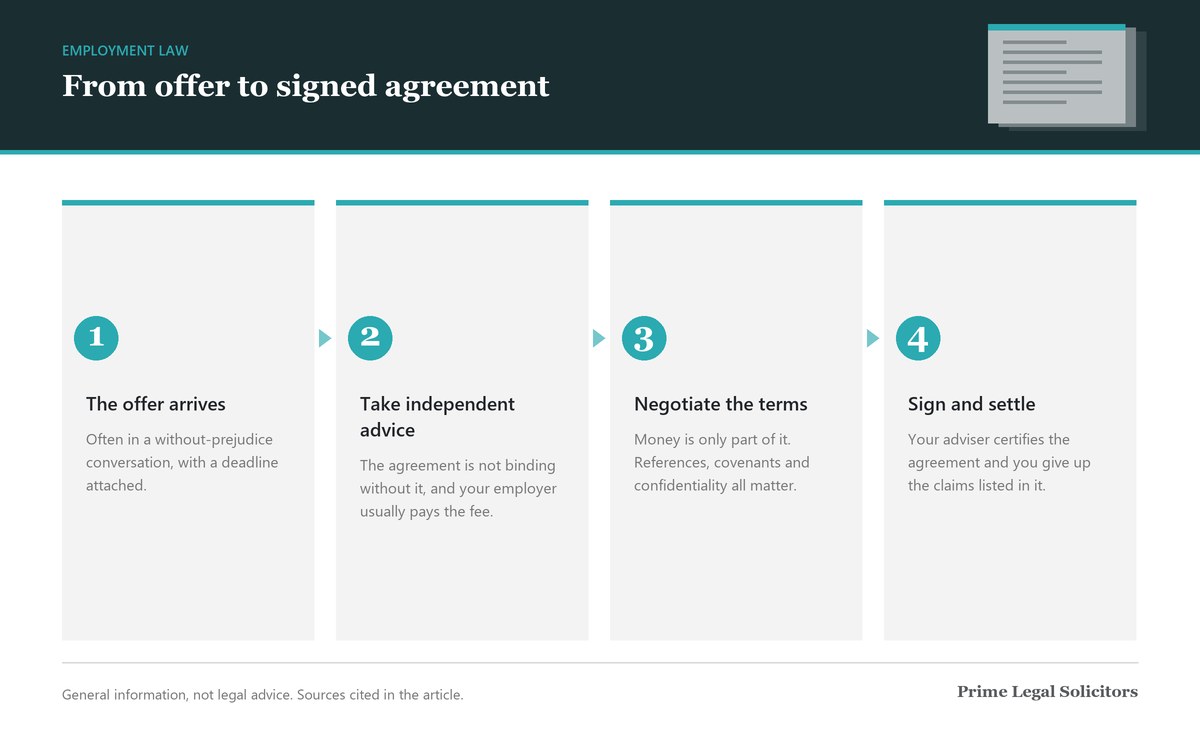
- The conversation. Often framed as without prejudice or as a protected conversation. Ask for the offer in writing, and do not agree a number on the spot.
- The draft arrives. Read it twice: once for the money, once for the clauses.
- Work out your tribunal deadline. Every other date on this list is negotiable; that one is not.
- Instruct a solicitor and send the document bundle listed above.
- Advice on terms and effect. What the waiver covers, what is missing, anything unusual.
- Negotiation, if you want it. Points go in writing and the employer responds; allow for a decision-maker being away.
- Decision. The Acas Code’s ten calendar days is the benchmark for considering written terms and taking advice.
- Signature. Your adviser signs the certificate confirming the statutory conditions are met.
- Payment, on the date fixed in the document — then check the payslip against the schedule you were given.
If a document is in front of you now, the useful next step is a short conversation with employment law solicitors about what it says and waives, before the date in the covering email arrives. Contact the team with the draft and your contract for a view.
Rules checked: 14 October 2026. Review triggers: any change to the £30,000 threshold in s.403 ITEPA 2003 or to the PENP rules in s.402D, and any revision of the Acas Code of Practice on settlement agreements. Tax treatment should be confirmed against the HMRC guidance linked below.
Frequently asked questions
How much does a settlement agreement solicitor cost?
It depends on scope. Advice on the terms and effect of the agreement is the statutory advice s.203 ERA 1996 requires, and the contribution your employer agrees usually covers it. Negotiation is separate work and can cost more than the contribution. We publish how we charge on our pricing page, and we will tell you before starting whether the contribution is likely to cover what you want done.
Does my employer have to pay for settlement agreement advice?
There is no legal duty to pay. But the waiver is void without independent advice under s.203(3) ERA 1996, so employers almost always agree a contribution, written into the agreement as a fixed sum paid direct to your solicitor against an invoice. If the sum offered will not cover the work the draft actually needs, asking for more is routine and usually easier to agree than more compensation.
What is the difference between a COT3 and a settlement agreement?
A COT3 is recorded by an Acas conciliator and takes effect under s.203(2)(e) ERA 1996, so it does not require you to take independent legal advice. A settlement agreement is a private contract that is void unless the s.203(3) conditions are met, including advice from a named independent adviser. COT3s are usually much shorter, which cuts both ways: a short waiver can still be very wide.
Do I need a solicitor to sign a COT3?
No. That is the main practical difference from a settlement agreement, and almost nobody mentions it. Acas conciliation is free and there is no statutory advice requirement, so a COT3 can be concluded without a solicitor and without anyone paying legal fees. Advice is still worth having on the width of the waiver and on what the figure compares to, but it is a choice rather than a condition.
Is a settlement agreement payment tax free?
Partly, at most. Genuine termination compensation is taxed only above the £30,000 threshold in s.403 ITEPA 2003. Notice pay, post-employment notice pay under s.402D, holiday pay, bonus and commission are taxed as earnings in full and get nothing from that threshold. Statutory redundancy pay is tax free but counts towards it. Ask for a written schedule showing how each element is treated.
What happens if I refuse a settlement agreement?
Nothing automatic. The agreement is voluntary, so your employment continues on its existing terms. Your employer may instead run a redundancy, performance or disciplinary process, and that can still end in dismissal. You keep the right to bring a tribunal claim, subject to time limits that keep running. The offer may also be withdrawn or reduced, so refuse deliberately rather than by delay.
How long do I have to consider a settlement agreement?
The Acas Code of Practice on settlement agreements says that, as a general rule, a minimum of ten calendar days should be allowed to consider the proposed written terms and to receive independent advice, unless both sides agree otherwise. If you are being pressed to sign within a day, you can point to the Code and ask for the full period. Your tribunal deadline keeps running either way.
Can I still claim after signing a settlement agreement?
Generally no, for the claims the agreement lists — that is what you are being paid for. Accrued pension rights, the right to enforce the agreement itself and unknown personal injury claims are usually carved out. If the s.203 conditions were not met the waiver can be ineffective, but never sign on the assumption that it will fail; the advice requirement exists precisely so that it does not.
Can I ask for a better reference?
Yes, and it is one of the most commonly agreed changes, because it costs the employer nothing in cash. Ask for the agreed wording to be annexed as a schedule, with an obligation to give that reference and no other in answer to requests, and to keep any internal announcement consistent with it. A bare promise of “a reference” is close to unenforceable.
Sources
- Employment Rights Act 1996, s.203 (restrictions on contracting out)
- Income Tax (Earnings and Pensions) Act 2003, s.403 (£30,000 threshold)
- HMRC Employment Income Manual EIM13505 — termination payments and the £30,000 threshold
- Acas — Settlement agreements
- Acas — Early conciliation (and COT3 settlements)
- Equality Act 2010, s.144 (contracting out)
- GOV.UK — Redundancy: your rights
Author

Suits You Media Dev