

If your employer unreasonably fails to follow the Acas Code of Practice on disciplinary and grievance procedures, a tribunal can increase your compensation by up to 25%. If you fail to follow it, your award can be cut by the same amount. Before bringing almost any tribunal claim, you must also notify Acas for early conciliation. This guide explains both rules, how conciliation pauses the time limit, and what changed in 2026.
Key takeaways
- Under section 207A of the Trade Union and Labour Relations (Consolidation) Act 1992, a tribunal may increase an employee’s award by up to 25% for an employer’s unreasonable failure to follow the Acas Code, or reduce it by up to 25% for the employee’s.
- The adjustment only applies to claims listed in Schedule A2 to that Act, such as unfair dismissal, discrimination, unpaid wages and contract claims. In unfair dismissal it applies to the compensatory award. Our guide to unfair dismissal compensation explains the awards.
- Denial of the right to be accompanied is a separate claim worth up to two weeks’ capped pay.
- Early conciliation is compulsory for most claims under section 18A of the Employment Tribunals Act 1996.
- Since 1 October 2026, most claims have a six-month time limit, and conciliation still stops the clock. See our article on the new time limits.
The short answer
The Acas Code is not law in itself. A breach does not, on its own, give you a claim. But tribunals must take the Code into account when deciding whether you were treated fairly. Where a claim succeeds, a failure to follow it can change how much you receive.
Early conciliation is different. It is a legal precondition for most claims. Skip it and the tribunal cannot accept your claim. Get the dates wrong and you may be out of time. If you are in a disciplinary or grievance process now, our employment law solicitors can review it with you.
What the Acas Code requires
The current Code dates from 2015. Acas consulted in 2026 on a revised version. Until a new Code is brought into force, the 2015 Code is the one tribunals apply.
It covers disciplinary matters involving misconduct or poor performance, and individual grievances. It does not apply to redundancy dismissals, to fixed-term contracts that simply expire, or to collective grievances raised by a recognised union.
In a disciplinary case, your employer should investigate without unreasonable delay, tell you the allegation in writing with the evidence, and hold a meeting where you can respond and call witnesses. You should be allowed to be accompanied. The decision should be confirmed in writing, with a right of appeal, heard where possible by a manager not involved before.
For a grievance, you should raise it formally, in writing and without unreasonable delay. Your employer should then meet you, let you be accompanied, give a written decision and offer an appeal. If you are offered money to leave instead, read our guide to settlement agreements explained first.
The 25% uplift: when a tribunal can increase your award
Section 207A(2) has three conditions. The claim must concern a matter to which the Code applies. The employer must have failed to comply with it. And that failure must have been unreasonable. If all three are met, the tribunal may increase the award by up to 25%, if it considers that just and equitable.
- It is discretionary. Twenty-five per cent is a ceiling, not a starting point. The more serious or deliberate the failure, the larger the uplift is likely to be.
- The failure must be unreasonable. An honest procedural slip may attract nothing. Dismissing without any meeting, or ignoring a written grievance, is far more likely to.
- It only helps employees. Section 207A applies to claims by an employee. Other workers cannot rely on it.
- It needs a successful claim. There is no free-standing claim for breach of the Code.
In unfair dismissal, the adjustment is made to the compensatory award, not the basic award. Section 124A of the Employment Rights Act 1996 says it is applied before any reduction for your own contributory conduct. Our article on claim value shows how those awards are built up.
Which claims the adjustment applies to
The adjustment is limited to the jurisdictions in Schedule A2. These are the ones employees meet most often.
| Type of claim | Statutory basis | 25% adjustment available? |
|---|---|---|
| Unfair dismissal, including constructive dismissal | Section 111, Employment Rights Act 1996 | Yes, to the compensatory award |
| Discrimination, harassment and victimisation | Section 120, Equality Act 2010 | Yes |
| Equal pay | Section 127, Equality Act 2010 | Yes |
| Unauthorised deductions from wages | Section 23, Employment Rights Act 1996 | Yes |
| Detriment, including whistleblowing detriment | Section 48, Employment Rights Act 1996 | Yes |
| Breach of contract on termination, such as unpaid notice | Employment Tribunals Extension of Jurisdiction (England and Wales) Order 1994 | Yes |
| Holiday pay | Regulation 30, Working Time Regulations 1998 | Yes |
| Denial of the right to be accompanied | Section 11, Employment Relations Act 1999 | No, it is not listed |
Schedule A2 also covers redundancy payments, minimum wage and several trade union claims. From 30 October 2026 it includes the new protection against detriment for taking protected industrial action. A listed claim is not enough on its own. The Code must also be relevant, so a genuine redundancy dismissal is unlikely to attract an uplift. If the label your employer used looks wrong, get advice early.
When your award can be reduced instead
The rule works both ways. Under section 207A(3), if you unreasonably failed to follow the Code, your award may be reduced by up to 25%. The classic example is an employee who resigns and claims constructive dismissal without ever raising a written grievance. Refusing to attend a properly arranged hearing, or ignoring an offered appeal, can have the same effect.
So follow the Code yourself, even if you have lost faith in your employer. Put your grievance in writing, attend meetings or explain why you cannot, and appeal on time. If you are thinking of resigning, our employment team can check you have done enough first.
The right to be accompanied, and its separate award
Section 10 of the Employment Relations Act 1999 gives every worker, not only employees, the right to be accompanied at a disciplinary or grievance hearing on a reasonable request. The companion can be a fellow worker, a trade union representative certified as competent, or a trade union official. Your employer does not have to accept a friend, relative or solicitor. Our Manchester solicitors can still advise you before and after the hearing.
The companion can put your case, sum up and confer with you, but cannot answer questions for you. If they are unavailable, you can propose another time. The hearing must be moved if that time is reasonable and within five working days of the original date.
A refusal can be challenged under section 11. The award is up to two weeks’ pay, with a week’s pay capped at the statutory maximum. The time limit for this complaint is now six months. It is usually brought alongside a larger claim.
Do I have to go through Acas before a tribunal claim?
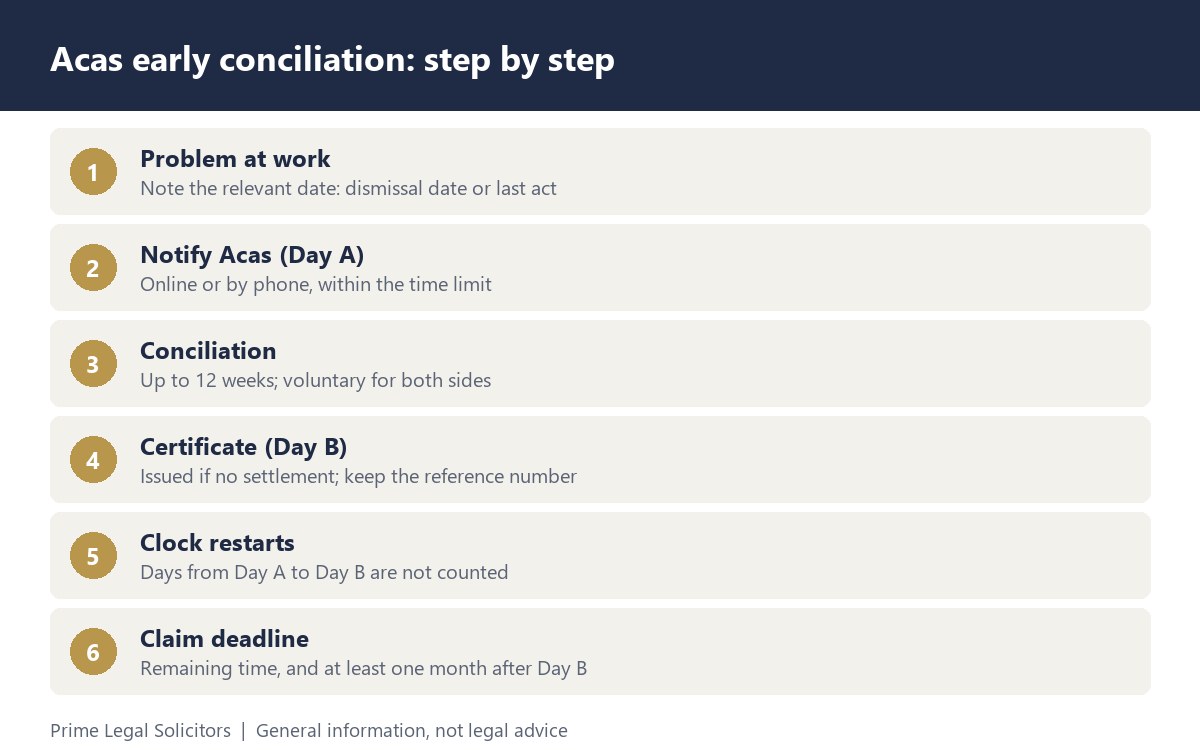
In almost all cases, yes. Section 18A of the Employment Tribunals Act 1996 requires you to give Acas prescribed information before presenting a claim. Where the rule applies, the tribunal cannot accept a claim without an early conciliation certificate. Its reference number goes on your claim form.
You notify Acas online or by phone. A conciliator then tries to help you and your employer settle. For notifications made on or after 1 December 2025, the period can last up to 12 weeks, up from six. Taking part is voluntary for both sides. If either declines, or settlement is not possible, Acas issues the certificate. A settlement is usually recorded in a binding COT3 agreement. Our guide to negotiated exit terms compares this with a settlement agreement.
From 26 November 2026, amending regulations require more information when you notify Acas. You must say whether you want to try to settle and, if so, describe the matter, whether it is ongoing, whether you raised it with your employer and whether you are or were employed by them. You can raise several matters, or name several employers, in one notification.
The exemptions
Regulation 3 of the Early Conciliation Regulations 2014 lists the exemptions. You do not need your own certificate where:
- someone else has conciliated the same dispute and you are joining their claim form;
- your claim is on the same form as a claim that does not need conciliation;
- your employer has already contacted Acas about the dispute;
- you claim unfair dismissal with an application for interim relief, for example in some whistleblowing cases; or
- the claim is against the Security Service, the Secret Intelligence Service or GCHQ.
These are narrow, so most people should notify Acas. Interim relief has its own very short deadline, so take urgent legal advice if it may apply.
How early conciliation affects your time limit
Since 1 October 2026, Schedule 12 to the Employment Rights Act 2025 has extended most tribunal time limits, including unfair dismissal and discrimination, from three months to six. The longer limit applies where the relevant date is on or after 1 October 2026. For a dismissal, that is usually the effective date of termination. For a series of acts, it is the last one. If the relevant date was earlier, three months still applies. Our article on tribunal time limit changes has the detail.
The stop-the-clock rule did not change. Under section 207B of the Employment Rights Act 1996, and section 140B of the Equality Act 2010:
- Day A is the day you notify Acas. Day B is the day you receive, or are treated as receiving, the certificate.
- The period from the day after Day A to Day B does not count.
- If the limit would expire between Day A and one month after Day B, it expires one month after Day B instead.
Two points catch people out. The clock only stops if you contact Acas before the original limit expires. And if your employer contacts Acas first, your clock does not stop. Tribunals can extend time only in limited cases, so never rely on it.
Employment Rights Act 2025: what comes next
Two changes take effect on 1 January 2027, for dismissals with an effective date of termination on or after that date. The qualifying period for ordinary unfair dismissal falls from two years to six months. Until then, two years’ service is still needed, although discrimination and automatically unfair dismissal remain day-one protections. Section 124 of the Employment Rights Act 1996, which caps the compensatory award, is also repealed. The Act does not change section 207A or the 25% figure. If your dismissal date is close to 1 January 2027, the timing may matter, and our pricing page explains how we charge for advice.
What to do next
- Keep everything in writing: invitations, meeting notes, outcomes and appeals.
- Follow the Code yourself and ask to be accompanied.
- Work out your relevant date and diarise the time limit at once.
- Notify Acas well within time and keep the certificate.
- Recalculate the deadline when the certificate arrives.
- Take advice before you resign or sign anything. Call 0330 341 4757 or contact our team.
Frequently asked questions
What happens if my employer does not follow the Acas Code?
A breach alone does not give you a claim, but tribunals must take the Code into account when judging fairness. If your claim succeeds and the failure was unreasonable, the tribunal may increase your award by up to 25% under section 207A, where it is just and equitable.
Is the 25% Acas uplift automatic?
No. It is discretionary and 25% is the maximum. Minor or technical lapses may attract nothing. In unfair dismissal it applies to the compensatory award only. Our employment solicitors can assess it for your case.
Can my compensation be reduced if I did not follow the Code?
Yes. If you unreasonably failed to comply, for example by resigning without a written grievance or refusing to attend a hearing, your award may be reduced by up to 25%.
Does the Acas Code apply to redundancy?
No. It does not apply to redundancy dismissals or to fixed-term contracts that simply expire. If a so-called redundancy is really about conduct or performance, the Code may still be relevant.
Do I have to go through Acas before making a tribunal claim?
In almost all cases, yes. You must notify Acas and obtain an early conciliation certificate first. The few exemptions include joining someone else’s claim, your employer having contacted Acas already, and interim relief applications.
How long does Acas early conciliation take?
Up to 12 weeks for notifications made on or after 1 December 2025. It ends sooner if either side declines or settlement is not possible. The period does not count towards your time limit.
Does early conciliation extend the time limit?
Yes, if you notify Acas within the original limit. The conciliation days do not count, and you always have at least one month after receiving the certificate. The base limit for most claims is now six months, as our time limits article explains.
Can I bring a friend to a disciplinary hearing?
Not as of right. The statutory companion is a fellow worker or a trade union representative or official. Your employer may agree to someone else. Refusing a reasonable request for a lawful companion can lead to an award of up to two weeks’ pay.
Please note: This article is general information about the law in England and Wales as at November 2026. It is not legal advice and does not create a solicitor-client relationship. Speak to a solicitor before making a decision. Prime Legal Solicitors is authorised and regulated by the Solicitors Regulation Authority, SRA No. 834471.
Author

Suits You Media Dev