
When someone dies without a will, a fixed statutory order decides who gets what, and nobody has any discretion to depart from it. A long-term unmarried partner inherits nothing – and jointly owned property never enters the estate at all.
Key takeaways
- An unmarried partner inherits nothing under the intestacy rules, however long the relationship. The Administration of Estates Act 1925 sets a fixed order and nobody can depart from it.
- Where a spouse or civil partner and children survive, the spouse takes the personal chattels, the £322,000 statutory legacy with interest, and half the residue absolutely; the children take the other half on the statutory trusts.
- The statutory legacy has been £322,000 for deaths on or after 26 July 2023 (SI 2023/758). The figure that applies is the one in force at the date of death.
- Property held as beneficial joint tenants passes to the survivor outside the estate, which changes the answer for most families — check the title, not your memory of the purchase.
- Children take per stirpes, by branch. A deceased child’s share passes to that child’s own children rather than being shared among the surviving children.
- The probate application fee is £526 for estates over £5,000, effective 13 July 2026 (SI 2026/642 as amended by SI 2026/665). Check the current figure before paying.
The short answer: the statutory order
When someone dies without a valid will they die intestate, and a fixed statutory order in the Administration of Estates Act 1925 decides who inherits. Nobody has any discretion. An unmarried partner inherits nothing under the intestacy rules, however long you lived together and whatever you called each other. That is the first thing most people need to know, and the thing most people do not.
The estate goes to the first category on the list with a living member, and that category excludes everyone below it. GOV.UK publishes a summary of who inherits when someone dies without a will; what follows is the detail it leaves out.
| Who survives | What the spouse or civil partner gets | What everyone else gets |
|---|---|---|
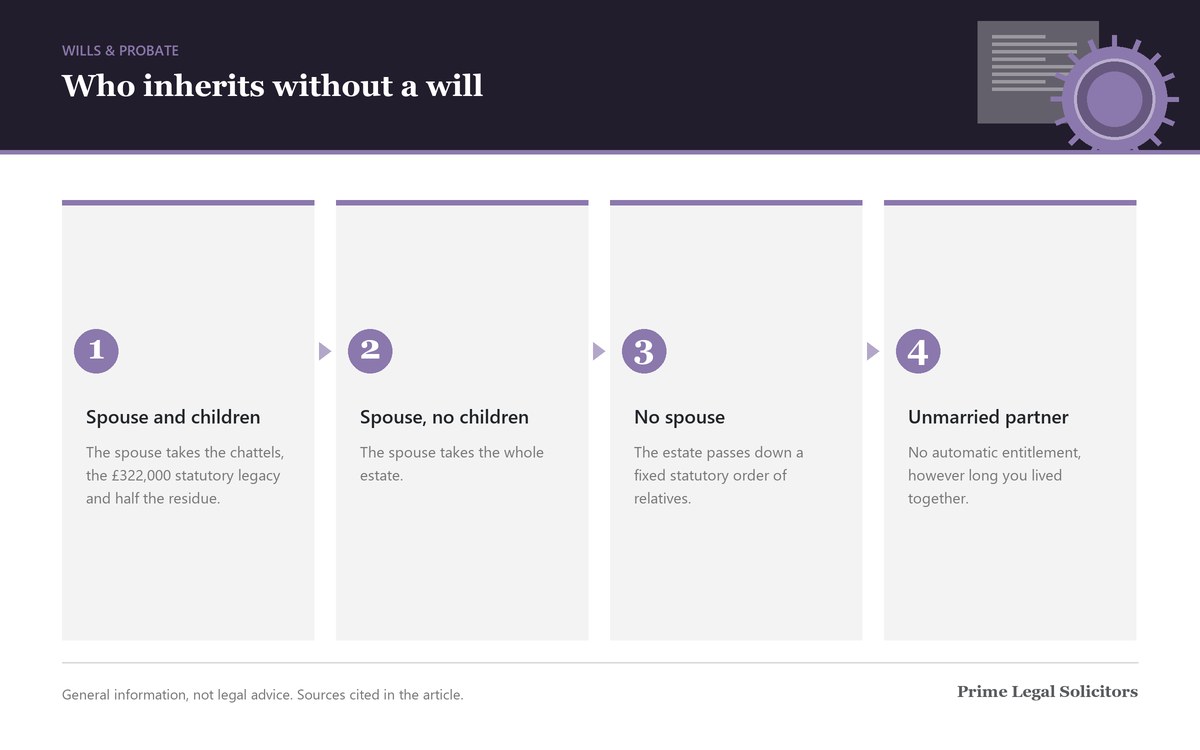
| Spouse or civil partner, and children or other direct descendants | All the personal chattels, the statutory legacy of £322,000 with interest from the date of death, and half of what is left, absolutely | The children share the other half of the residue equally, on the statutory trusts |
| Spouse or civil partner, no descendants | The entire estate, absolutely | Nothing. Parents and siblings take nothing where a spouse or civil partner survives |
| Children or descendants, no spouse or civil partner | – | The children take the whole estate equally on the statutory trusts; a dead child’s share passes down to that child’s own children |
| No spouse, civil partner or descendants; parents survive | – | The parents take the whole estate equally |
| No parents; brothers and sisters of the whole blood survive | – | Whole-blood siblings take equally on the statutory trusts; a dead sibling’s share passes to their children |
| Then in order: half-blood siblings, grandparents, whole-blood uncles and aunts, half-blood uncles and aunts | – | The first category with a living member takes everything; closer categories exclude remoter ones entirely |
| Nobody in any category | – | The estate passes to the Crown, the Duchy of Lancaster or the Duchy of Cornwall as bona vacantia |
| An unmarried partner, however long you lived together | – | Nothing under the intestacy rules. A cohabitant has no automatic entitlement at all |
The statutory legacy: £322,000
The statutory legacy – the fixed sum a surviving spouse or civil partner takes before the rest is divided – has been £322,000 for deaths on or after 26 July 2023, set by the Administration of Estates Act 1925 (Fixed Net Sum) Order 2023, SI 2023/758. This is not a recent change, and the figure that applies is the one in force at the date of death, not the date of distribution. It carries interest from the date of death under s.46(1A), at the Bank of England rate in force at the end of the day the person died.
The 28-day survivorship rule
A husband, wife or civil partner inherits under the intestacy rules only if they survive the deceased by 28 days. If they die inside that period the estate is distributed as though they had not survived at all. It matters in accidents where a couple die together or within days of each other, and it can move an entire estate from one family to another.
Which assets fall outside the estate entirely
Before applying the table, work out what the estate actually contains, because this changes the answer for most families. Several common assets never pass under the intestacy rules at all.
| Asset | In the intestate estate? | Who receives it instead |
|---|---|---|
| Property held as beneficial joint tenants – often the family home | No. It passes by survivorship | The surviving joint owner, automatically, outside the estate |
| Property held as tenants in common | Yes, the deceased’s share | Distributed under the statutory order |
| Joint bank or building society accounts | Usually no, where held jointly with survivorship | The surviving account holder |
| Life policies written in trust | No | The named beneficiaries under the trust |
| Discretionary pension and death-in-service lump sums | Usually no | Whoever the scheme trustees decide, often guided by a nomination form |
| Sole-name bank accounts, investments, vehicles, personal possessions | Yes | Distributed under the statutory order |
| Assets held in a trust set up in the deceased’s lifetime | No | Governed by the trust deed |
The practical effect is that the intestacy rules may govern far less – or far more – than the family assumes. Establish how each asset was owned first, then apply the statutory order to what is left. A house in joint names and a nominated pension can mean a surviving partner is provided for even though they inherit nothing under the rules; equally, a house in one name alone can mean a spouse and three children are suddenly co-owners.
Married or civil partner, with children
This is the most common intestacy and the most misunderstood. A surviving husband, wife or civil partner does not automatically inherit everything. They take three things:
- The personal chattels – broadly the tangible movable property: furniture, jewellery, cars, tools, pictures, clothes. The definition in s.55(1)(x) excludes money, securities, and property used solely for business purposes or held solely as an investment.
- The statutory legacy of £322,000, with interest from the date of death.
- Half of whatever is left, absolutely.
The children take the other half of the residue in equal shares, on the statutory trusts under s.47. If the estate is worth less than the statutory legacy, the spouse takes everything and the children receive nothing – which is why the size of the estate, not the family structure, often decides the outcome.
Married or civil partner, no children
Where there is a surviving spouse or civil partner and no children or remoter descendants, the spouse takes the whole estate absolutely. Parents, brothers and sisters take nothing. This has been the position since 1 October 2014, and it still surprises the deceased’s own family, who frequently expect a share.
Separation makes no difference. A spouse you have not lived with for fifteen years inherits as a spouse unless and until the marriage is dissolved by a final order. Judicial separation can change the position; a long estrangement does not.
Unmarried partners: the hard truth
There is no such thing as a common-law spouse in the law of England and Wales. A cohabiting partner has no entitlement whatsoever under the intestacy rules, regardless of the length of the relationship, whether you have children together, whether you shared finances, or whether everyone understood you to be a couple for life.
The results are harsh and routine: a partner of thirty years watching the estate pass to a sibling the deceased had not spoken to in a decade; a partner who paid half the mortgage on a house held in the other’s sole name, inheriting none of it.
If you are not married to your partner
Three things change the outcome, and two of them have to be done before death.
- How the home is owned. A beneficial joint tenancy passes to the survivor outside the estate. Tenancy in common does not. Check the Land Registry title, not your memory of the conveyance.
- A will. This is the entire answer, and it is inexpensive compared with the alternative. Our wills solicitors deal with cohabiting couples constantly.
- A claim after death. A cohabitant who lived with the deceased as a partner for at least two years immediately before the death, or who was maintained by them, may be able to claim reasonable financial provision under the Inheritance (Provision for Family and Dependants) Act 1975. The deadline is tight and the test is not generous. We deal with that claim, its grounds and its deadlines in our guide to challenging how an estate is divided.
| Relationship to the deceased | Inherits on intestacy? | May claim under the 1975 Act? |
|---|---|---|
| Spouse or civil partner (surviving by 28 days) | Yes, first in line | Yes, on the higher spousal standard |
| Former spouse or civil partner, marriage dissolved | No | Possibly, if not remarried and no bar was imposed on divorce |
| Unmarried partner, lived together as partners for 2 years or more | No | Yes, as a cohabitant, for maintenance |
| Unmarried partner of less than 2 years | No | Only if financially maintained by the deceased |
| Biological or adopted child, any age | Yes | Yes |
| Step-child, never adopted | No | Yes, if treated as a child of the family |
| Grandchild, parent of grandchild still living | No – their parent takes the share | Only if maintained by the deceased |
| Grandchild whose parent died before the deceased | Yes, taking the parent’s share per stirpes | Yes |
| Parent, sibling, grandparent, uncle or aunt | Only if no nearer category survives | Only if maintained by the deceased |
| Carer, friend, charity | No | Only a dependant maintained by the deceased |
Children, grandchildren and per stirpes
Where children inherit, they take on the statutory trusts under s.47 of the 1925 Act. Two features of that matter.
First, a child’s share is contingent: they take it absolutely at 18, or earlier if they marry or form a civil partnership. Until then the share is held in trust for them, and the administrators have duties about how it is invested and applied.
Second, and this is the part almost nobody explains, the division is per stirpes – Latin for “by the branch”. The estate is divided into one share for each of the deceased’s children, living or dead. If a child died before the deceased leaving children of their own, that branch’s share does not disappear and is not redistributed among the surviving children. It passes down and is divided among the children of the child who died.
If one of the children has already died
Imagine someone who dies intestate with no spouse, leaving an estate of £300,000 and three children, one of whom died two years earlier leaving two children of her own.
- Per stirpes, which is what the law does: three branches, so three shares of £100,000. The two surviving children take £100,000 each. The dead child’s £100,000 is split between her two children, giving them £50,000 each.
- Per capita, which is what families often assume: four living descendants, so £75,000 each.
The difference here is £25,000 per person, and it is a common source of family disputes because the arithmetic feels unfair to whichever side loses by it. The law is not interested in how it feels. If a grandchild’s parent is still alive, that grandchild inherits nothing: the parent takes the whole branch share.
What happens to the family home
Start with the title, not the rules. If the house was held as beneficial joint tenants, it passes to the surviving co-owner by survivorship the moment of death. It is not part of the estate, it is not available for distribution, and it does not count towards the statutory legacy. If it was held as tenants in common, the deceased’s share does form part of the estate and passes under the statutory order.
Where a spouse and children inherit and the house is in the deceased’s sole name, the practical consequence is co-ownership between a surviving spouse and children who may be minors. The spouse can require the house to be appropriated towards their own entitlement, but the valuation and the mechanics need care, and a mortgage lender may have views. This is the point at which most families need a probate solicitor rather than a form.
Note too that the home is where inheritance tax and the residence nil-rate band usually bite. We do not give tax planning advice on this page; HMRC and GOV.UK publish the current thresholds and reliefs.
Two estates, worked out to the penny
Both examples are hypothetical. Both assume the spouse survived by at least 28 days and that all debts, funeral expenses and administration costs have already been paid.
Estate A, below the statutory legacy. Net estate £240,000, of which personal chattels are £9,000. A surviving wife and two adult children. The wife takes the chattels, then the statutory legacy – but the estate is smaller than £322,000, so she takes the whole of it. The children receive nothing. This is the outcome most families have never contemplated: adult children, a modest estate, and no inheritance at all.
Estate B, above the statutory legacy. Net estate £740,000, of which personal chattels are £18,000, leaving £722,000 of money and other assets. A surviving husband and two children, one aged 15.
- Chattels to the husband: £18,000.
- Statutory legacy to the husband: £322,000, plus interest from the date of death.
- Residue: £722,000 − £322,000 = £400,000.
- Half the residue to the husband absolutely: £200,000.
- Half the residue to the children on the statutory trusts: £200,000, so £100,000 each.
- The adult child takes their £100,000 now. The 15-year-old’s share is held on the statutory trusts until they turn 18.
The husband therefore receives £540,000 of the £740,000. Had the house been in joint names, it would have passed to him outside the estate altogether and the children’s shares would have been calculated on a much smaller figure – the single most important variable in most real estates.
If nobody survives: bona vacantia
If no relative in any statutory category survives, the estate passes to the Crown as bona vacantia – or to the Duchy of Lancaster or the Duchy of Cornwall depending on where the deceased lived. The Government Legal Department publishes a list of unclaimed estates, and relatives can come forward.
Someone who was not entitled under the intestacy rules but who was dependent on the deceased – a cohabiting partner or a carer – may apply for a discretionary ex gratia payment out of a bona vacantia estate. It is discretionary, there is no entitlement, and no one can tell you in advance what it would produce.
Who can administer the estate, step by step
There are no executors on an intestacy, so somebody has to be appointed. The order of priority for a grant of letters of administration is set by rule 22 of the Non-Contentious Probate Rules 1987 and follows the order of entitlement: spouse or civil partner first, then children, then parents, then siblings, and so on. A beneficiary who does not want the job can renounce or let someone else with equal entitlement apply.
- Establish who owns what. Obtain the Land Registry title, account statements at the date of death, pension and policy details, and the ownership basis of each asset.
- Value the estate at the date of death, including chattels, and identify debts.
- Deal with inheritance tax. The relevant HMRC account must be completed before or alongside the application, and any tax due is normally paid before the grant issues.
- Apply for letters of administration, online or on form PA1A – the paper form for an estate with no will.
- Pay the application fee. It is £526 for estates over £5,000, with no fee for estates of £5,000 or less, effective from 13 July 2026 under SI 2026/642 as amended by SI 2026/665. Check the current figure on GOV.UK before you pay, and see our published fees for what professional help costs.
- Collect in, pay debts, then distribute strictly in accordance with the statutory order, holding any minor’s share on the statutory trusts.
The documents you will need
- The death certificate, and the original of any document suggesting a will exists.
- The Land Registry title for any property, and any mortgage statement.
- Bank, building society, investment and pension valuations at the date of death.
- Evidence of family relationships: birth, marriage, civil partnership, adoption and death certificates for anyone in the chain.
- A schedule of debts, funeral expenses and lifetime gifts.
If nobody wants to be the administrator
Estates do get stuck here, usually because no family member wants the responsibility or the family cannot agree who. Nothing can be sold, no account can be closed and no beneficiary can be paid until someone has a grant. Where the deceased was a landlord, the problem compounds: rent still arrives, repairs are still owed, and the compliance duties on a landlord do not pause for probate. A professional administrator can be appointed instead.
Common mistakes: where families get this wrong
- Assuming a partner inherits. They do not, however long the relationship and whatever the family all agreed.
- Assuming the spouse takes everything. Where there are children and the estate exceeds £322,000, they do not.
- Assuming jointly owned property passes under intestacy. A beneficial joint tenancy passes by survivorship, outside the estate entirely.
- Assuming step-children inherit. Only adopted children count as children for intestacy. A step-child may have a 1975 Act claim instead.
- Dividing per capita between grandchildren. The division is per stirpes, by branch.
- Using the wrong statutory legacy. The figure that applies is the one in force at the date of death.
- Paying out before debts and tax. Administrators can be personally liable for distributing too early.
- Delaying because nobody wants the job. The estate simply freezes, and assets lose value while it does.
Putting it right afterwards
Three routes exist once the intestacy rules have produced the wrong answer, and only one of them is quick.
A deed of variation lets the adult beneficiaries who inherited agree to redirect their entitlement – for example to the deceased’s partner. Executed within two years of death and in the right form, it can be read back for inheritance tax purposes. It needs everyone who loses out to agree, and it cannot bind a minor’s share without court approval.
A 1975 Act claim is the route for a partner, dependant or child who inherits too little. The grounds, the deadline and the evidence are covered in our guide to contesting a will or an estate – and the time limit runs from the grant, so do not wait.
And a will prevents all of it. One point of timing is worth knowing: pension pots left on death have historically sat outside the inheritance tax net, and that has changed. The law has been changed by the Finance Act 2026, which received Royal Assent on 18 March 2026; under ss.66–71 the charge applies to deaths on or after 6 April 2027. That is not tax planning advice, and anyone whose estate plan assumes the old position should take proper advice from our wills and probate solicitors well before that date.
Frequently asked questions
Who inherits if there is no will?
In England and Wales the Administration of Estates Act 1925 sets the order. A surviving spouse or civil partner comes first, then children and their descendants, then parents, whole-blood siblings, half-blood siblings, grandparents, and uncles and aunts. The first category with a living member takes, and closer categories exclude remoter ones entirely. If nobody qualifies, the estate passes to the Crown as bona vacantia.
Does my partner automatically inherit if we are not married?
No. There is no common-law spouse in the law of England and Wales, and a cohabiting partner has no entitlement under the intestacy rules however long you lived together or whether you had children. A partner may be able to claim reasonable financial provision under the Inheritance (Provision for Family and Dependants) Act 1975, but that is a claim to bring, not an inheritance.
What is the statutory legacy?
It is the fixed sum a surviving spouse or civil partner takes before the rest of the estate is divided with the children. It has been £322,000 for deaths on or after 26 July 2023, set by SI 2023/758, and it carries interest from the date of death. The figure that applies is the one in force when the person died, not when the estate is distributed.
What does per stirpes mean?
It means by the branch. The estate is divided into one share for each of the deceased’s children, whether or not they are still alive. If a child died first leaving children of their own, that branch’s share passes down to those grandchildren rather than being shared out among the surviving children. It is why grandchildren in different branches often inherit different amounts.
What happens to the house if there is no will?
It depends on how it was owned. A property held as beneficial joint tenants passes automatically to the surviving co-owner by survivorship and never forms part of the estate. A property held as tenants in common, or in the deceased’s sole name, does form part of the estate and passes under the statutory order, which can leave a spouse co-owning with children.
Do step-children inherit on intestacy?
Not unless they were legally adopted by the deceased. For intestacy purposes children means biological and adopted children, so a step-child who was never adopted takes nothing however close the relationship. A step-child treated as a child of the family may instead be able to bring a claim under the Inheritance (Provision for Family and Dependants) Act 1975.
What are letters of administration?
They are the grant that gives someone authority to deal with an estate where there is no will, in place of the grant of probate an executor would obtain. The order of priority to apply is set by rule 22 of the Non-Contentious Probate Rules 1987 and follows the order of entitlement, starting with the spouse or civil partner, then children. The paper application is form PA1A.
How much does it cost to apply for probate?
The application fee is £526 for estates over £5,000, with no fee where the estate is £5,000 or less. That figure took effect on 13 July 2026 under SI 2026/642 as amended by SI 2026/665. Court and probate fees are changed by statutory instrument without much notice, so check the current fee on GOV.UK before you pay it.
Can you change how an intestate estate is divided?
Sometimes. Adult beneficiaries who have inherited can sign a deed of variation redirecting their entitlement, and if it is executed within two years of death and in the right form it can be read back for inheritance tax. Everyone giving something up has to agree, and a minor’s share cannot be varied without court approval. Otherwise the route is a 1975 Act claim.
Sources
- GOV.UK — Who inherits if someone dies without a will
- Administration of Estates Act 1925, s.46 (order of entitlement)
- Administration of Estates Act 1925, s.47 (statutory trusts)
- The Administration of Estates Act 1925 (Fixed Net Sum) Order 2023
- GOV.UK — Applying for probate
- Finance Act 2026, s.71
- Inheritance (Provision for Family and Dependants) Act 1975
Author

Suits You Media Dev