

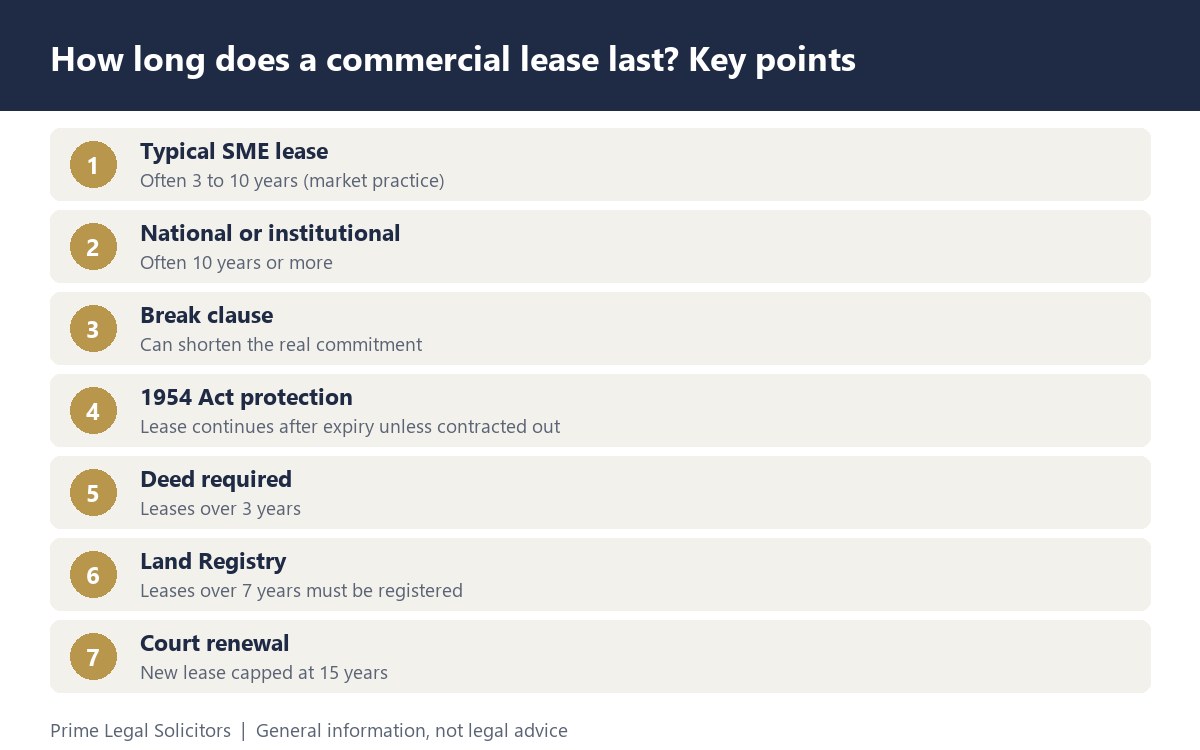
There is no legal standard length for a commercial lease in England and Wales. The term is whatever the landlord and tenant agree. In practice, many leases of shops, offices and small industrial units to smaller businesses run for three to ten years, often with a break clause. National tenants and larger buildings tend to take longer terms. Just as important are the break clause and whether the tenant has a statutory right to renew.
Key takeaways
- Lease length is a matter of negotiation, not law. The usual ranges describe market practice and vary with location and the tenant’s strength. Our commercial lease solicitors act on both sides.
- A break clause can shorten the real commitment, but its conditions are applied strictly.
- Unless the lease is contracted out, an occupying business tenant usually has security of tenure under Part II of the Landlord and Tenant Act 1954.
- A lease of more than three years must be made by deed. A lease of more than seven years must be registered at HM Land Registry.
- SDLT may be due on rent and premium. A ban on upwards-only rent reviews is law but not yet in force. See our published fees.
The short answer: it depends on what you negotiate
No statute sets a minimum or maximum term for a commercial lease. A lease can run for a few months or for 999 years. The parties fix the term in the heads of terms and then in the lease.
Some patterns are well established. Smaller businesses want flexibility. Landlords and their lenders want long, secure income, because years of unexpired term make a building more valuable. The term you agree reflects that tension, and the break clause is often where it is resolved.
The stated term is also not the whole story. A protected tenant can usually stay on after expiry and apply for a new lease. An unprotected tenant must leave unless a new deal is done. Our commercial lease team looks at the term, the break and the renewal position together.
Typical lease lengths by property and tenant
The table describes common market practice. It is not a rule and not survey data. Use it as a starting point for negotiation.
| Property and tenant | Common term | Typical features |
|---|---|---|
| Small shop, independent tenant | Often 3 to 10 years | Tenant break part way through; rent deposit or guarantor often required |
| Office suite, SME tenant | Often 3 to 10 years | Five years with a year three break is a familiar structure |
| Small industrial or trade unit | Often 3 to 10 years | Full repairing terms are usual, so a schedule of condition matters |
| National retailer or multiple | Often 10 years or more | Stronger covenant gives more leverage on breaks and incentives |
| Large office or logistics building | Often 10 to 15 years or longer | Long income supports investment value; reviews usually five-yearly |
| Pop-up or seasonal use | Weeks or months | Often a licence or a short contracted-out lease |
Location matters too. Strong demand for prime space lets landlords hold out for longer terms. Secondary space often goes on shorter terms with a rent-free period. Our London solicitors and Manchester solicitors see both.
Short and long leases: the trade-offs
- Tenant, shorter term: less liability if the business struggles or grows, but less certainty and less time to recover fit-out costs.
- Tenant, longer term: security for a key location and often better incentives, but a long rent and repair liability, sometimes personally guaranteed.
- Landlord, shorter term: flexibility to redevelop, re-let or sell, but void risk and repeated letting costs.
- Landlord, longer term: secure, financeable income, but dependence on one tenant whose covenant may weaken.
A break clause or a contracted-out lease can soften either position. If the deal involves subletting, the headlease will control what an underlease can say, so the lease solicitors should check that the two fit.
Break clauses: the real length of many leases
A break clause lets one or both parties end the lease early. A ten-year lease with a tenant break at year five is, commercially, a five-year commitment with an option on the rest.
The risk lies in the conditions. Courts require a break to be exercised exactly as the lease says. Common conditions are:
- notice in the right form, served on the right person, within the right window;
- payment of all sums due up to the break date;
- vacant possession on the break date;
- compliance with the tenant’s covenants, including repair.
Vacant possession means returning the premises free of people, belongings and anything that stops the landlord using them. Leaving partitioning or a subtenant behind can defeat the break. Tenants should push for a break conditional only on paying the main rent and giving vacant possession.
After Marks and Spencer plc v BNP Paribas [2015] UKSC 72, a tenant who pays a full quarter’s rent to satisfy a break condition will not usually recover the part after the break date unless the lease says so. A failed break leaves the tenant bound for the full term, which is why breaks feature often in commercial lease disputes.
Break clause checklist for tenants
- Diarise the earliest and latest dates for serving notice.
- Check who must serve, on whom, how and where.
- Pay every sum due up to the break date, without deduction.
- Clear the premises in time and return the keys.
Security of tenure under the 1954 Act
Part II of the Landlord and Tenant Act 1954 protects tenants who occupy premises for their business. Under section 24, a protected tenancy does not end on its expiry date. It continues on the same terms until ended in a way the Act allows. Tenancies for a term certain of six months or less are excluded, unless the lease can extend beyond six months or the tenant and any predecessor have been in occupation for over twelve months (section 43(3)).
Section 25 notices and section 26 requests
A landlord ends a protected tenancy with a section 25 notice in the prescribed form. It must give a termination date six to twelve months ahead, and not before the contractual expiry date. It must say whether the landlord opposes a new tenancy and, if so, on which grounds. If not, it must set out proposals for the new lease.
A tenant whose lease was granted for a term certain of more than one year can serve a section 26 request, again naming a date six to twelve months ahead. The landlord has two months to serve a counter-notice if it will oppose. Court deadlines run from these documents, so get advice early.
Grounds for opposing renewal
Section 30(1) sets out the only grounds a landlord can rely on: (a) disrepair; (b) persistent delay in paying rent; (c) other substantial breaches; (d) suitable alternative accommodation; (e) the landlord needs the whole of a property sublet in part; (f) demolition or reconstruction; and (g) the landlord’s own occupation. Ground (g) is not available to a landlord whose interest was bought or created within five years before the tenancy ends, where the property was let throughout (section 30(2)). A tenant who loses on grounds (e), (f) or (g) may be entitled to statutory compensation.
Contracting out of the 1954 Act
The parties can agree that sections 24 to 28 will not apply. Under section 38A and Schedule 2 to the Regulatory Reform (Business Tenancies) (England and Wales) Order 2003:
- The landlord serves a warning notice explaining the rights being given up.
- If served at least 14 days before the tenant enters into the lease or becomes contractually bound, the tenant signs a simple declaration.
- If less than 14 days’ notice is given, the tenant makes a statutory declaration before an independent solicitor or other authorised person.
- The lease must refer to the notice, the declaration and the agreement.
All of this must happen before the tenant is bound, including by an agreement for lease. If it is not done properly, the lease is likely to be protected. A contracted-out lease ends on its expiry date with no right to stay. Our landlord and tenant guide covers the wider law.
Deeds, registration and Stamp Duty Land Tax
- Deed: a legal lease must be made by deed (section 52, Law of Property Act 1925). Section 54(2) excepts leases taking effect in possession for up to three years at the best rent reasonably obtainable without a premium. Most written commercial leases are executed as deeds anyway.
- Registration: a lease granted for more than seven years must be registered at HM Land Registry (section 27, Land Registration Act 2002). Until then the tenant does not hold the legal estate.
- SDLT: on a new non-residential lease, SDLT on the net present value of the rent is 0% up to £150,000, 1% from £150,001 to £5,000,000 and 2% above. A premium is taxed separately: 0% up to £150,000, 2% on the next £100,000 and 5% above £250,000. A return may be needed even if no tax is due.
Longer terms increase the rent’s net present value, so a long lease at a modest rent can still attract tax. For deals in central London offices, this is often a live point.
Rent reviews over a longer term
Leases of five years or more usually provide for rent review, commonly every five years, to open market rent, an index such as RPI or CPI, or fixed uplifts. Many existing leases say rent can only go up.
The English Devolution and Community Empowerment Act 2026 received Royal Assent on 29 April 2026. It bans upwards-only rent reviews in new commercial leases in England and Wales, including renewals. As at November 2026 the ban is not in force, and its start date will be set by regulations. Leases granted before then keep their review terms, subject to transitional rules that can catch later renewals. Ask our commercial property lawyers to check any option or renewal you are agreeing now.
The RICS Code for leasing business premises
The RICS Code for leasing business premises, first edition, took effect on 1 September 2020 and applies in England and Wales. Its mandatory parts bind RICS members and regulated firms, usually agents and surveyors. It covers term, breaks, rent review, repair and whether the 1954 Act will apply, and expects unrepresented parties to be urged to take advice. It does not bind landlords or tenants directly, but it is a useful checklist for heads of terms.
What happens when the lease ends
- Protected lease: the tenancy continues under section 24 until ended under the Act. A tenant who wants to leave can serve a section 27 notice. A tenant not in occupation at expiry is not protected.
- Contracted-out lease: the lease ends on expiry. A tenant who stays on may be a tenant at will. If rent is paid and accepted regularly, a court may find a periodic tenancy, which could carry 1954 Act protection.
Landlords should document any extension properly. Tenants should not assume they can stay on indefinitely. Our landlord and tenant solicitors deal with holding over regularly.
Lease renewals and the Law Commission review
Most renewals are agreed without a hearing. If terms cannot be agreed, the court fixes them, generally starting from the existing lease. Under section 33, a court-ordered fixed term cannot exceed 15 years.
The Law Commission is reviewing Part II of the 1954 Act. It published a first consultation paper on 19 November 2024, an interim statement in June 2025, and a second consultation paper on 16 June 2026, which closed on 16 September 2026. The proposals keep the right to renew and contracting out, with changes such as raising the short tenancy threshold. As at November 2026 the Commission is analysing responses and no final report has been published. The law has not changed. Our Yorkshire property team handles renewals across the North.
Licences to occupy as an alternative
For short or flexible arrangements, a licence to occupy may suit better. A licence is a personal permission, not an interest in land, so the 1954 Act does not apply. The label is not decisive. If the occupier in fact has exclusive possession for a term at a rent, it may be a tenancy whatever it is called. Our fixed fees start at £980 plus VAT for a licence to occupy, £1,000 plus VAT for a lease or agreement for lease, and £1,250 plus VAT for an underlease.
Frequently asked questions
How long is a typical commercial lease in the UK?
There is no standard length. In England and Wales, many leases to smaller businesses run for three to ten years, often with a break. National tenants and larger buildings often take ten years or more. These are market patterns, not legal rules. Our lease team can advise on your deal.
What is the minimum length of a commercial lease?
There is no legal minimum. A fixed term of six months or less falls outside the 1954 Act unless it can extend beyond six months or the tenant has occupied for more than twelve months.
Can I leave a commercial lease early?
Only if the lease allows it, usually through a break clause, or the landlord agrees to a surrender. Assignment or subletting may be possible with consent.
Do I have a right to renew my business lease?
Usually, if you occupy for your business and the lease was not contracted out. The landlord can only refuse on a section 30 ground, such as redevelopment or own occupation.
Does a commercial lease need to be registered?
A lease granted for more than seven years must be registered at HM Land Registry. A lease of more than three years must also be made by deed.
How long is a court-ordered renewal lease?
The court decides what is reasonable, up to a maximum fixed term of 15 years under section 33. Agreed renewals can be longer.
Is stamp duty payable on a commercial lease?
Only if the net present value of the rent exceeds £150,000, or a premium exceeds the nil band. Many short leases at modest rents pay nothing, though a return may still be needed.
How much does a commercial lease solicitor cost?
Our fees start at £1,000 plus VAT for a lease and £980 plus VAT for a licence to occupy. Disbursements are extra. To discuss your lease, contact our team or call 0330 341 4757.
Please note: This article is general information about the law in England and Wales as at November 2026. It is not legal advice and does not create a solicitor-client relationship. Speak to a solicitor before making a decision. Prime Legal Solicitors is authorised and regulated by the Solicitors Regulation Authority, SRA No. 834471.
Author

Suits You Media Dev