

Most possession claims are not lost on the facts. They are lost on paperwork that was done, or not done, long before the claim was issued. This is the check a tenant’s adviser will run against your file: the deposit, licensing, certificates, the notice and proof of service. It also covers the realistic stages of a claim and the one line no landlord may cross.
Key takeaways
- Deposit protection and the prescribed information are two separate duties. If either was missed, the court cannot make a possession order on most grounds until the deposit is returned, and the tenant can claim one to three times the deposit.
- Selective, additional and HMO licensing designations can change from one street to the next. Letting an unlicensed property that needs a licence is a criminal offence and can lead to a rent repayment order.
- Formal notice defects, such as the wrong form, the wrong landlord name, grounds without particulars or a short notice period, cannot be fixed after the event. You have to serve a fresh notice. Our guide to choosing a section 8 ground covers the notice itself.
- A disrepair counterclaim can be set off against arrears. If it takes the balance below a mandatory threshold, the mandatory ground falls away and an undefended claim becomes a trial.
- Only a County Court bailiff or a High Court enforcement officer may evict a tenant. Anything else risks a criminal offence under the Protection from Eviction Act 1977.
The short answer: most claims fail before they are issued
Possession claims are rarely lost on the facts. They are lost on preconditions: an unprotected deposit, prescribed information never served, a property that needed a licence and did not have one, a notice on the wrong form or in the wrong name, or arrears paid down below the threshold by the hearing date. Every one of those can be fixed before you pay a court fee. Almost none can be fixed afterwards.
Since section 21 was abolished on 1 May 2026, every possession claim in England runs on a ground in Schedule 2 to the Housing Act 1988. That puts more weight on the notice and on your compliance file, because there is no longer a simpler route to fall back on. The Renters’ Rights Act checklist sets out the wider duties that sit behind everything on this page.
What follows is the pre-issue audit, in the order a tenant’s adviser will run it. This page assumes you have already chosen your ground and asks whether the claim will survive.
The five questions a judge or a duty solicitor asks first
- Was the deposit protected in an authorised scheme, and was the prescribed information given, within the statutory period?
- Did the property need a licence, and did it have one when the notice was served?
- Was the notice on the current prescribed form, in the correct landlord’s name, properly particularised and in time?
- Can the landlord prove service, and prove the ground as at today’s date rather than the notice date?
- Is there a live disrepair complaint that could become a counterclaim?
The pre-issue readiness checklist
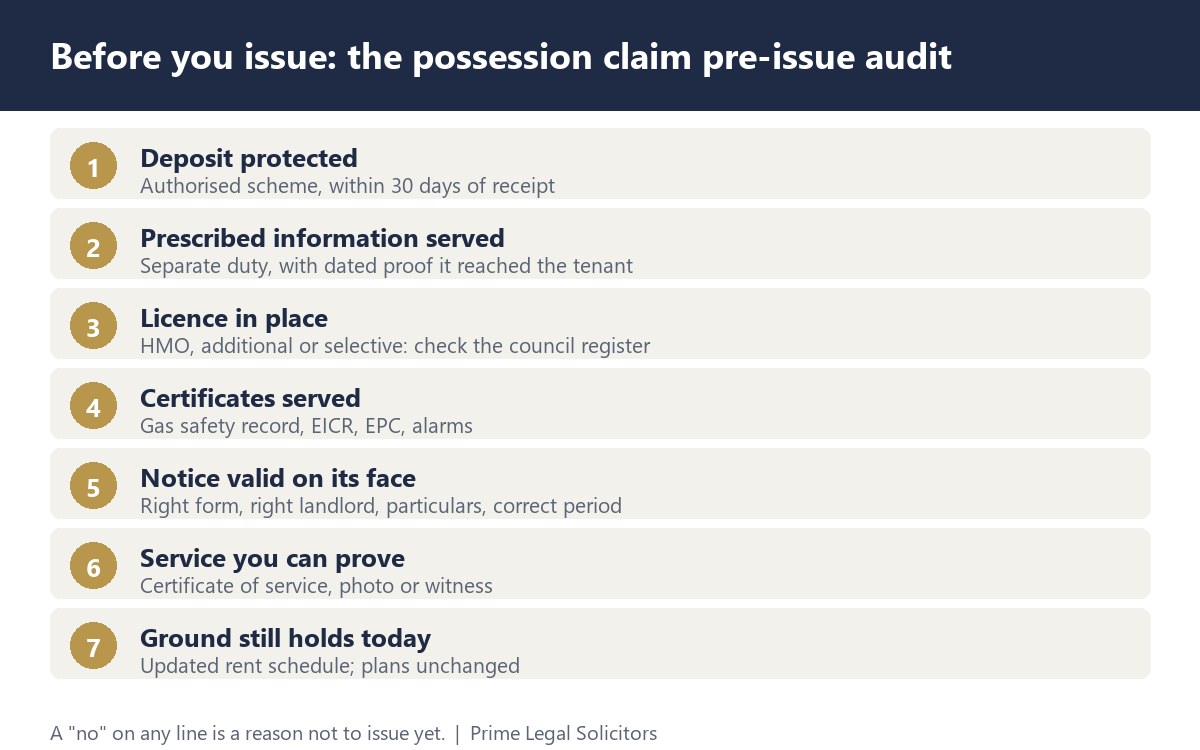
Work down this table before you file anything. A “no” in the first column is not something to argue at the hearing. It is a reason not to issue yet. If you would rather have someone else run the check, our landlord and tenant solicitors review files before issue.
| Precondition | Why it defeats the claim | How to check | How to fix before issuing |
|---|---|---|---|
| Deposit protected in an authorised scheme | The court cannot make a possession order on most grounds while the deposit rules are unmet, and the tenant can claim one to three times the deposit | Search the scheme’s records by property and tenant; find the certificate and the date you received the deposit | Return the deposit in full, or with agreed deductions, before serving. Protecting it late does not undo the breach |
| Prescribed information served | A separate duty from protection, and the one most often missed. It has the same effect as an unprotected deposit | Look for the signed prescribed information, the scheme leaflet and dated proof it was given to the tenant and any relevant person | Take advice. Returning the deposit is usually the safest fix |
| Licence in place where one is required | Letting an unlicensed property is a criminal offence, risks a rent repayment order, and counts against you on any discretionary ground | Check the council’s licensing register and designation map for the address, and count the occupiers and households | Apply before serving. A valid application is far better than none |
| Gas safety record, EICR, EPC, alarms | Not an absolute bar on its own, but the first thing a defence adviser asks for | Pull the file: dates of issue, dates given to the tenant, and the engineer’s registration | Obtain and serve current documents, and record how you served them |
| Written terms and tenant information | Cheap to do at the start, expensive to reconstruct in a witness statement later | Find the written statement of terms, or for older tenancies the government information sheet, with a dated record of service | Serve what is missing now and keep the evidence |
| Notice valid on its face | An invalid notice is a complete answer to the claim and cannot be repaired | Current prescribed form; correct landlord name; every ground set out with particulars; period counted from the longest band; claim issued within 12 months of service | Serve a fresh notice. Do not issue on a notice you suspect is defective |
| Proof of service | You will be asked how the notice was served, and “I posted it” is not evidence | Certificate of service, dated photograph, witness details, or the tenancy’s own service clause | Re-serve in a way you can prove if you cannot evidence the first attempt |
| The ground still holds today | Mandatory arrears grounds must be met at the hearing as well as at the notice date | Rent schedule updated to today; confirmation that your plan to sell or move in is unchanged | If the ground has fallen away, do not issue. You will pay the fee and may pay the tenant’s costs |
The deposit: the mistake that most often loses the claim
There are two obligations, not one. Under Part 6 of the Housing Act 2004, a tenancy deposit must be protected in an authorised scheme, and the prescribed information about that protection must be given to the tenant, both within 30 days of receiving the deposit. Landlords who did the first and forgot the second are the largest group of avoidable defeats, because the certificate sits in the file and looks like compliance. Our landlord and tenant law guide explains how the schemes work.
The consequences run in two directions. On a tenant’s application under section 214, the court must order the deposit to be repaid or protected, and must order the landlord to pay the tenant not less than the deposit and not more than three times the deposit. Separately, section 215 now says the court may only make a possession order on an assured tenancy if the deposit rules have been met. The old reassurance that a deposit problem “only blocks section 21” is out of date.
There are two exceptions. The restriction does not apply to orders on Ground 7A (serious antisocial behaviour) or Ground 14 (nuisance and annoyance). It also falls away once the deposit has been returned, in full or with agreed deductions, or once the tenant’s section 214 claim has been decided, withdrawn or settled.
If the deposit was protected late
Late protection does not rewrite history. The breach happened, and the tenant’s penalty claim survives it. For possession, the usual route is to return the deposit, in full or less any amount the tenant genuinely agrees is due, before the notice is served. Keep the correspondence that proves it. Do this at the start, not on the morning of the hearing, because the tenant has to co-operate with the accounting.
If you cannot find the paperwork
Assume it is a problem until you have the scheme certificate, the prescribed information and dated proof that both reached the tenant. The schemes keep records and will confirm what was protected and when. A former letting agent still holds the file and can be asked for it.
Licensing: selective, additional and HMO
There are three regimes, and landlords routinely assume they fall into none of them. Mandatory HMO licensing under Part 2 of the Housing Act 2004 covers larger houses in multiple occupation. Additional licensing extends that to smaller HMOs where a council has made a designation. Selective licensing under Part 3 covers ordinary single-family lets in designated areas. Designations can change street by street, so two properties a mile apart in Salford or Manchester can sit on opposite sides of the line.
Letting without a required licence is a criminal offence under sections 72 and 95 of the Housing Act 2004. A council can impose a financial penalty instead of prosecuting under section 249A. The tenant or the council can also apply to the First-tier Tribunal for a rent repayment order under the Housing and Planning Act 2016, which for licensing offences can now cover up to two years’ rent. Repeat or serious offending can lead to a banning order and entry on the database of rogue landlords.
If you discover the property needed a licence
Apply straight away, before serving any notice. A valid pending application puts you in a much better position, both with the council and with a judge deciding whether it is reasonable to order possession on a discretionary ground. Take advice before you issue. A possession claim tells the court, and in practice the council, exactly which property you are letting and on what terms. Our landlord solicitors in Yorkshire regularly deal with licensing problems found late in Leeds and Bradford.
Notice defects, and which ones can be cured
The defects that end a claim outright are the formal ones: the wrong form, a landlord named incorrectly, a ground recited without particulars, a notice period counted from the wrong band, or a claim issued more than 12 months after the notice was served (section 8(3)(c) of the Housing Act 1988). The answer to all of them is a fresh, correct notice, which means the notice period starts again.
Two problems come up often enough to name.
- The wrong landlord name. The notice must be given by or on behalf of the landlord, and the landlord must be identified correctly. A trading name, a dissolved company or a deceased joint owner invites a challenge. Where the property is jointly owned, name every landlord.
- Particulars that are not particulars. “Rent arrears” and “antisocial behaviour” are conclusions. A rent schedule with dates and a running balance, or an incident log with dates, times and what was seen or heard, are particulars.
If you have not served yet, our guide to which ground to use sets out the notice period for each ground and the evidence it needs.
A hypothetical, to show what the mistake really costs
Imagine a landlord in Bradford whose tenant is in serious arrears. The notice is served correctly and the claim is issued. At the first hearing, the tenant’s adviser shows that the deposit was protected eleven weeks after it was taken and that the prescribed information was never served.
The claim does not simply pause. The landlord has to deal with the deposit before possession can be pursued, which in practice means returning it and agreeing the accounting with a tenant who now has no reason to hurry. The court fee already paid is gone, the landlord may face a costs order, and the arrears keep growing. The tenant’s conduct was never in doubt. A twenty-minute file check before issue would have changed the whole case.
The evidence the judge wants and you may not have
Judges in the busy possession lists at Manchester Civil Justice Centre, Leeds Combined Court Centre and Bradford County Court hear many of these in a morning. The claims that go smoothly are the ones where the file answers the obvious questions before they are asked.
- The tenancy: the signed agreement or written statement of terms, and proof of who the landlord and tenant actually are.
- The notice: the completed form and a certificate or statement of service.
- The arrears: a schedule showing rent due, rent paid, the date paid and the running balance, from the first missed payment to the hearing date. Reprint it the day before.
- The ground: for a sale, the agency agreement or conveyancing file; for moving in, more than a bare statement; for behaviour, a dated log plus police or council correspondence.
- Compliance: the deposit certificate, prescribed information with proof of service, gas safety record, EICR and EPC.
- Your own conduct: on any discretionary ground, the letters offering a repayment plan, records of calls and any referral to the council’s housing options team. Landlords leave this out more than anything else, and it often decides reasonableness.
For landlords in Leeds and across Greater Manchester, we can prepare the bundle and attend the hearing for you.
If the tenant raises a disrepair counterclaim
This is the most common way a straightforward arrears claim becomes a contested trial. The tenant alleges a breach of the repairing obligation in section 11 of the Landlord and Tenant Act 1985, or that the property was unfit for human habitation under section 9A of the same Act, and counterclaims damages. Those damages can be set off against the arrears. If the set-off takes the balance below a mandatory arrears threshold, the mandatory ground goes with it.
A counterclaim also changes the shape of the case. It leaves the short possession list, gets directions, and comes back with witness statements, disclosure and often a surveyor. That adds months rather than weeks, and it adds cost on both sides.
What protects you is paperwork made at the time: every report acknowledged in writing, every inspection recorded with dated photographs, every job instructed and signed off. A landlord who can produce that file usually keeps the counterclaim to its true value. A landlord who cannot is arguing about memory. The same discipline applies to commercial premises, where commercial lease disputes run on different rules but turn on the same kind of evidence.
The realistic timeline, stage by stage
No solicitor can tell you the date you will get your property back, and you should be wary of anyone who offers one. Our guide to choosing a solicitor covers what to ask instead. What can be set out honestly is each stage, who controls it and what delays it.
| Stage | What happens | Who controls the timing | What typically delays it |
|---|---|---|---|
| 1. Notice | Section 8 notice served in the prescribed form, giving every ground and the earliest date proceedings can begin | You | Choosing a long-notice ground, or mixing a four-month ground into a four-week notice |
| 2. Pre-issue audit | Deposit, licensing, certificates, notice validity and proof of service checked | You | Returning a deposit, or waiting for a licence application |
| 3. Issue | Claim form N5 with particulars of claim N119, filed under CPR Part 55 at the hearing centre serving the property | You, then the court | Filing at the wrong hearing centre; incomplete particulars; court workload |
| 4. Hearing listed | The court fixes a date on issue. Under CPR 55.5 the hearing is at least 28 days after issue, normally no more than eight weeks, and the tenant must be served at least 21 days before it | The court | List capacity, which varies between hearing centres and through the year |
| 5. First hearing | Often ten to fifteen minutes. Under CPR 55.8 the judge may decide the claim or give directions. Default judgment does not apply, so an undefended claim still has to be proved | The judge | A defence that raises a real issue; a disrepair counterclaim; an adjournment for an updated rent schedule |
| 6. Order | Outright possession, a suspended order on terms, a money judgment, or dismissal | The judge | On mandatory grounds, section 89 of the Housing Act 1980 limits postponement to 14 days, or up to six weeks for exceptional hardship |
| 7. Enforcement | Warrant of possession requested on form N325; the County Court bailiff sets an appointment. Transfer to the High Court for a writ needs permission | The court and the bailiff | Bailiff availability; a tenant’s application to suspend the warrant |
The two things you control are the quality of the notice and the completeness of the file. Both do more for your timeline than any amount of chasing. Court fees change from time to time, so check the current issue fee and warrant fee on GOV.UK on the day you file. If the property is in Greater Manchester, our Manchester solicitors can file and attend for you.
If you are tempted to take possession yourself
Only a court officer may carry out an eviction
Section 3 of the Protection from Eviction Act 1977 makes it unlawful to enforce a right to possession of let residential premises except through the courts. Changing the locks, removing belongings, cutting off gas, water or electricity, or making life unpleasant enough that the tenant leaves can be criminal offences of unlawful eviction or harassment under section 1 of the same Act. They also give the tenant a damages claim, and they will sink a possession claim that would otherwise have succeeded.
The only people who may lawfully remove a tenant are a County Court bailiff acting on a warrant of possession or a High Court enforcement officer acting on a writ. Tenants who believe they are being evicted unlawfully can contact their council’s housing team, and the police in an emergency.
What it costs, and what you can recover
There are three layers: the court fees, your own legal costs (see our pricing), and the arrears themselves.
Recovery is the part landlords misjudge. On a possession claim, the costs a court orders against a tenant are usually fixed costs under the Civil Procedure Rules plus the court fee, unless the tenancy provides for more and the judge is willing to order it. Even with an order, a tenant who could not pay the rent often cannot pay the costs. Treat recovery as a bonus, not part of the plan. If you are weighing up whether the claim is worth running, speak to our team before you issue.
If the money matters more than the property
Say so at the outset, because it changes the strategy. A suspended possession order with a realistic payment schedule keeps a tenant who is now paying and avoids an empty property. It is often the better commercial result. Pushing for outright possession on a discretionary ground against a tenant who has started paying is the expensive option, and the one least likely to get you the order you asked for.
What to do next
- Do the audit first. Deposit certificate, prescribed information with proof of service, licensing register check, gas safety record, EICR, EPC and written terms.
- Fix what is broken. Return a mishandled deposit; apply for a missing licence. Neither is quick, and both are quicker than a struck-out claim.
- Read your own notice as if you were defending it. Form, names, grounds, particulars, period, the 12-month limit and service.
- Build the bundle: tenancy, notice, certificate of service, rent schedule, compliance documents, evidence for the ground, and a record of what you did to resolve things.
- Confirm the hearing centre for the property’s address and check the current fee on GOV.UK the same day.
- File N5 and N119, diarise the hearing date, and reprint the rent schedule the day before.
- If the order is not complied with, request the warrant on N325 promptly. Delay only lengthens the queue.
- Get advice early where the claim is defended, a licence may have been needed, or disrepair has been raised. Our team, led by Hassan Ansari, acts for landlords across Greater Manchester and West Yorkshire.
The landlords who lose are rarely the ones with weak facts. They are the ones who did the paperwork casually years ago and never looked at it again.
Frequently asked questions
Why do possession claims get dismissed?
Almost always on a precondition rather than the facts. The most common are an unprotected deposit or prescribed information never served, a property that needed a licence and did not have one, a notice on the wrong form or in the wrong landlord’s name, grounds with no particulars, a short notice period, no provable service, or a mandatory arrears ground that no longer holds at the hearing.
Can I evict if the deposit was not protected?
Not on most grounds while the deposit rules are unmet. Section 215 of the Housing Act 2004 restricts the court’s power to make a possession order, except on Grounds 7A and 14. The usual fix is to return the deposit, in full or with agreed deductions, before serving a fresh notice. The tenant can separately claim one to three times the deposit under section 214, so take advice first.
How long does a possession claim take?
Nobody can honestly give you a date. The stages are the notice period, your pre-issue fixes, issue, a hearing at least 28 days after issue under CPR 55.5, the order, and enforcement by warrant. The things outside your control are the court’s list, whether the claim is defended, and bailiff availability. A disrepair counterclaim adds months rather than weeks.
What happens at a possession hearing?
The first hearing is usually ten to fifteen minutes. The judge may decide the claim there or give directions for a longer hearing. Bring the tenancy, the notice, proof of service, an updated rent schedule and your compliance documents. If the tenant raises a real defence or a counterclaim, the case is allocated and listed again.
Do I need a licence to evict a tenant?
There is no eviction licence. But if the property needed an HMO, additional or selective licence under the licensing rules and did not have one, you have a problem. Letting unlicensed is a criminal offence under the Housing Act 2004, can lead to a rent repayment order, and weighs against you on any discretionary ground. Apply before serving notice.
Can a landlord evict without a court order?
No. Section 3 of the Protection from Eviction Act 1977 makes it unlawful to enforce a right to possession of let residential premises except through the courts, and section 1 makes unlawful eviction and harassment criminal offences. Only a County Court bailiff on a warrant or a High Court enforcement officer on a writ may remove a tenant.
What is a suspended possession order?
A possession order that does not take effect while the tenant keeps to terms set by the court, usually the current rent plus a monthly sum off the arrears. It is available on discretionary grounds and is common in arrears cases. If the terms are broken you can apply for a warrant without a fresh order, although the tenant may apply to suspend it.
Can I recover my legal costs from the tenant?
Sometimes, and rarely in full. The court usually orders fixed costs under the Civil Procedure Rules plus the court fee, unless the tenancy provides for more and the judge agrees. Our fees are published. A tenant who could not pay the rent often cannot pay a costs order either.
Which court will hear my possession claim?
The County Court hearing centre that serves the property’s address. For central Manchester and Salford that is usually Manchester Civil Justice Centre. In West Yorkshire it is usually Leeds Combined Court Centre or Bradford County Court, depending on where the property is. Filing at the wrong centre does not end the claim, but the transfer costs time.
Please note: This article is general information about the law in England as at 12 November 2026. It is not legal advice and does not create a solicitor-client relationship. Speak to a solicitor before making a decision. Prime Legal Solicitors is authorised and regulated by the Solicitors Regulation Authority, SRA No. 834471.
Author

Suits You Media Dev