

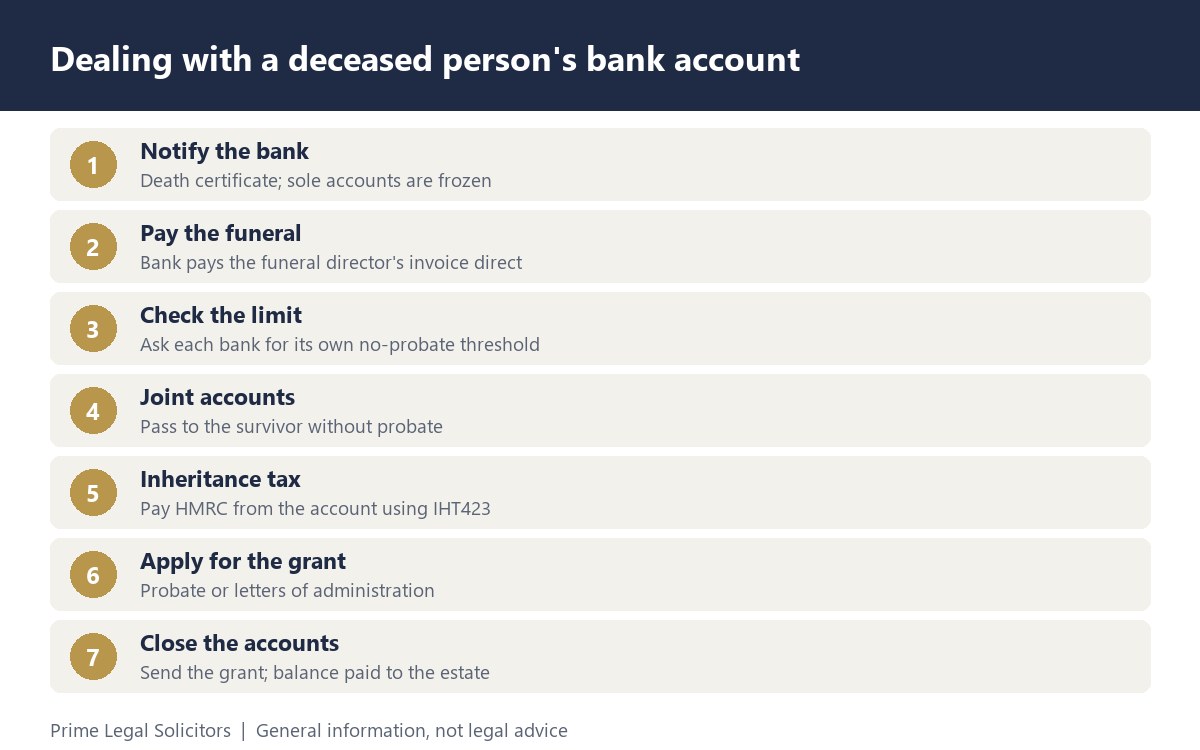
Usually not in full, and never by using the person’s card or PIN. Once the bank is told of a death, sole accounts are frozen. Before a grant of probate, most banks will still pay the funeral bill direct, release small balances under their own policies, and pay inheritance tax to HMRC from the account. Joint accounts normally pass straight to the survivor. Larger sums wait for the grant.
Key takeaways
- Sole accounts are frozen once the bank is notified. Payments out stop, but money can still be paid in.
- Most banks will pay a funeral director’s invoice directly from the deceased’s account before probate.
- Each bank sets its own limit for releasing money without a grant. Our probate solicitors can ask each bank for its figure.
- Money in a joint account usually passes to the survivor without probate.
- Inheritance tax can be paid from the deceased’s accounts before the grant, using form IHT423.
- Using the deceased’s card, PIN or online banking after death is unauthorised. If there is no will, the intestacy rules decide who can apply.
The short answer: limited access, through the bank
A bank account in the sole name of someone who has died becomes part of their estate. The bank must pay the money only to the person with legal authority to receive it. Above a certain level, the only proof it will accept is a grant of representation: a grant of probate if there is a will, or letters of administration if there is not.
Some things can still happen before the grant. Banks follow industry bereavement principles agreed through UK Finance, and most will release money for a short list of purposes if you deal with them directly. They will not let you take over the account. Our wills and probate guide explains where this fits in the wider estate.
What happens when the bank is told
When the bank learns of the death, it freezes accounts in the deceased’s sole name. Card payments are declined. Direct debits and standing orders stop. Money can still come in, so a final salary or pension payment will usually still land. Most banks ask for a copy of the death certificate, or an interim certificate from the coroner, plus proof of your identity. You do not need probate to report the death.
Telling several banks at once
The Death Notification Service is a free service that lets you notify a number of member banks, building societies and other firms in a single submission. Where the deceased held an account, each member should contact you, normally within 10 working days. Not every bank is a member, so contact any others yourself.
Tell Us Once does not cover banks
The government’s Tell Us Once service reports a death to most government bodies in one go, including HMRC, the Department for Work and Pensions, the Passport Office, the DVLA and the local council. It does not notify banks. A probate solicitor can handle the private notifications for you.
What the bank can release before the grant
Practice varies between banks, so treat this table as a guide to the questions to ask, not a promise.
| Payment or account | Usually possible before the grant? | What the bank normally asks for | Points to watch |
|---|---|---|---|
| Funeral director’s invoice | Yes, paid direct to the funeral director | Death certificate and the invoice | Paid to the funeral director, not to you |
| Small sole-name balances | Often, under the bank’s own limit | Death certificate, ID and a signed form or indemnity | Limits differ between banks and change |
| Inheritance tax | Yes, under the Direct Payment Scheme | Form IHT423 for each account | Paid to HMRC. Not every provider takes part |
| Joint account | Yes, it passes to the survivor | Death certificate | The deceased’s share still counts for inheritance tax |
| Probate application fee | Sometimes, at the bank’s discretion | A written request | Not guaranteed. Ask first |
| Larger sole-name balances | No | The grant | Expect to wait for the grant |
Paying for the funeral
Funeral costs come out of the estate before anything goes to the beneficiaries. Most banks will pay the funeral director directly from the deceased’s sole account on sight of the death certificate and the invoice, with no grant. If you have already paid the funeral yourself, keep the receipt. You can claim it back from the estate later.
How much can banks release without probate?
There is no single legal limit for an ordinary bank account. Each bank or building society sets its own threshold, and the figure differs widely. Some publish it. Others decide case by case, and some apply a lower limit where there is no will. Ask each bank in writing for its current limit and forms.
The limit usually applies to the total held with that bank, not each account. Other assets matter too. If the deceased owned a house in their sole name, a grant will almost always be needed anyway. Our guide explains when probate is needed. A bank that releases money without a grant usually asks you to sign an indemnity, making you liable if the money should have gone to someone else.
The Administration of Estates (Small Payments) Act 1965
This Act sets a statutory limit of £5,000 for paying out money on a death without a grant. It applies only to sums held under particular statutes and schemes listed in it, such as some society holdings and certain pension and annuity arrangements. It does not set the limit for a high street current or savings account. Those limits are the bank’s own policy.
Joint accounts pass by survivorship
When one holder of a joint account dies, the money normally passes automatically to the survivor. It is not governed by the will and does not need probate. The survivor usually just gives the bank a death certificate.
There are exceptions. If the deceased paid in all the money and another name was added only for convenience, for example to help an elderly parent pay bills, the money may belong to the estate. That can lead to disputes, which our guide to contesting a will touches on. Unmarried partners with no joint account and no will have no automatic right to a sole account. See the common-law marriage myth.
Paying inheritance tax before the grant
Where inheritance tax is due, you usually have to pay at least part of it before you can get a grant. Tax is due by the end of the sixth month after the death, and HMRC charges interest after that. Yet the money is often in a frozen account.
Under the Direct Payment Scheme, banks, building societies and investment providers, including National Savings and Investments, can pay some or all of the tax straight to HMRC from the deceased’s accounts. You can start before probate:
- Ask each provider to recognise you as the personal representative.
- Get an inheritance tax payment reference number.
- Send form IHT423 to the provider, one for each account.
- Send form IHT400 and its schedules to HMRC.
In England and Wales, once payment is made, HMRC sends a code that lets you apply for probate. Larger estates often need inheritance tax planning advice at this stage.
Who has authority: executor or administrator?
If there is a valid will, the executors named in it have authority from the date of death. Their authority comes from the will, and the grant of probate confirms it. Banks still will not release more than their limit until they see the grant, because it is the proof that the will is valid and the executor may act.
If there is no will, nobody has authority until the court appoints an administrator by issuing letters of administration. The order of who may apply is set by the Non-Contentious Probate Rules 1987, starting with the spouse or civil partner, then the children. Our intestacy rules guide sets out who inherits.
After the grant, the personal representative sends the bank a copy. The bank closes the accounts and pays the balance to them, or into an executorship account. Our probate team can apply for the grant and collect the money.
Do not use the deceased’s card, PIN or online banking
Knowing the PIN gives you no right to use it
A person’s authority over their account ends when they die. Withdrawing cash or paying bills with their card, PIN or online login is unauthorised, even for an executor, a close relative or someone named in a lasting power of attorney, which also ends on death. It can breach the bank’s terms, cause disputes and, in some cases, amount to a criminal offence. If it has already happened, keep a record of every payment and tell the executor or a solicitor.
Debts, direct debits, overpayments and business accounts
Debts and overdrafts. Debts are paid from the estate, not by the family personally, unless you were a joint borrower or guarantor. If the deceased owed money to the same bank, it may be able to set the debt off against the credit balance. Joint holders are usually each liable for a joint overdraft.
Direct debits and standing orders. These stop when the account is frozen. Tell energy, council tax and insurance providers so services can be cancelled or transferred. Payments taken after the death may be refundable to the estate.
Pensions and benefits. Payments made after the date of death are usually overpayments, and the DWP or the pension scheme can recover them from the estate. Settle those figures before distributing anything.
Business accounts. A sole trader’s business account is frozen like any personal account. A partnership account depends on the partnership agreement and bank mandate. A limited company’s account belongs to the company, not the estate. If the deceased was the only director, nobody may be able to operate it until a new director is appointed, so get early advice if wages or suppliers need paying.
How long does a grant take, and what does it cost?
HMCTS says you will usually get probate within 12 weeks of applying, but longer if more information is needed. Valuing the estate and dealing with HMRC beforehand can take several months. Check current HMCTS processing times on GOV.UK when you apply.
The probate application fee is £526 for an estate valued over £5,000, with no fee at £5,000 or less. Extra copies of the grant cost £2 each if ordered with the application, or £16 each later. Order one for each bank. Court fees change, so check GOV.UK before applying. For our own charges, see our pricing page.
What to do next
- Register the death and use Tell Us Once.
- Find every account and notify the banks, using the Death Notification Service where you can.
- Send the funeral invoice to the bank for direct payment.
- Ask each bank for the balance and its no-probate limit.
- Deal with inheritance tax through the Direct Payment Scheme if needed.
- Apply for the grant, then send a copy to each bank.
Our wills and probate team works across London, Manchester, Yorkshire and Lancashire, including families in Rochdale and Oldham, Bolton and Bury and Huddersfield and Kirklees. To talk it through, contact our team or call 0330 341 4757.
Frequently asked questions
Can I access a deceased person’s bank account before probate?
Only in limited ways, through the bank. Most banks will pay the funeral bill direct, release small balances under their own limits, and pay inheritance tax to HMRC. Larger sole-name balances are released only on a grant. Our probate solicitors can deal with the banks for you.
How much can banks release without probate?
It depends on the bank. There is no single legal limit for ordinary accounts, and each bank sets and changes its own threshold. The £5,000 limit in the Administration of Estates (Small Payments) Act 1965 applies only to certain statutory schemes.
Is a bank account frozen when someone dies?
Yes, once the bank is told. Sole accounts are frozen and payments out stop, although money can still be paid in. A joint account usually continues in the survivor’s name.
Can the bank pay for the funeral?
Usually, yes. Most banks pay the funeral director’s invoice directly from the deceased’s account on seeing the death certificate and invoice, before any grant.
What happens to a joint account when one person dies?
The money normally passes automatically to the survivor, without probate, and is not covered by the will. The deceased’s share still counts for inheritance tax. Our probate guide explains more.
Can I use my late parent’s bank card if I know the PIN?
No. Authority to use the account ends on death, so using the card, PIN or online banking afterwards is unauthorised, even for an executor.
What if there is no will?
Nobody has authority over the account until letters of administration are granted to the closest relative entitled under the Non-Contentious Probate Rules 1987. Banks will usually still pay the funeral bill before then.
Do I have to pay the deceased’s overdraft?
Not personally, unless you were a joint account holder, joint borrower or guarantor. Debts are paid from the estate first. If it cannot pay them all, take advice before paying anyone.
Please note: This article is general information about the law in England and Wales as at November 2026. It is not legal advice and does not create a solicitor-client relationship. Speak to a solicitor before making a decision. Prime Legal Solicitors is authorised and regulated by the Solicitors Regulation Authority, SRA No. 834471.
Author

Suits You Media Dev