

Twelve penalty points normally means a disqualification of at least six months. A court can shorten it, or impose none, but only on proof of exceptional hardship, and the bar is higher than most people expect.
Key takeaways
- Twelve or more penalty points for offences committed within three years of each other triggers a mandatory disqualification under section 35 of the Road Traffic Offenders Act 1988.
- The minimum is six months, one year if one disqualification of 56 days or more was imposed in the previous three years, and two years if two or more were.
- The three-year window runs between offence dates, not conviction dates, and the points the court is about to impose count towards the twelve.
- “I will lose my job” alone is usually not enough. What moves a court is serious, evidenced harm to other people, proved by documents and witnesses who attend.
- Section 35(4)(c) stops you relying on the same circumstances twice within three years.
- No solicitor can promise an exceptional hardship application works. It is a discretionary judicial decision; preparation is the only part you control.
The short answer: what twelve points costs you
Twelve or more penalty points for offences committed within three years of each other means the magistrates must disqualify you, and the minimum period is six months. The only route to keeping your licence is to prove exceptional hardship under section 35 of the Road Traffic Offenders Act 1988. The burden is on you, the evidence normally has to be given on oath, and most arguments fail because nobody brings any.
If you already have a hearing date, do these three things before you read the rest:
- Download your driving record from the DVLA view driving licence service and write down the offence date next to every endorsement, not the conviction date.
- Add the points you are about to receive to the total. Nine points plus a three-point speeding matter is a totting case on the day you walk in.
- Start asking people for letters now. Employer letters, GP letters, care plans and payroll records take two to four weeks to arrive. That is the single most common reason an argument collapses.
The power sits in section 35 of the Road Traffic Offenders Act 1988. Section 35(1) says the court “must order him to be disqualified for not less than the minimum period” unless it is satisfied there are grounds for mitigating the normal consequences. It is not a discretion the bench exercises loosely, and no solicitor can tell you in advance how a particular bench will decide. If what brought you here is the Single Justice Procedure notice that got you here, the box asking whether you want to attend court is the most important thing on the form. Tick it. A totting disqualification should never be decided on the papers in your absence.
How points count, and when they stop counting
Two separate clocks run on your licence and confusing them is why people misjudge their own risk.
- The totting clock asks whether the offences were committed within three years of each other. It runs between offence dates, so a conviction entered late after a long adjournment does not shift it.
- The retention clock is how long the endorsement stays visible on your record: four years for most offences, eleven for drink-driving.
| Offence code | What it is | Points | How long it stays on your licence |
|---|---|---|---|
| SP30 | Exceeding the statutory speed limit on a public road | 3–6 | 4 years from the date of the offence |
| SP50 | Exceeding the speed limit on a motorway | 3–6 | 4 years from the date of the offence |
| CU80 | Breach of requirements as to control of the vehicle — the hand-held mobile phone code | 3–6 | 4 years from the date of the offence |
| TS10 | Failing to comply with traffic light signals | 3 | 4 years from the date of the offence |
| CD10 | Driving without due care and attention | 3–9 | 4 years from the date of the offence |
| IN10 | Using a vehicle uninsured against third party risks | 6–8 | 4 years from the date of the offence |
| MS90 | Failure to give information as to the identity of the driver | 6 | 4 years from the date of the offence |
| DD40 | Dangerous driving | 3–11 | 4 years from the date of the conviction |
| DR10 | Driving or attempting to drive with alcohol above the limit | 3–11 | 11 years from the date of the conviction |
Codes, points and retention periods come from the GOV.UK guide to endorsement codes and penalty points, checked on 14 October 2026. Do the arithmetic from your own DVLA record, because where a range applies the points actually imposed depend on what the court decided that day.
Four years on the record is not four years of counting
An SP30 sits on your record for four years from the offence date but only counts towards totting for three. So an endorsement still printed on your licence may be outside the window, and an offence you had half forgotten may be inside it. Work it out on paper, with the offence dates in a column, before you decide what to plead. Some people who assume they are a totting case are not.
If you passed your test in the last two years
New drivers are in a harsher position. Under the Road Traffic (New Drivers) Act 1995 a licence is revoked rather than the driver disqualified once points reach the relevant threshold during the probationary period, and you go back to a provisional licence and retake the test. Exceptional hardship is no answer to revocation, because revocation is an administrative DVLA consequence rather than a court sentence. Check the GOV.UK new drivers guidance for the threshold before you plan around totting at all.
One point of clarification, because it gets asked in every totting appointment: the drink-drive limit in England and Wales is unchanged at 80mg of alcohol per 100ml of blood, and a drink-drive conviction carries its own obligatory disqualification separate from totting. The detail sits with a careless or dangerous driving charge and the sentencing comparison there.
The minimum ban, and when it is longer
Section 35(2) sets a floor, not a fixed figure, and the floor depends on what is already behind you. A previous disqualification only counts if it was for a fixed period of 56 days or more and was imposed within the three years before the date of the current offence. Short bans of a few weeks, and disqualifications until an extended test is passed, are left out of the calculation.
| Your prior disqualifications | Minimum ban | Statutory basis |
|---|---|---|
| None to be taken into account | 6 months | s.35(2)(a) Road Traffic Offenders Act 1988 |
| One qualifying disqualification of 56 days or more, imposed in the 3 years before the current offence | 1 year | s.35(2)(b), read with s.35(3) |
| Two or more such qualifying disqualifications in that 3-year period | 2 years | s.35(2)(c), read with s.35(3) |
| Any of the above, where the offending itself is serious | The court may go longer than the minimum | The minimum is a floor, not a tariff |
| Several convictions dealt with on the same occasion | One disqualification only, but its length reflects all the offences | s.35(3) |
Those minimum periods are confirmed in the Sentencing Council’s totting up disqualification explanatory material, checked on 14 October 2026. There are two different routes to a shorter ban or none, and they get conflated constantly.
Exceptional hardship mitigates the consequences
This accepts the conviction and the points and asks the court to reduce or remove the disqualification because of the consequences it would cause. If the bench accepts it, the points stay on your licence. You keep driving while carrying twelve or more points, which leaves you badly exposed to any further offence in the next three years.
Special reasons attack the endorsement itself
Special reasons is a different application. It points to something about the offence—a genuine emergency, a drink spiked without your knowledge, a shockingly short distance driven—and asks the court not to endorse at all. Special reasons must relate to the offence rather than the offender, and the category is narrow. Where one is available, run it first: succeeding means the points are never imposed and totting never arises. Most totting cases have no special reasons point, which is why having motoring offence solicitors read the file before you concede anything matters more than the advocacy on the day.
What exceptional hardship actually means
The Sentencing Council guidance is blunt about the threshold. The court must be satisfied that what you are describing is “not merely inconvenience, or hardship, but exceptional hardship for which the court must have evidence”. It also records the position the bench starts from: “almost every disqualification entails hardship for the person disqualified and their immediate family.” Hardship is assumed. You are being asked to show something beyond what every disqualified driver endures.
“It is for the offender to prove to the civil standard of proof that such grounds exist,” the guidance continues—more likely than not. Other than very exceptionally that means evidence from the witness box, on oath, tested in cross-examination by the prosecutor. A letter handed up at the door of the court is not evidence in the same sense, and the bench is entitled to give it limited weight precisely because nobody can question it.
Section 35(4) then closes off three categories completely. The court cannot take into account:
- any circumstances alleged to make the offence, or any of the offences, not serious;
- hardship, other than exceptional hardship; and
- any circumstances which, within the three years immediately preceding the conviction, have already been taken into account to reduce or avoid a totting up disqualification.
Limb (a) catches more people than they expect. “It was a quiet dual carriageway at three in the morning” is not an exceptional hardship argument at all: it says the offence was not serious, and the statute puts that out of bounds. Limb (c) is dealt with separately below.
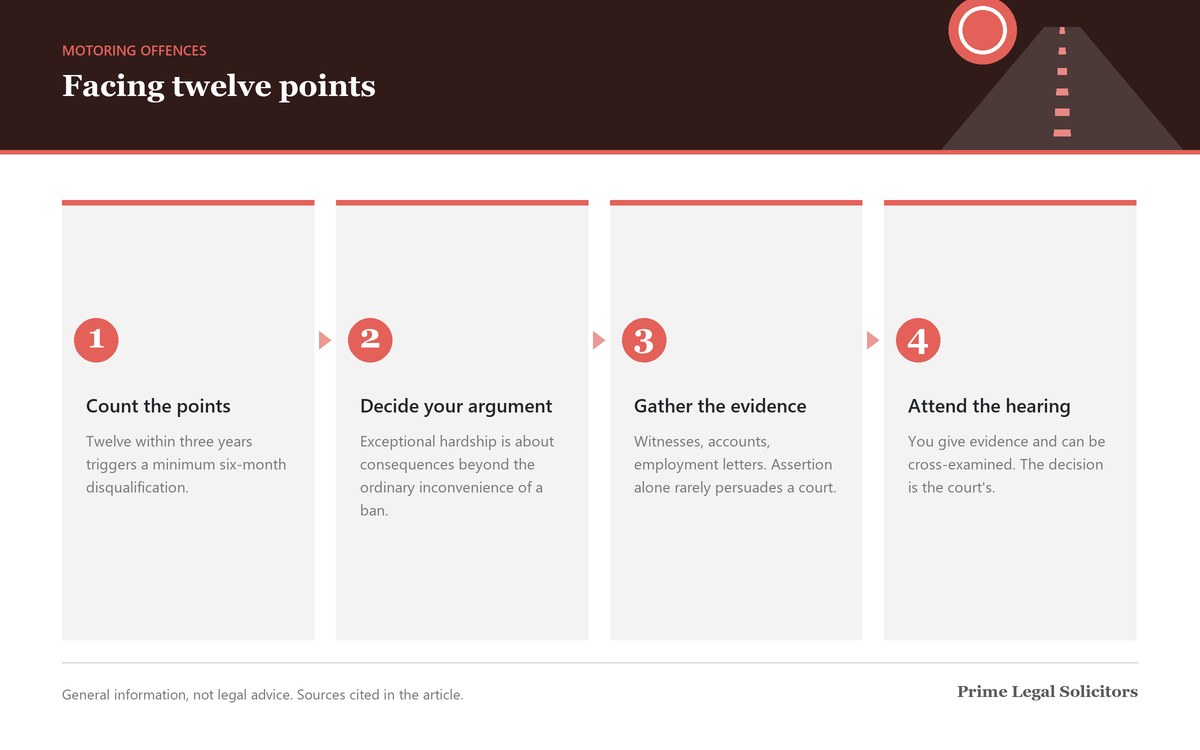
Do you have an exceptional hardship argument?
Nobody can tell you how your bench will decide. The honest pattern is this: arguments built on hardship to you rarely get traction, and arguments built on serious, evidenced harm to other people are where cases are won. Find your own facts in the left column.
| What you want to say | Who bears the hardship | How it usually lands | What would have to be in the bundle |
|---|---|---|---|
| “I will lose my job” | You | Usually not enough on its own. The court hears it in most totting cases and job loss is ordinary hardship | Nothing fixes this by itself. It only becomes an argument when the consequence reaches other people |
| “My commute becomes three hours each way” | You | Inconvenience, and s.35(4)(b) excludes it | Not arguable as hardship, however real |
| “My business cannot trade and my staff lose their jobs” | Employees | Capable of being exceptional, if specific and evidenced | Named employees, payroll records, accounts, contracts that depend on you driving, and ideally an employee in the witness box |
| “My mother has dementia and I do every hospital run” | A dependent adult | Among the strongest categories, if nobody else can do it | GP or consultant letter about her, care plan or social services assessment, appointment letters, evidence on who else lives in the house |
| “My disabled child cannot get to school any other way” | A child | Capable of being exceptional | School letter, EHC plan or equivalent, the actual timetable, and transport evidence for the actual route |
| “We lose the house because the income stops” | Dependants in the household | Arguable where the chain is proved end to end | Contract or employer letter, payslips, mortgage or tenancy statements, and a household budget |
| “There is no bus” | Depends who needs the journey | Supports another ground; it is not a ground by itself | Dated journey planner printouts or timetables showing the first service arrives after the shift starts, or that no service exists |
| “I am a carer and there is nobody else” | The person cared for | Strong where documented, weak where described | Carer’s allowance award, GP or social worker letter, and an honest account of every other adult who could help |
Even strong categories fail when they are thin. Benches are used to hearing that a relative cannot manage, then learning in cross-examination that two other adults live at the address. The guidance tells courts to be “cautious before accepting assertions of exceptional hardship without evidence that alternatives are not viable”, so taxis, a colleague, a partner who drives, a bus route or a hired driver must be addressed before the prosecutor raises them.
The evidence bundle, item by item
Exceptional hardship cases are won in the four weeks before the hearing, not in the courtroom. Build a paginated bundle and serve it on the prosecution in advance.
- Your own witness statement. Short, numbered paragraphs, signed and dated. You will still give evidence orally, but a statement forces you to fix your figures before the prosecutor tests them.
- An employer letter that says something. On letterhead, signed, dated, naming the signatory and their role, and stating precisely what would happen and why. “It would be difficult” is worthless. If driving is a contractual requirement, attach the clause.
- Payslips and bank statements—three to six months, showing what the income is and who it supports.
- Payroll records and filed accounts where you say employees would lose work. Three named people with payroll entries is an argument; “my staff” is not.
- Medical and care evidence about the dependant, not about you: GP letter, consultant letter, care plan, social services assessment, school or SEN documentation.
- Transport evidence, printed with the date visible, for the actual journey at the actual time.
- Witnesses who will attend. An employer, an employee or a relative in the box carries far more weight than their letter.
- A household budget if the argument runs through money. The bench will ask what a taxi account for six months would cost against what you earn.
Warn your witnesses that they will be questioned
People agree to write a letter and are then horrified to learn they may be cross-examined about it. Tell them at the outset, give them the hearing date early, and warn their employer. A witness who does not turn up leaves a hole exactly where your argument needed to be strongest, and courts rarely adjourn a totting application because a witness was not told.
A worked example, start to finish
Imagine a self-employed plumber, hypothetically, with a conviction listed at Rochdale Magistrates’ Court. His record shows SP30 (3 points, offence 4 March 2024), TS10 (3 points, offence 19 January 2025), and CU80 (3 points, offence 2 August 2025). He is now pleading guilty to a further SP30 committed on 11 September 2026, which carries 3 points.
The arithmetic:
- All four offence dates fall within three years of each other—4 March 2024 to 11 September 2026 is two years and six months.
- 3 + 3 + 3 = 9 points already live, plus the 3 the court is about to impose = 12.
- No previous disqualification of 56 days or more, so the s.35(2)(a) minimum is six months.
- Had the first SP30 been committed on 4 March 2023 instead, it would be outside the window, the total would be 9, and there would be no totting case at all. Three years changes everything, which is why the offence dates come before the advice.
His argument is not “I will lose my work”. It is that he employs two apprentices whose wages come out of jobs he drives to, and that his father-in-law, who lives with the family, has advanced Parkinson’s and is taken to a weekly hospital appointment eleven miles away on a route with no direct bus. The bundle he serves fourteen days before the hearing contains: his own signed statement; filed accounts and payroll records naming both apprentices; signed statements from both apprentices, who attend; a consultant’s letter about his father-in-law; the hospital appointment schedule; dated journey planner results for the hospital route at 8am; six months of bank statements; and a quote for a hired driver, with a budget showing what it would do to the business over six months.
Whether a bench accepts that is a judicial decision on the day and nobody can promise the outcome. What the bundle does is give the court something it can properly act on, and that is the whole of what preparation controls.
What goes wrong, and why
The failures seen most often in totting lists, in rough order of cost.
- Assertion with no paperwork. “My employer says I would be dismissed”, no letter, no employer present. The prosecutor only has to ask how the court is supposed to test that.
- Job loss alone. It is the most common argument and the weakest. Without a consequence that reaches someone else, it is the ordinary hardship the statute expects you to bear.
- Not warning third parties. A relative or employee whose evidence is central, told four days before, who cannot get the day off.
- Arguing the offence was trivial. Excluded outright by s.35(4)(a), and it tells the bench you have not read the test.
- Leaving alternatives unaddressed. If the court can see an obvious substitute you have not dealt with, the hardship stops being exceptional.
- Re-using the same grounds inside three years. The prosecution will have the court record even when you have forgotten the detail.
- Pleading guilty by post. Returning an SJP form without asking to attend can mean a disqualification imposed without you ever being heard.
- Treating the application as a formality. A contested application with two witnesses is not a ten-minute slot, and a case that cannot be heard that day may be adjourned for months.
- Driving home. If the application fails the disqualification bites immediately, in the courtroom.
What happens at the hearing
Your case will be listed at the magistrates’ court covering the area where the offence happened; Rochdale, Manchester and Salford, and Bradford and Keighley Magistrates’ Courts all deal with totting lists regularly. You will be before magistrates with a legal adviser, or a district judge sitting alone.
- The current offence is dealt with first: plea, conviction, and the points imposed.
- The legal adviser identifies that you have reached twelve points and that s.35 is engaged.
- You go into the witness box, take the oath and give your evidence.
- The prosecutor cross-examines you.
- Your witnesses give evidence and are cross-examined in turn.
- Your advocate makes submissions on why the hardship is exceptional, and why the alternatives are not viable.
- The bench retires and then gives its decision with reasons.
If the argument does not succeed
The disqualification starts immediately and you will be asked to surrender your licence in the courtroom. You cannot drive home: bring someone who can, or plan for a taxi or the train. A disqualification of 56 days or more also becomes a qualifying prior disqualification for three years, so it changes the minimum if you are ever back in the same position.
You can appeal a magistrates’ court decision to the Crown Court—Manchester and Bradford Crown Courts among them. Under rule 34.2 of the Criminal Procedure Rules 2025 an appeal notice against sentence must be served not more than 15 business days after sentence. Lodging an appeal does not suspend the disqualification automatically, though you can apply for it to be suspended pending the hearing. Do not assume you can keep driving while you wait.
If you have argued exceptional hardship before
Section 35(4)(c) is the provision that ends most second applications. Circumstances already taken into account within the three years immediately preceding this conviction, to reduce or avoid a totting up disqualification, cannot be relied on again. The argument that kept your licence last time is unavailable this time.
What may still be open is a genuinely different set of circumstances rather than the same situation continuing: a relative who has become ill since, a business that did not exist before. The distinction is between new facts and an old argument in new clothes, and the prosecution will have the previous record. A second application inside three years is substantially harder, and the honest advice is often to look first at whether there is a defence, a special reasons point, or an argument for a shorter disqualification.
What to do this week
- Find the deadline and write it on the envelope. An SJP notice gives 21 days from the date on the notice; a summons gives a hearing date.
- Download the DVLA record and list every offence date and points figure, including the matter you are now facing.
- Do the three-year arithmetic and confirm you actually reach twelve. Some people do not.
- Check for a defence or special reasons before you concede anything. Once you plead guilty, the points follow.
- Ask for the letters today. Employers, GPs and schools work in weeks, not days.
- Identify your witnesses and tell them the date and that they may be questioned.
- Get advice early. Our motoring team covers courts across Greater Manchester and West Yorkshire, and you can read our published motoring defence fees before you instruct anyone, or contact the team if the hearing is close.
- Arrange a lift home for the hearing date.
One practical consequence worth planning for in parallel: if a disqualification does follow and your contract requires a licence, dismissal is a real possibility, and losing your licence can also cost you your job. Employers still have to follow a fair process, and the time limits for challenging a dismissal are short.
What we cannot tell you
No solicitor can tell you that an exceptional hardship argument is bound to work, and you should be wary of one who does. The decision belongs to the court, on the evidence, and benches differ. What preparation changes is whether the bench has material it can properly act on or a bare assertion it is likely to reject. Being told candidly that an argument is weak is more useful than being told what you want to hear.
Frequently asked questions
What is exceptional hardship?
It is hardship going beyond the ordinary consequences of losing a licence. Sentencing Council guidance requires the court to be satisfied it is “not merely inconvenience, or hardship, but exceptional hardship for which the court must have evidence”, and records that almost every disqualification causes hardship. In practice courts look for serious, evidenced harm to other people, such as employees or a dependant who relies on you for care.
How many points before a driving ban?
Twelve or more penalty points for offences committed within three years of each other triggers a totting up disqualification under section 35 of the Road Traffic Offenders Act 1988. The points the court is about to impose count towards that total, so nine live points plus a three-point speeding matter makes you a totting case on the day. Drivers in their first two years face licence revocation instead.
How long do penalty points stay on your licence?
GOV.UK says most endorsements stay on the driving record for four years from the date of the offence, including speeding, careless driving, insurance and mobile phone codes. Dangerous driving stays four years from the date of conviction, and drink-driving codes stay eleven years from conviction. Counting towards totting is a separate three-year window measured between offence dates, so the two periods differ.
Is losing your job exceptional hardship?
On its own, usually not. Courts hear it in most totting cases, and section 35(4)(b) excludes hardship that is not exceptional. What gives the argument weight is the consequence reaching other people: employees who lose their own jobs, dependants who lose a home, someone who loses the only person who can take them to hospital. Evidence for that chain is what the court needs.
Can you use exceptional hardship twice?
Not on the same grounds within three years. Section 35(4)(c) stops the court taking into account circumstances already used in the three years immediately before the conviction to reduce or avoid a totting up disqualification. A genuinely different set of circumstances may still be arguable, such as a relative who has since become seriously ill, but a second application inside three years is substantially harder.
What evidence do I need for exceptional hardship?
Documents about other people, and witnesses who attend. Typically: a signed employer letter on letterhead stating exactly what would happen, payroll records and accounts if staff are affected, GP or consultant letters and care plans about the dependant, dated public transport printouts for the actual journey, payslips and bank statements, and your own witness statement. You will normally give evidence on oath and be cross-examined.
How long is a totting up ban?
The minimum is six months where no previous disqualification counts, one year where you have had one disqualification of 56 days or more imposed in the three years before the current offence, and two years where you have had two or more. Those are minimums under section 35(2), and the court can impose longer where the offending justifies it.
Do I need a solicitor for a totting up hearing?
You can present an exceptional hardship application yourself, and for a straightforward matter with no disqualification risk a solicitor may be unnecessary. Where twelve points are in prospect the application involves sworn evidence, cross-examination and a served bundle, and the consequences of getting it wrong last at least six months. Representation is worth considering, and our fees are published before you instruct.
Does the court have to disqualify at twelve points?
Section 35(1) says the court must disqualify for at least the minimum period unless it is satisfied there are grounds for mitigating the normal consequences of the conviction. Exceptional hardship is the usual ground. If the court accepts it the bench can shorten the disqualification or impose none, but the points remain on your licence and any further offence leaves you badly exposed.
Author

Suits You Media Dev