
Family law
How Much Does a Child Custody Case Cost in the UK? Fees at Every Stage
A child custody case can cost a few hundred pounds through mediation or over £10,000 if it goes to a final hearing. Court fees, mediation, our staged solicitor fees and legal aid, with worked examples.

A child custody case in England and Wales can cost almost nothing if parents agree through mediation, or well over £10,000 each if it goes all the way to a contested final hearing. The court fee to apply is £270. Most of the cost is legal fees, and those depend mainly on how many hearings your case needs. This guide sets out the real costs at each stage, using our own published fees, and explains how to keep the bill down.
Key takeaways
- “Custody” is not the legal term any more. The court makes a child arrangements order, which says who a child lives with and spends time with. The costs are the same thing people mean by a custody battle.
- The court application fee is £270 from 13 July 2026 (previously £263). Help with Fees can reduce or remove it on a low income.
- Our fees start from £1,500 + VAT to negotiate without court. A case that runs to a final hearing starts from about £9,500 + VAT in total, before barrister and expert costs.
- The government’s mediation voucher scheme gives up to £500 towards mediation in disputes about children, and was extended for another year in May 2026.
- Legal aid for children cases is mostly limited to cases with evidence of domestic abuse or child abuse.
The short answer: it depends on how far your case goes
There is no single price for a custody case because most of the cost depends on how far the dispute goes. The family law process is designed to push parents towards agreement. Every extra hearing means more preparation, more statements and more time at court. A case that settles at the first hearing costs a fraction of one that goes to a final hearing with a Cafcass report, witnesses and a barrister.
It helps to think of the cost in four layers:
- Court fees: the £270 application fee, plus small fees for any later applications.
- Mediation: the MIAM, which is usually compulsory before applying, and any mediation sessions.
- Legal fees: your solicitor and, for contested hearings, often a barrister.
- Extras: expert reports, drug or alcohol testing, contact centre fees and travel.
Most parents only pay for the first two or three layers, because most disputes about children settle before a final hearing. Our wider guide to the cost of a family lawyer covers divorce and finances too.
What each stage costs
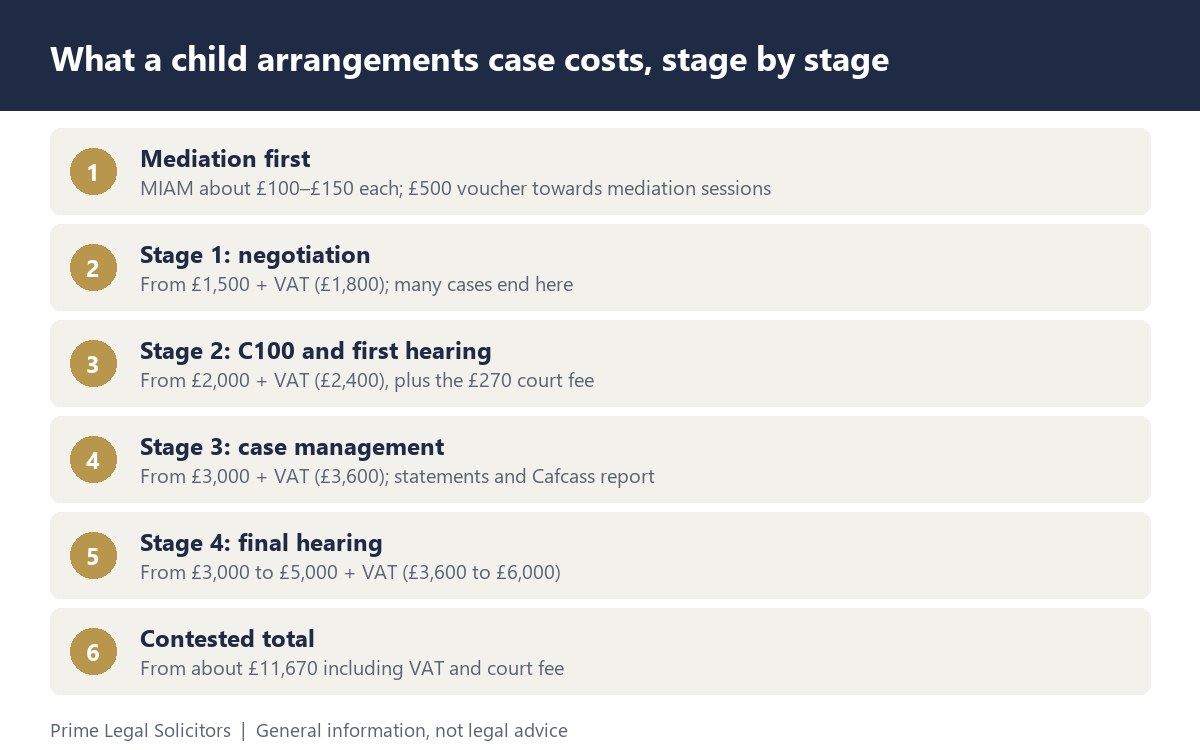
These are our published starting fees for child arrangements cases, as at November 2026. They are the same figures shown on our pricing page. We always give a full written estimate before starting, and payment plans are available.
| Stage | What happens | Our fee from | Including VAT |
|---|---|---|---|
| 1. Out-of-court negotiation | Advice, letters to the other parent, proposals, a consent order if agreed | £1,500 + VAT | £1,800 |
| 2. Application and first hearing | Form C100, safeguarding letter, preparing for and attending the FHDRA | £2,000 + VAT, plus £270 court fee | £2,670 |
| 3. Case management and interim hearings | Statements, Cafcass section 7 report, directions and dispute resolution hearings | £3,000 + VAT | £3,600 |
| 4. Final hearing | Trial bundle, witness evidence, cross-examination and judgment | £3,000 to £5,000 + VAT | £3,600 to £6,000 |
Each stage is only paid if your case reaches it. A parent who settles through negotiation pays stage 1 only. A parent whose case goes to a contested final hearing will usually pay all four, which starts from about £11,670 including VAT and the court fee. Complex cases cost more than these starting points, for example where there are allegations of abuse, several children, or a move abroad in dispute.
Court fees for child arrangements cases
Court fees are set by the government and are the same whichever solicitor you use. From 13 July 2026, the main fees in private children cases are:
| Application | Fee |
|---|---|
| Child arrangements, prohibited steps or specific issue order (form C100) | £270 |
| Parental responsibility order | £270 |
| Enforcement order where an order is broken (form C79) | £270 |
| Non-molestation or occupation order (form FL401) | No fee |
| Recording a parental responsibility agreement | No fee |
If you are on a low income or certain benefits, or have little savings, apply for Help with Fees at the same time as you apply. You may pay nothing or a reduced amount. Our guide to parental responsibility agreements explains the free route for fathers where both parents agree.
Mediation and MIAM costs
Before you can apply for a child arrangements order, you normally have to attend a mediation information and assessment meeting, or MIAM. The court can refuse to deal with an application where a parent has not attended without a valid exemption. Exemptions include domestic abuse, child protection concerns and genuine urgency.
Mediators set their own prices. A MIAM typically costs around £100 to £150 per person, and joint mediation sessions often cost a few hundred pounds per session, split between the parents. Ask the mediator for their fees in writing first. Three practical points matter here:
- The mediation voucher. The Family Mediation Voucher Scheme pays up to £500 towards mediation for disputes involving a child. It is not means-tested, is one per family, and does not cover the MIAM itself. The Ministry of Justice extended it for another year on 15 May 2026.
- Legal aid for mediation. If you qualify financially, legal aid covers your MIAM and mediation. Where one parent qualifies, the other parent’s MIAM and first mediation session are covered too.
- Mediation is not binding. If you reach agreement, a solicitor can turn it into a consent order so it can be enforced.
Our guide to mediation versus court explains when mediation is worth trying and when it is not safe.
Worked examples: three cases, three bills
Example 1: agreement through negotiation
Sam and Priya separate and disagree about weekday overnights. Sam instructs us to set out a proposal, after taking separation advice. After two rounds of letters and one mediation session, they agree a schedule, which we draft as a consent order.
- Our stage 1 fee: £1,500 + VAT = £1,800.
- Mediation session, after the £500 voucher: nil.
- MIAM: about £120.
- Sam’s total: about £1,920. If they apply to court to approve the consent order, add the £270 court fee.
Example 2: settled at the first hearing
Jo’s ex will not engage with mediation. Jo applies on form C100. Cafcass carries out safeguarding checks and, at the first hearing, the parents agree arrangements with the help of the Cafcass officer.
- Stage 1: £1,800 including VAT.
- Stage 2: £2,000 + VAT = £2,400, plus the £270 court fee.
- MIAM: about £120.
- Jo’s total: about £4,590.
Example 3: contested to a final hearing
Chris and Alex cannot agree whether their daughter should live mainly with one of them. The court orders a section 7 report, applying the welfare checklist, a dispute resolution hearing fails, and the case goes to a final hearing with a barrister.
- Stages 1 and 2: £4,200 including VAT, plus £270 court fee.
- Stage 3: £3,000 + VAT = £3,600.
- Stage 4: £3,000 to £5,000 + VAT = £3,600 to £6,000, which may include the barrister.
- MIAM: about £120.
- Chris’s total: about £11,790 to £14,190. Alex will have similar costs if they also use a solicitor.
The court rarely orders one parent to pay the other’s costs in children cases, so each parent normally pays their own whatever the outcome. That makes early settlement the single biggest saving. A first meeting with a family lawyer is the best time to plan it.
Extra costs that can come up
Some costs only arise in certain cases. Ask about them early, because they can be significant.
| Cost | When it arises | Who usually pays |
|---|---|---|
| Cafcass safeguarding checks and section 7 reports | In most court cases | Free. Cafcass is funded by the government |
| Barrister for a hearing | Contested hearings, especially final hearings | The parent who instructs them |
| Drug or alcohol testing | Where substance misuse is alleged | Often split between the parents, as the court directs |
| Expert reports, such as a psychologist | Complex cases, with the court’s permission | Usually split between the parents |
| Supervised contact centre | Where contact must be supervised | Varies by centre, and some are free for supported contact |
| Fact-finding hearing | Where serious allegations such as abuse are disputed | Each parent pays their own legal costs |
Where there are allegations of domestic abuse, the case may need a separate fact-finding hearing, which adds cost and time. Our guide to domestic abuse and family law explains how those hearings work, and when legal aid may be available.
Can you get legal aid for a custody case?
Since 2013, legal aid for private children cases has been limited. You may qualify if you are financially eligible and can provide evidence that you, or your child, have been a victim of domestic abuse or are at risk of it, or that the child is at risk of abuse from the other parent. Accepted evidence includes a protective injunction, a police caution or conviction, or a letter from a doctor or domestic abuse service.
Legal aid is also available for mediation for parents who qualify financially, without needing evidence of abuse. If you do not qualify, our children law team offers fixed staged fees so you know the cost before each step. If you need urgent protection, our injunction solicitors can act the same day.
Should you represent yourself?
You do not have to use a solicitor. Many parents in the family court act for themselves, and the court and Cafcass are used to helping litigants in person. It can work in a straightforward case where both parents are reasonable.
The risks are real, though. Applications filed incorrectly, statements that focus on the other parent rather than the child, and agreeing to terms you do not understand can all lead to more hearings, and so more cost, later. Some parents use a solicitor for specific tasks only, such as drafting the statement or attending the final hearing. That limits cost while getting help where it matters most. If you are weighing it up, our article on what family courts focus on explains what judges look for.
Seven ways to keep the cost down
- Try mediation first, where it is safe. Use the £500 voucher if it is still available.
- Keep the child at the centre. Courts and Cafcass respond to proposals about the child’s needs, not complaints about the other parent.
- Make a sensible proposal early. A clear, reasonable offer in writing often ends a dispute before court.
- Answer your solicitor quickly and fully. Chasing for documents is billed time.
- Do not fight over small things. Spending £2,000 on an argument over one extra evening a month is rarely worth it.
- Ask for staged estimates. Review the cost and the likely outcome at each stage before moving on.
- Keep a simple diary. A dated record of contact and problems saves time when statements are written.
If conflict with the other parent is driving the cost, our guidance on co-parenting with a high-conflict parent may help.
If your situation is different
If you are a grandparent
Most grandparents need the court’s permission before they can apply for a child arrangements order, which adds a step. The court fee is the same. Our guide to grandparents’ rights explains the process.
If an order is already in place but is being broken
You can apply to enforce it on form C79, for a £270 court fee. Enforcement cases are often shorter than the original case, but you will still usually need a hearing.
If you are also dealing with divorce and finances
Children arrangements are dealt with separately from the divorce and the money, and each has its own costs. The court fee for the divorce application itself is £628. Our guides to no-fault divorce and financial remedy proceedings set out those costs.
If you are unmarried
The costs and the process for children are the same whether or not you were married. Unmarried fathers without parental responsibility may want to apply for it at the same time. Our guide to cohabitation rights covers the other issues unmarried couples face.
How we can help
We act for mothers, fathers and grandparents in child arrangements cases across England and Wales, with teams in London, Manchester, Lancashire and Yorkshire. We offer a free initial consultation, staged fixed fees and payment plans. Call 0330 341 4757 or contact us online.
Frequently asked questions
How much does a child custody battle cost in the UK?
Anything from a few hundred pounds, if you agree through mediation, to £10,000 or more each for a case that goes to a contested final hearing. At Prime Legal, a full contested case starts from about £11,670 including VAT and the court fee.
How much is the court fee for a child arrangements order?
£270 from 13 July 2026, paid when you file form C100. Help with Fees can reduce it if you are on a low income or certain benefits.
Do I have to pay for Cafcass?
No. Cafcass safeguarding checks and section 7 welfare reports are free to parents. Our child arrangements guide explains what Cafcass does.
Will the other parent have to pay my legal costs?
Very rarely. In children cases the court usually makes no order for costs, so each parent pays their own. Costs orders are reserved for unreasonable conduct during the case.
Can I get legal aid for child custody?
Only in limited cases, mainly where there is evidence of domestic abuse or child abuse and you meet the financial test. Legal aid for mediation is wider and does not need evidence of abuse. Our Lancashire family team can check eligibility.
How long does a custody case take?
A case that settles at the first hearing may finish within three to four months of applying. A contested case with a section 7 report and a final hearing often takes nine to twelve months or longer, depending on the court.
Is a MIAM compulsory?
Usually, yes, before you apply for a child arrangements order, unless an exemption such as domestic abuse or urgency applies. The MIAM is not covered by the mediation voucher.
Is there a fixed fee for a child arrangements case?
We charge a staged fixed fee for each step, so you know the cost before you commit to the next one. See our Yorkshire family lawyers or any of our offices for a written estimate.
Please note: This article is general information about the law of England and Wales as at November 2026. It is not legal advice and does not create a solicitor-client relationship. Fees shown are our published starting points and may vary with the complexity of your case. Speak to a solicitor before making a decision. Prime Legal Solicitors is authorised and regulated by the Solicitors Regulation Authority, SRA No. 834471.
Services and fees
Talk to a family solicitor about child arrangements
A full cost estimate before any work starts. Payment plans are available.
- Child arrangements ordersFrom £1,500 + VAT
- Divorce and civil partnership dissolutionFrom £750 + VAT
- Family law
Fees are a guide and exclude disbursements. See all our fees
Keep reading
More family law guides

Moving Abroad With Your Child After Separation: Getting Permission to Relocate
Want to move abroad with your child after separating? You need the other parent's consent or the court's permission. How to apply, what the court weighs up, and what the staying parent can do.
 Hassan Ansari
Parental Responsibility Agreement: How to Make One, Step by Step
A parental responsibility agreement gives a father or step-parent parental responsibility without going to court. Which form to use, how to sign it, and what to do if the mother refuses.
Hassan Ansari
Can a Non-Molestation Order Be Extended? How Long Orders Last and How to Apply
A non-molestation order can be extended if you apply on form FL403 before it expires. This guide covers how long orders last, breach, emergency applications and legal aid.
Hassan Ansari
Speak to a solicitor
Talk to our family law team
Your first consultation is free. Meet us in person, or talk by phone or video call.
Book a free consultation- Phone0330 341 4757
- WhatsApp07918 328638 (opens WhatsApp)
- Emailinfo@
primelegalsolicitors .co.uk - Opening hoursMonday to Friday, 9am to 5.30pm
Our offices
Prime Legal Group Ltd is authorised and regulated by the Solicitors Regulation Authority, SRA number 834471 (opens in a new tab)