

If you want to move abroad permanently with your child after separating, you need the written consent of everyone with parental responsibility, or the permission of the family court. Taking a child under 16 out of the UK without either can be the criminal offence of child abduction, even if you are the parent the child lives with. This guide explains when you need permission, how to apply, what the court weighs up, and what the parent who is staying behind can do.
Key takeaways
- A permanent move abroad needs the written consent of every person with parental responsibility or a court order. This is often called “leave to remove”.
- Without consent, removing a child under 16 from the UK can be an offence under section 1 of the Child Abduction Act 1984, with a maximum sentence of seven years.
- A parent named in a child arrangements order as the person the child lives with can take the child abroad for up to one month without consent, unless a court order says otherwise.
- The court decides by looking at the child’s welfare as a whole, comparing the realistic options side by side. There is no presumption for or against the move.
- The application is made on form C100, usually after a mediation meeting. The court fee is £270 from 13 July 2026. Contested cases often take six to twelve months.
Do you need permission to move abroad with your child?
Yes, in almost every case. The law protects the relationship between a child and both parents, so neither parent can decide on their own to move a child to another country. That is true whether you were married or living together unmarried, and whether or not there is already a court order. The rules come from two sources.
The first is the criminal law. Section 1 of the Child Abduction Act 1984 makes it an offence for a person connected with a child under 16 to take or send the child out of the United Kingdom without the appropriate consent. A “connected” person includes a parent, a father with parental responsibility and anyone named in a child arrangements order. Appropriate consent means the consent of the mother, any father with parental responsibility, any guardian or special guardian and anyone the child lives with under a court order, or the court’s permission. The maximum penalty is seven years’ imprisonment. Our guidance for fathers explains how this affects separated dads.
The second is the Children Act 1989. Where a child arrangements order says who the child lives with, section 13 says nobody may remove the child from the UK without the written consent of every person with parental responsibility or the court’s permission. A temporary trip is different, as the next section explains.
Do not move first and ask later. If you take a child abroad without consent, the other parent can ask the courts of the new country to order the child’s return under the 1980 Hague Convention. Courts in Hague countries usually order a quick return to the UK, and the way you left will count against you when the relocation question is finally decided. If there is any doubt, get advice before you book flights. Our family law team deals with urgent international cases.
Holidays and short trips: the one-month rule
The rules are lighter for holidays, but they still apply, including where the other parent already lives in another country. Our international family law overview covers those wider cross-border issues. The table shows when you need consent to take your child out of the UK.
| Your situation | Holiday or trip under one month | Trip of one month or more, or a permanent move |
|---|---|---|
| No court order, other parent has parental responsibility | Consent needed from every person with parental responsibility | Consent or court permission needed |
| A child arrangements order says the child lives with you | No consent needed, unless another order forbids it | Written consent of everyone with parental responsibility, or court permission |
| A child arrangements order says the child spends time with you | Consent needed from the parent the child lives with and anyone else with parental responsibility | Consent or court permission needed |
| You are the child’s special guardian | No consent needed for trips of up to three months | Written consent of everyone with parental responsibility, or court permission |
| A prohibited steps order forbids removal | Court permission needed | Court permission needed |
Even where consent is not legally needed, carry a signed letter from the other parent with their contact details, the travel dates and a copy of the birth certificate. Border officers and airlines may ask for it, especially if your surname differs from your child’s. If the other parent keeps refusing a reasonable holiday, you can ask the court for a specific issue order. Our guide to mediation versus court explains how to try to resolve that first.
How to apply for permission to relocate
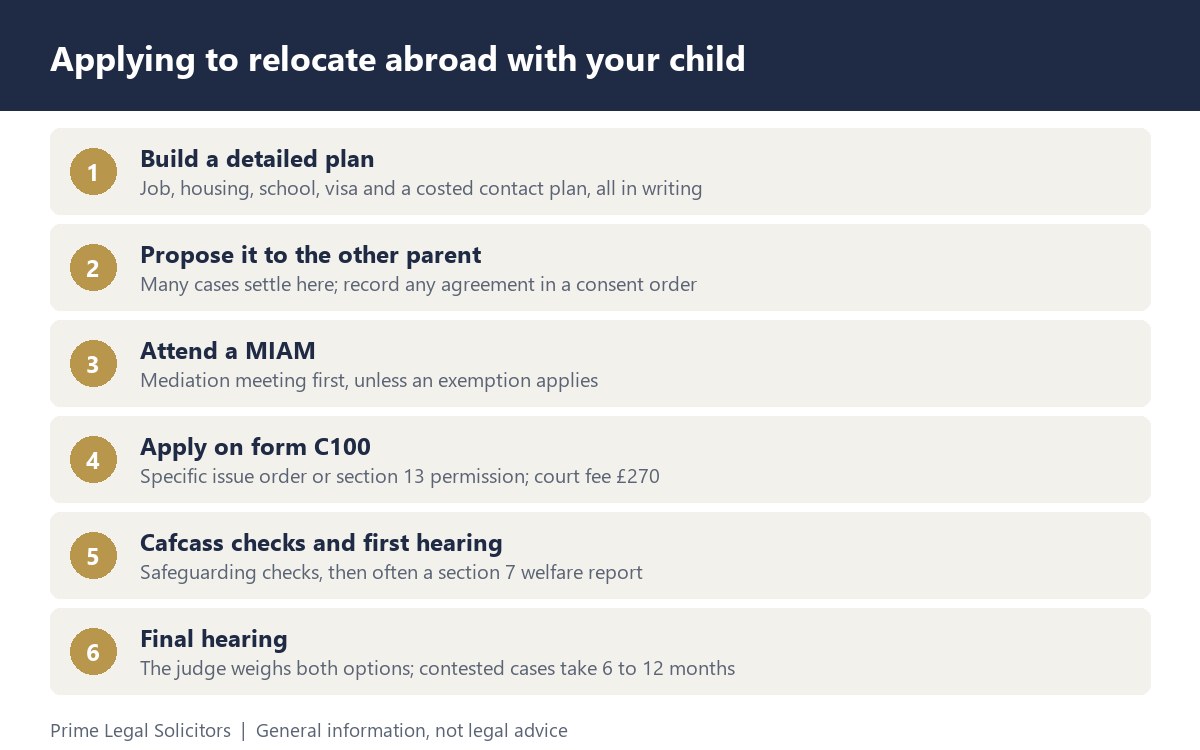
1. Build a detailed plan before you ask
One of the most common reasons relocation applications fail is a vague plan. Before you raise the move, you should know where you will live, which school your child will attend, how you will support yourself, whether you and your child have the right to live there, and how the other parent’s relationship with the child will be kept up. A plan that only says “a better life” will not succeed.
2. Propose it to the other parent in writing
Set out the plan and the contact you are offering, with dates, who travels and who pays. Many relocation cases settle at this stage, often with agreed conditions. If agreement is reached, record it in a consent order rather than an informal letter, so it can be enforced in both countries. A first meeting with a family lawyer helps you work out what is a realistic offer.
3. Attend a MIAM
Before applying, you must normally attend a mediation information and assessment meeting (MIAM), unless an exemption applies, such as domestic abuse or urgency. Mediation can work in relocation cases, as our mediation guide explains. The parents’ choices are stark, though, and many cases still go to court.
4. Apply on form C100
If there is no order in place, you apply for a specific issue order under section 8 of the Children Act 1989, giving permission to relocate. If a child arrangements order already says the child lives with you, you apply for permission under section 13 instead. Both are made on form C100, or on form C2 if proceedings are already running. The court fee is £270 from 13 July 2026, and Help with Fees can reduce it. Our children law solicitors can prepare the application and your statement.
5. Cafcass checks and the first hearing
Cafcass carries out safeguarding checks before the first hearing, the FHDRA. At that hearing the court tries to narrow the issues. If the case does not settle, the judge sets a timetable, usually including statements from both parents and often a section 7 report from Cafcass. The report covers the child’s wishes and feelings and a welfare recommendation. Older children’s views carry real weight. Our article on what family courts focus on explains how Cafcass reports are used.
6. The final hearing
At the final hearing, both parents give evidence and can be cross-examined. The judge then decides whether to allow the move, and if so on what conditions. Contested cases commonly take six to twelve months from application to final hearing, so build that into any job start or school date. Our family law overview sets out the wider court process.
How the court decides: welfare, not winners
The child’s welfare is the court’s paramount consideration under section 1 of the Children Act 1989. For many years courts followed Payne v Payne [2001], which was widely seen as favouring the parent who wanted to move. The Court of Appeal has since made clear that this is no longer the approach. In Re F (A Child) (International Relocation Cases) [2015] EWCA Civ 882, it said the court must carry out a holistic analysis of welfare. Each realistic option, the child moving or the child staying, is weighed against the other, and nobody starts with an advantage. Relying selectively on Payne is likely to be an error of law. The same welfare approach applies to moves within the UK, as the court confirmed in Re C (Internal Relocation) [2015] EWCA Civ 1305.
The welfare checklist in section 1(3) is a helpful guide. Our article on the presumption of parental involvement explains a related change in how courts approach each parent’s role. In practice, judges ask questions like these:
| Question the court asks | Evidence that helps |
|---|---|
| Is the plan genuine and well researched? | Job offer or proof of income, tenancy or property details, school place confirmation, visa or residence rights |
| What will the move do to the child’s relationship with the other parent? | A dated contact plan, who travels and pays, video-call schedule, previous record of supporting contact |
| What are the child’s own wishes and feelings? | Cafcass section 7 report, considered in light of the child’s age and understanding |
| What will the impact be on the parent who wants to move if permission is refused? | Evidence of family support abroad, isolation or financial pressure here, health effects |
| Is the opposition genuine and child-focused? | The other parent’s actual involvement, reliability with contact, any history of control |
| Can the contact arrangements be enforced in the new country? | Advice on the 1980 and 1996 Hague Conventions, mirror orders, undertakings |
No single factor decides a case. A strong plan can still fail if the move would seriously damage a close relationship with the other parent. A modest plan can succeed where the child’s main carer would be seriously harmed by staying. If there has been domestic abuse, the court also considers the risks of each option. Our guide to domestic abuse and family law explains how that evidence is used.
Worked example: a move to Spain for work
Amira lives in Manchester with her eight-year-old son. The father, Tom, has him every other weekend and one evening a week, and has parental responsibility. Amira has been offered a permanent post in Valencia, where her parents now live, at a salary well above what she earns here. Tom will not agree.
Amira’s plan sets out a flat near her parents, a confirmed place at an English-medium school and her employment contract. Because the UK has left the EU, she first confirms that her job gives her and her son the right to live in Spain. She offers Tom half of every school summer holiday, alternate Christmases, every half-term in the UK, and twice-weekly video calls. She will pay two-thirds of the flights and accompany her son on flights until he is older. She also gets advice from a Spanish lawyer on registering the English order in Spain, and keeps a record of how she has supported Tom’s contact with their son.
Tom argues the move would replace his weekly involvement in his son’s life with time concentrated in the school holidays. The Cafcass officer, following the usual child arrangements process, reports that the boy is close to both parents and his grandparents, and is anxious about leaving his school friends.
The judge compares the two options. Permission might be granted, with conditions such as a mirror order in Spain and a fixed contact schedule, if the judge finds Amira’s plan genuine, the contact offer realistic and her record of supporting contact good. It might be refused if the judge finds that the loss of weekly contact outweighs the benefits. There is no formula. The quality of the evidence on both sides is what decides it. Families in Manchester and elsewhere should start gathering it early.
If you are the parent being left behind
If you are worried the other parent will move your child abroad, act early. Your options depend on how urgent the risk is.
- Write to object. Make clear in writing that you do not consent to the move. Keep copies.
- Apply for a prohibited steps order. The court can forbid removal from England and Wales without your consent or a court order. In urgent cases this can be done the same day without notice.
- Ask for passport surrender. The court can order the child’s passports, and sometimes the other parent’s, to be handed over to a solicitor or the court.
- Call the police if removal is imminent. If you believe a child will be taken abroad within the next 48 hours, the police can issue an all-ports alert to stop the child leaving.
- Get your parental status in order. If you do not have parental responsibility, apply for it alongside any other order. Our parental responsibility guide explains how.
- Respond to any application properly. You can oppose the move, or agree it on conditions. Courts value a parent who engages with the plan rather than one who simply says no.
If your child has already been taken, contact us straight away. Hague Convention applications are time-sensitive, and the International Child Abduction and Contact Unit handles applications from England and Wales. Our cross-border family guide explains how these cases fit together.
Evidence checklist for the parent who wants to move
- Written job offer or contract, or proof of how you will support yourself.
- Housing: a tenancy, purchase details or a letter from family you will live with, with photos.
- School: confirmation of a place, the curriculum, the language of teaching and any support for special needs.
- Immigration: visa or residence rights for you and the child in the new country.
- Healthcare and childcare arrangements.
- A detailed contact proposal with a calendar, flight costs, who travels with the child, and video-call times.
- Evidence you have supported the child’s relationship with the other parent in the past.
- Advice from a lawyer in the destination country on registering or mirroring the English order.
- Evidence of family support in the new country, for example from grandparents or siblings.
- Your reasons, set out honestly. Courts are alert to moves motivated by wanting to cut the other parent out.
What goes wrong in relocation cases
| Mistake | Why it hurts | Better approach |
|---|---|---|
| Leaving first and applying later | A Hague return order is likely, and the court will question your judgement | Get consent or a court order before the child leaves |
| A vague plan | The court cannot assess the child’s life abroad | Confirm job, housing, school and visa in writing |
| A token contact offer | It suggests the other parent’s role does not matter to you | Offer a costed, dated plan and say who pays |
| Accepting a job with a fixed start date | A six to twelve month court timetable rarely fits | Negotiate a flexible start, or apply as early as possible |
| Ignoring enforcement abroad | The left-behind parent’s contact may be unenforceable | Take local advice on mirror orders and the Hague Conventions |
| Dismissing the move outright as the other parent | The court may see opposition as control rather than concern | Engage with the plan and propose conditions |
Most of these are avoidable with early advice. Our family lawyer costs guide explains how to budget for a relocation case.
If your situation is different
If you want to move within the UK
Moving to another part of England, Wales, Scotland or Northern Ireland is not removal from the United Kingdom, so the Child Abduction Act does not apply. You do not normally need permission unless a court order restricts where the child lives. The other parent can still apply for a prohibited steps order, and the court applies the same welfare test. A long-distance move that ends weekly contact can be challenged. Our guide to co-parenting with a high-conflict parent may help if relations are strained.
If the other parent does not have parental responsibility
If the father is not married to the mother, is not on the birth certificate and has no agreement or order, his consent is not legally required under the Child Abduction Act. He can still apply to court for parental responsibility and a prohibited steps order to stop a move. Our guide to parental responsibility agreements explains how fathers get it.
If you are moving to a country outside the Hague Convention
Where the destination is not a party to the 1980 Hague Convention, the left-behind parent has no simple route to get the child back if things go wrong. Courts are more cautious, and may require safeguards such as a mirror order made in the new country before the move, financial security, or undertakings. Expert evidence on the foreign legal system is often needed.
If your child is older
The views of a teenager carry significant weight, and a court is unlikely to force a 15-year-old to move abroad against their settled wishes. The Child Abduction Act offence also only applies to children under 16, although section 13 and court orders can still apply until 18.
If you are divorcing at the same time
Relocation often overlaps with the financial settlement, for example where the family home is to be sold to fund the move. It is usually best to deal with both together, so the court can see the whole picture. Our no-fault divorce guide covers the divorce process itself.
Costs and how we can help
The court fee for a relocation application is £270 from 13 July 2026. Legal costs depend on whether the case settles. A negotiated agreement recorded in a consent order costs a fraction of a contested final hearing. Our published fees for children cases start from £1,500 plus VAT for out-of-court negotiation, with further stages for court hearings. Our pricing page has the details.
We act for parents who want to move and for parents who want to stop a move, including urgent applications to prevent removal. We offer a free initial consultation. Call 0330 341 4757 or contact us online. We have teams in London, Manchester, Lancashire and Yorkshire.
Frequently asked questions
Can I move abroad with my child without the father’s permission?
Not if he has parental responsibility, unless the court gives you permission. Removing a child under 16 from the UK without the consent of everyone with parental responsibility can be child abduction under the Child Abduction Act 1984. Apply to the family court if he will not agree.
How long does a relocation case take?
If the case settles early, it can be resolved in a few months. A contested case with a Cafcass report and a final hearing commonly takes six to twelve months, depending on the court.
What are my chances of getting permission to relocate?
There is no presumption either way. The court compares the child’s life if they move with their life if they stay. A well-researched plan, a realistic contact offer and a record of supporting the other parent’s relationship all improve your chances.
Can I take my child on holiday abroad without consent?
Only if a child arrangements order says the child lives with you, and the trip is for less than one month, and no other order prevents it. Otherwise you need the consent of everyone with parental responsibility. Carry a consent letter either way. Our Manchester family solicitors can draft one.
Can I stop my ex taking my child abroad?
Yes. You can apply for a prohibited steps order, ask for the passports to be surrendered and, if removal is imminent, ask the police for an all-ports alert. Act quickly. Our Yorkshire family lawyers and other offices handle urgent applications.
Does my child get a say?
Yes. Cafcass will usually speak to the child and report their wishes and feelings. The older and more mature the child, the more weight their views carry, although the court makes the final decision.
Which form do I use to apply?
Form C100, applying for a specific issue order, or for permission under section 13 if a lives-with order is already in place. If you are already in proceedings, use form C2. A MIAM is usually required first.
Can a relocation order be enforced abroad?
Often, but not automatically. Between countries in the 1996 Hague Convention, orders are generally recognised. Elsewhere, a mirror order made by the foreign court may be needed. Take advice in both countries before the move. Our Lancashire family team can help.
Please note: This article is general information about the law of England and Wales as at November 2026. It is not legal advice and does not create a solicitor-client relationship. Speak to a solicitor before making a decision. Prime Legal Solicitors is authorised and regulated by the Solicitors Regulation Authority, SRA No. 834471.
Author

Suits You Media Dev