
If your UK visa has been refused, you can usually challenge it in one of three ways: administrative review, an appeal to the First-tier Tribunal, or judicial review. Your refusal letter tells you which one is open to you, and the deadlines are short: as little as 14 days in the UK. Just as important is whether your permission to stay continues while you challenge. That is decided by section 3C of the Immigration Act 1971, not by the letter.
Key takeaways
- Read the remedy section of your refusal letter first. If it offers administrative review, there is no right of appeal, and filing an appeal instead wastes the only route you had.
- Administrative review must be requested within 14 calendar days if you are in the UK and not detained, 7 days if detained, and 28 days for an entry clearance refusal, each from when you receive the decision. The fee is £80.
- A First-tier Tribunal appeal from inside the UK must reach the tribunal within 14 days of the decision being sent, not received. Appeal fees are £82 on the papers and £144 with a hearing.
- Section 3C leave keeps your existing permission, including the right to work and rent, only if you applied before your leave expired. It ends if you leave the UK, miss the review deadline or lose the review. Our immigration appeals solicitors can confirm your position.
- Judicial review does not revive leave that has ended. Where the refusal was right but you can now meet the rules, a fresh application is often the better route.
The short answer: your refusal letter tells you which route
A UK visa or immigration refusal can be challenged in one of three ways, and usually only one is open to you. Your decision letter names it. Administrative review corrects caseworking errors and must be sought within 7, 14 or 28 calendar days depending on where you are. An appeal to the First-tier Tribunal exists only for specified decisions, within 14 days in the UK or 28 days outside it. Judicial review challenges the lawfulness of the decision itself.
Before any of that, answer the question that actually decides your next month: does your permission to be here survive while you challenge? That is section 3C leave, and it is the second section below. Your eVisa record may not show it.
Deadlines and fees checked November 2026
The administrative review periods come from paragraph AR 2.6 of Appendix Administrative Review to the Immigration Rules. The appeal periods come from rule 19 of the Tribunal Procedure (First-tier Tribunal) (Immigration and Asylum Chamber) Rules 2014. Fees change by statutory instrument, so take your own deadline from your own decision letter and work to the earlier date. Nobody can promise an outcome on any of these routes.
Reading the refusal letter
Refusal letters are badly laid out but they are not vague. Four things in yours decide everything that follows.
- The reasons. Usually a list of rule paragraphs with a sentence each. Mark which are factual findings (“you did not provide bank statements covering…”) and which are judgements about whether a requirement is met. Skilled Worker refusals often turn on the salary rules.
- The remedy section. Near the end, headed something like “what to do if you think this decision is wrong”. If it offers administrative review, there is no right of appeal. If it offers an appeal, it will say which tribunal and give the deadline.
- The dates. The date of decision, the date of the notice and the date you received it are three different things, and the two routes count from different ones.
- Whether anything was overlooked. If a document you uploaded is described as missing, that is a caseworking error. If the caseworker read your documents and was not satisfied by them, that is not.
That last distinction is the single most useful thing in this article, because it is the difference between a route that can help you and one that cannot. Our London immigration team reads refusal letters every week.
Which route applies to you
| What your refusal letter says or shows | Route | Deadline |
|---|---|---|
| Offers administrative review; you are in the UK and not detained | Administrative review | 14 calendar days from receipt of the notice (AR 2.6) |
| Offers administrative review; you are in the UK and detained | Administrative review | 7 calendar days from receipt (AR 2.6) |
| Offers administrative review; you are outside the UK | Administrative review | 28 calendar days from receipt (AR 2.6) |
| Refuses a human rights or protection claim, or a decision with a right of appeal under s.82 Nationality, Immigration and Asylum Act 2002 | Appeal to the First-tier Tribunal | 14 days from the date the notice was sent if you are in the UK; 28 days from receipt if outside (rule 19) |
| An EU Settlement Scheme decision carrying appeal rights | Appeal under the Citizens’ Rights Appeals Regulations 2020 | Periods differ, take the date from the letter |
| Offers no review and no appeal, and you say the decision is unlawful, irrational or procedurally unfair | Judicial review in the Upper Tribunal | Promptly, and no later than 3 months (rule 28) |
| Refuses on a requirement you genuinely did not meet, and you can now meet it | A fresh application | No deadline, but section 3C leave will usually have ended |
| Your administrative review has itself been refused | Judicial review, or a fresh application | Promptly, and no later than 3 months (rule 28) |
If the letter offers administrative review and you file an appeal instead, the tribunal will reject it for want of jurisdiction, and the review deadline will have run. Read the remedy section before you do anything else. Partner refusals, such as a spouse visa, are often treated as human rights decisions and carry an appeal instead.
Does your leave continue while you challenge? Section 3C
This is the question people actually ring about: can I keep working, can I keep my tenancy, am I now here unlawfully? The answer is in section 3C of the Immigration Act 1971, and it is narrower than most people assume. Our applications team checks it first on every refusal.
Section 3C applies where all three of these are true: you had limited leave to enter or remain; you applied to the Home Office to vary that leave; and you made the application before the leave expired. If so, your existing leave is extended automatically, by operation of law. You do not apply for it and you are not sent a document confirming it.
Under section 3C(2) the extension lasts while any of the following is true: the application is neither decided nor withdrawn; an in-country appeal could still be brought (ignoring the possibility of a late appeal with permission); such an appeal is pending; an appeal under the Citizens’ Rights Appeals Regulations 2020 could be brought or is pending; or an administrative review could be sought or is pending.
That last limb is why the review deadline matters so much. If you let the 14 days expire without filing, section 3C leave ends with it. File in time and your leave continues until the review is decided.
Four ways people lose section 3C leave
- Applying late. An application made one day after your leave expired attracts no section 3C protection at all. There is no discretion in it. Overstaying also breaks continuous residence for the 10-year route.
- Leaving the UK. Section 3C(3): leave extended by the section lapses if you leave the UK. A week abroad for a funeral can end your status and your pending application’s in-country appeal rights.
- An invalid application. If the application is rejected as invalid, unpaid fee, no biometrics, wrong form, it may be treated as never having been validly made, and the protection goes with it.
- Cancellation. Under section 3C(3A) the extended leave may be cancelled for breach of a condition or for deception.
Note also section 3C(4): you cannot make a new variation application while leave is extended under the section. You can vary the existing application (section 3C(5)), which is a different thing and often the right move. Our business immigration team sees this often with sponsored workers.
If you are working: what section 3C means for a right to work check
Your conditions continue as they were. If your previous leave allowed you to work for that employer, section 3C leave carries the same permission. The practical problem is proof: your eVisa or status page may show the old expiry date, and an employer running an online check can be told your status has expired. The answer is the Employer Checking Service. Your employer submits a request to the Home Office and receives a Positive Verification Notice, which gives them a statutory excuse for a defined period and is renewed while the application remains outstanding.
Tell your employer in writing the day you apply, with the application submission confirmation. Employers who dismiss a worker in a panic over expired status can find themselves defending a claim: see our guide to what an unfair dismissal claim is worth.
If you are renting: what section 3C means for right to rent
The same structure applies to housing. A landlord in England who cannot verify your status online can use the Landlord Checking Service, which issues a Yes response where the Home Office records show a pending in-time application or appeal. That gives the landlord a statutory excuse. Do not wait for an eviction notice to raise it, and do not let a letting agent tell you that an expired card means you have no status. Landlords’ own duties are covered in our landlord compliance guide.
| Your situation | Section 3C leave? | What that means for work and renting |
|---|---|---|
| In-time application, still undecided | Yes, on the same conditions | Work continues if your old leave allowed it; employer uses the Employer Checking Service, landlord the Landlord Checking Service |
| Refused, administrative review still within the deadline | Yes, a review “could be sought” (s.3C(2)(d)) | Status continues, but only until the deadline passes. File in time or it ends |
| Administrative review filed and pending | Yes | Continues until the review is decided; verification through the checking services |
| Refused with an in-country right of appeal, appeal in time or pending | Yes | Continues while the appeal is pending within the meaning of s.104 of the 2002 Act |
| Review deadline missed, or review decided against you | No | Leave has ended. Working and renting rights go with it, whatever the card says |
| Application made after your leave expired | No, never arose | No right to work or rent from the expiry date; take advice urgently |
| You left the UK while the application was pending | No, lapsed under s.3C(3) | You may be unable to re-enter or to pursue an in-country appeal |
| Judicial review pending after section 3C has ended | No, judicial review does not extend leave | Any permission to work or rent must come from another source, if at all |
Judicial review is the trap in that table. It is a challenge to the lawfulness of a decision, not a continuation of your application, and bringing one does not revive leave that has already ended. Gaps in leave can also delay a later settlement application.
Administrative review: caseworking errors only
Administrative review is a second look by a different Home Office reviewer, limited to whether the original decision contained a caseworking error. It is not a second application and not a fresh assessment of your case. If you are sponsored, tell your employer, which has its own sponsor licence duties.
It can fix: evidence you submitted that was overlooked or recorded as missing; a rule applied wrongly; an arithmetic or date error; a mandatory step missed; a decision made on the wrong version of the rules. It cannot fix: a requirement you did not meet; evidence you did not send; a change in your circumstances since the decision; or a disagreement with a judgement the caseworker was entitled to reach.
Under AR 2.6 the request must be made within 7 calendar days if you are in the UK and detained, 14 calendar days if you are in the UK and not detained, and 28 calendar days if you are outside the UK, in each case running from when you receive notice of the decision. The fee is £80 as at November 2026, is not refunded if you withdraw the request, and is refunded in the circumstances GOV.UK sets out, broadly where the review succeeds.
Write the request as a short, numbered document that identifies each error, points to the page and date of the evidence already on file, and says what the correct outcome is. No new evidence. If your real position is that the caseworker was right on the material before them, administrative review is not your route. A financial requirement shortfall is a common example.
Appeal to the First-tier Tribunal
Only specified decisions carry a right of appeal, principally those listed in section 82 of the Nationality, Immigration and Asylum Act 2002, refusal of a protection or human rights claim, revocation of protection status, together with EU Settlement Scheme decisions under the Citizens’ Rights Appeals Regulations 2020. Most points-based and visitor refusals carry no appeal at all. Your letter will tell you which you have. Asylum refusals follow their own path, explained in our asylum guide.
An appeal is a hearing before an independent judge of the Immigration and Asylum Chamber. Unlike administrative review, the tribunal can hear evidence, including evidence that was not before the caseworker, and can hear you and your witnesses give oral evidence. Our immigration lawyers prepare the appeal bundle and attend the hearing.
The trap: sent versus received
Under rule 19 of the 2014 Rules, if you are in the UK the notice of appeal must be received by the tribunal not later than 14 days after you were sent the notice of decision. If you are outside the UK, it is 28 days after you received it.
So the in-country clock starts when the Home Office sent the decision, while the administrative review clock starts when you received it. If the letter sat unopened for four days, you have ten days left to appeal and fourteen to seek a review. Work from the date on the notice, not the date you read it. Our immigration team can check the date for you. Where you were in the UK when the decision was made but may not appeal from inside the UK, rule 19 gives 28 days from your departure; and where you pursued administrative review first, the period runs instead from receipt of the review decision or withdrawal of the request.
Appeal fees, as at November 2026, are set by article 3 of the First-tier Tribunal (Immigration and Asylum Chamber) Fees Order 2011: £82 where you consent to the appeal being decided on the papers, and £144 where you want a hearing. Exemptions are in article 5 and remission or reduction in article 7, so check whether you have to pay at all before you do. The notice of appeal is normally filed through the tribunal’s online service, with a paper notice of appeal where the online route is not available to you.
A late appeal is not impossible. You must explain the delay and ask the tribunal to extend time, and the tribunal decides. Do not plan on it. Our fees for appeals are published.
Judicial review: the last resort
Judicial review asks the Upper Tribunal to rule that the decision was unlawful, a legal error, irrationality, procedural unfairness, a failure to apply policy, or a breach of a public law duty. It is not an appeal on the merits. The tribunal does not substitute its own view of whether you should have been granted the visa.
Under rule 28 of the Tribunal Procedure (Upper Tribunal) Rules 2008, an application for permission must be made promptly and, unless another enactment specifies a shorter limit, must be received no later than three months after the decision. “Promptly” does real work: three months is an outer limit, not an entitlement. A different and shorter timetable applies where what you are challenging is a First-tier Tribunal decision (rule 28(3)), so take advice immediately in that situation.
You must normally exhaust the alternatives first. A judicial review brought while an administrative review was available is likely to fail on that basis alone. The pre-action protocol step, a letter before claim setting out the error and inviting the Home Office to withdraw the decision, resolves a meaningful number of cases without proceedings, and court fees apply on top of legal costs. This is not a route to run without representation; our immigration appeals solicitors can tell you quickly whether there is an arguable public law error.
Reapplying instead of challenging
Where the refusal is right on the evidence but you can now meet the requirement, a fresh application is often faster, cheaper and more likely to resolve matters than a challenge. It is the sensible answer where a document was genuinely missing, a financial requirement was narrowly missed, or your circumstances have changed.
The cost is your status. Section 3C leave does not continue because you have made a new application after your old leave ended, so between the end of the old leave and a grant you may have no right to work or rent. Weigh that before choosing. Our immigration advice and applications team can run the comparison with you, and our published fees set out what the work costs.
The deadlines, and why they differ
| Route | When it applies | Deadline | Fee | What it can fix | What it cannot |
|---|---|---|---|---|---|
| Administrative review | Where the decision letter offers it (Appendix AR) | 7 days detained in the UK, 14 days in the UK, 28 days outside, from receipt (AR 2.6) | £80 as at November 2026; refundable in the circumstances GOV.UK sets out | Caseworking errors: overlooked evidence, misapplied rules, date and arithmetic mistakes | New evidence, changed circumstances, a requirement you did not meet |
| First-tier Tribunal appeal | Specified decisions only, s.82 of the 2002 Act and EUSS appeals | 14 days from when the decision was sent in the UK; 28 days from receipt outside (rule 19) | £82 on the papers, £144 with a hearing, as at November 2026; exemptions and remission apply | Findings of fact, credibility, proportionality, new evidence, oral evidence | Decisions with no right of appeal |
| Judicial review | No review or appeal available, and the decision is arguably unlawful | Promptly, and no later than 3 months (rule 28); shorter where challenging an FtT decision | Court fees apply, check the current figures on GOV.UK | Legal error, irrationality, procedural unfairness, failure to follow policy | Disagreement with a lawful decision; it does not revive leave |
| Fresh application | The refusal was right and you can now meet the requirement | None, but section 3C leave will usually have ended | Application fee and the Immigration Health Surcharge, see GOV.UK | Gaps in evidence, changed circumstances | A refusal that was itself wrong; it does not correct the record |
The deadlines differ because they come from different instruments: the review periods are set by the Immigration Rules, the appeal period by tribunal procedure rules made under statute, and the judicial review limit by the Upper Tribunal’s own rules. There is no unified immigration appeal deadline, which is precisely why people miss them. Our Manchester solicitors diarise all three for every client.
Worked example: two refusals, two routes
Imagine two people refused on the same day, both in the UK, both with permission that had already expired when the refusal arrived, both protected by section 3C because they applied in time.
The first submitted six months of bank statements with her skilled worker application. The refusal says she provided only three months. She did not; the upload log shows six files. That is a caseworking error: the reviewer can look at the material already on file and see it. Administrative review is the route. She is in the UK and not detained, so she has 14 calendar days from receipt, and she files on day four with a numbered list identifying each statement by date and file name. Her section 3C leave continues because the review is pending, and her employer renews the Positive Verification Notice through the Employer Checking Service.
The second submitted three months of statements because that is what he had. The refusal says the rule requires six. The caseworker read everything and applied the rule correctly. There is no caseworking error, so administrative review would cost him the fee and fourteen days for nothing, and when the review is refused, his section 3C leave ends. His realistic options are a fresh application once he has the full six months, accepting the gap in status, or advice on whether anything else in his situation changes the analysis.
Ask us which applies to you. Same refusal letter, same day, opposite advice. Both illustrations are hypothetical, and no solicitor can tell you that either route will produce a particular result.
Common mistakes: what goes wrong
- Assuming there is a right of appeal. Most visa refusals carry none. Filing an appeal where the letter offers administrative review wastes the only route you had.
- Treating administrative review as a second application. New evidence cannot be considered. Sending it signals that you accept the original decision was right on the material before the caseworker.
- Letting section 3C leave lapse. Applying after your leave expired, missing the review deadline, or travelling abroad while an application is pending all end it.
- Counting from the wrong date. The in-country appeal clock runs from when the decision was sent; the review clock from when you received it. Confusing them loses days you did not know you were spending.
- Waiting for the paper letter. Decisions are often served electronically and the clock does not wait for the post. Keep your UKVI account details up to date.
- Going to judicial review too early. If a review or appeal was available and unused, permission is likely to be refused.
- Not telling the employer or landlord. The checking services exist precisely for this, but nobody can use them if they do not know an application is pending.
Evidence and documents to gather now
- The full decision letter, every page, including the remedy section and annexes.
- The envelope or the email, with its date and time, this is your evidence of when the notice was sent and received.
- Your application submission confirmation and payment receipt, which prove the application was in time for section 3C.
- The upload log or document list from the application, with file names and dates, the proof that something was overlooked.
- Copies of everything you submitted, in the order you submitted it.
- Your immigration history: every grant and refusal, with dates. Anyone relying on long residence needs every gap explained.
- Employment and tenancy details, so verification can be arranged through the checking services.
Your first 48 hours, step by step
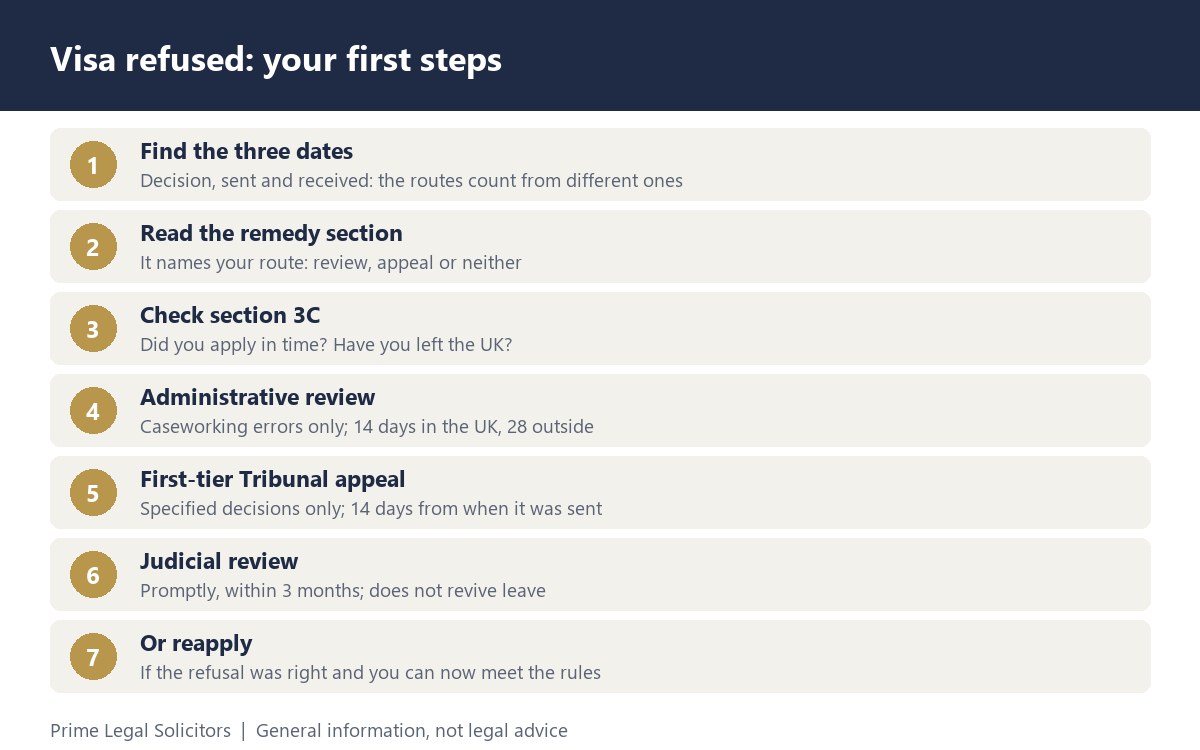
- Find the dates. Date of decision, date sent, date received. Write all three down.
- Read the remedy section and identify which route the Home Office says you have.
- Calculate both deadlines, review from receipt, appeal from sending, and diarise the earlier one.
- Check your section 3C position. Was the application in time? Have you left the UK since? Is a review still available?
- Tell your employer and landlord in writing, and ask them to use the Employer Checking Service or Landlord Checking Service.
- Separate the reasons into caseworking errors and genuine shortfalls. That split decides your route.
- Get advice before you spend the fee, not after it. If the ten-year route was involved, read our guide to the ten-year long residence route alongside this one.
- Do not travel while anything is pending, and do not start work you are not permitted to do.
If settlement or a later British citizenship application is your eventual goal, how you handle this refusal matters beyond the next month: gaps in status and findings of deception both follow you. If you want someone to read the letter with you, contact the team, and if you cannot afford advice, the immigration team can tell you whether a free advice service or the tribunal’s own guidance would do the job instead.
Frequently asked questions
What is the difference between administrative review and appeal?
An administrative review is a second look by a different Home Office reviewer, limited to caseworking errors in the original decision. An appeal is a hearing before an independent tribunal judge, who can consider evidence that was never before the caseworker and can hear you give oral evidence. Most visa refusals carry a right to a review only; appeals exist for specified decisions such as human rights and protection claims.
How long do I have to challenge a visa refusal?
For administrative review, Appendix AR 2.6 gives 7 calendar days if you are in the UK and detained, 14 calendar days if you are in the UK and not detained, and 28 calendar days if you are outside the UK, each from receipt of the notice. For a First-tier Tribunal appeal, rule 19 gives 14 days from the date the decision was sent if you are in the UK, or 28 days from receipt if you are outside. Our Bradford team can work out your date.
What is section 3C leave?
Section 3C of the Immigration Act 1971 automatically extends your existing leave where you applied to vary it before it expired and the leave runs out before a decision is made. It continues while the application is undecided, while an administrative review could be sought or is pending, and while an in-country appeal could be brought or is pending. Nothing is issued to confirm it.
Can I work while my appeal is pending?
If section 3C leave applies, your previous conditions continue, so you can work if your old leave allowed it. Your online status may still show the old expiry date, so your employer should use the Employer Checking Service to obtain a Positive Verification Notice. If section 3C never arose, or has ended, the right to work ends with it regardless of what any card says. Our business immigration team can advise employers on this.
Does section 3C leave cover my right to rent?
Yes, while it subsists. A landlord in England who cannot verify your status online can use the Landlord Checking Service, which issues a Yes response where Home Office records show a pending in-time application or appeal, giving the landlord a statutory excuse. Raise it when you apply rather than waiting for a notice, and do not accept that an expired card means you have no status.
Can I submit new evidence on administrative review?
No. The review is confined to whether the original decision contained a caseworking error, judged on the material that was already before the caseworker. Sending new documents does not help and tends to confirm that the original decision was right on what was submitted. If your real difficulty is missing evidence, a fresh application is usually the more sensible route. See our published fees for help with either route.
Can I reapply instead of appealing?
Often yes, and where the refusal was correct but you can now meet the requirement it is frequently faster and cheaper. The cost is your status: section 3C leave does not continue because you have made a new application after your previous leave ended, so you may have no right to work or rent in the meantime. Weigh the two before choosing. Our applications team can compare the options.
How long do I have for judicial review?
Rule 28 of the Tribunal Procedure (Upper Tribunal) Rules 2008 requires an application for permission to be made promptly and, unless another enactment sets a shorter limit, no later than three months after the decision. Promptness matters independently of the three months. A shorter timetable applies where you are challenging a First-tier Tribunal decision, so take advice at once. Get advice as soon as the decision arrives.
Do I need a solicitor to appeal a visa refusal?
Not always. A straightforward administrative review identifying an overlooked document is something many people do themselves, and the tribunal publishes guidance for appellants in person. Judicial review is different: it turns on public law argument and is difficult to run without representation. Whatever you decide, nobody can promise you an outcome, and be wary of anyone who does. We act from London, Manchester and Bradford.
Please note: This article is general information about UK immigration law as at November 2026. It is not legal advice and does not create a solicitor-client relationship. Speak to a solicitor before making a decision. Prime Legal Solicitors is authorised and regulated by the Solicitors Regulation Authority, SRA No. 834471.
Author

Suits You Media Dev