
A parental responsibility agreement is a free, formal document that gives a father, step-parent or second female parent the same legal parental responsibility as the mother, without going to court. You fill in the right form, sign it in front of a court official with photo ID and send it to the Central Family Court. It only takes effect once the court records it. This guide explains which form to use, how to complete it step by step, the mistakes that get forms sent back, and what to do if the other parent will not sign.
Key takeaways
- An agreement is made under section 4(1)(b) of the Children Act 1989 on form C(PRA1). Step-parents use C(PRA2) and second female parents use C(PRA3). There is no court fee.
- Both of you must sign in front of a justice of the peace, a justices’ clerk or an authorised court officer. A solicitor cannot witness it. Each signer needs photo ID, and the mother also needs the child’s full birth certificate.
- The signed form goes to the Central Family Court in London. The agreement does not take effect until the court has received and recorded it.
- Once recorded, it can only be ended by a court order or when the child turns 18. Our general guide to parental responsibility in the UK explains what the status means day to day.
- If the mother will not agree, the alternative is a court application for a parental responsibility order. The court fee for that rose to £270 on 13 July 2026.
What a parental responsibility agreement is
Parental responsibility is the legal bundle of rights, duties and authority a parent has for a child. It is what lets you consent to medical treatment, talk to the school as a parent, have a say on the child’s religion and name, and object if someone wants to take the child to live abroad. It does not, by itself, decide where a child lives or how often they see each parent. Those questions are dealt with by child arrangements orders.
A mother always has parental responsibility. A father has it automatically if he was married to the mother when the child was born, or later marries her. An unmarried father has it automatically if he is named on the birth certificate for a birth registered in England and Wales on or after 1 December 2003. For births registered in Scotland the date is 4 May 2006, and in Northern Ireland 15 April 2002.
For couples who are unmarried but living together, that leaves a large group of fathers with no parental responsibility: those whose name was left off the birth certificate, and some whose child was born and registered abroad. A parental responsibility agreement is the simplest fix where the mother is willing. The mother and father declare, on a court form, that the father shall have parental responsibility in addition to the mother. Nobody goes before a judge and the court does not assess the father’s suitability. That is why the law insists on careful witnessing and identity checks instead.
Is re-registering the birth an alternative? Yes. If the father is not on the birth certificate, both parents can jointly re-register the birth to add him, and that also gives him parental responsibility. Re-registration is done through the register office, not the court. An agreement is useful where the parents would rather not have a new certificate issued, where the child was registered abroad, or for step-parents, who cannot get parental responsibility through the register.
Which form do you need?
There are three agreement forms, and using the wrong one is one of the most common reasons a form is returned. Each is tied to a different section of the Children Act 1989. If you are not sure which applies, our family law team can confirm it before you book a court appointment.
| Form | Legal basis | Who it gives parental responsibility to | Who must sign |
|---|---|---|---|
| C(PRA1) | Section 4(1)(b) Children Act 1989 | The child’s father, where he does not already have it | The mother and the father |
| C(PRA2) | Section 4A(1)(a) Children Act 1989 | A step-parent married to, or in a civil partnership with, a parent who has parental responsibility | The step-parent and every parent who has parental responsibility |
| C(PRA3) | Section 4ZA(1)(b) Children Act 1989 | A second female parent under the Human Fertilisation and Embryology Act 2008, where she does not already have it | The mother and the second female parent |
Each form covers one child only. If you have three children together, you need three forms, each signed and witnessed separately. The forms are free to download from GOV.UK, and your local family court can give you a printed copy. If you are also going through a divorce, deal with parental responsibility separately, as the divorce itself does not change it.
How to make a parental responsibility agreement, step by step
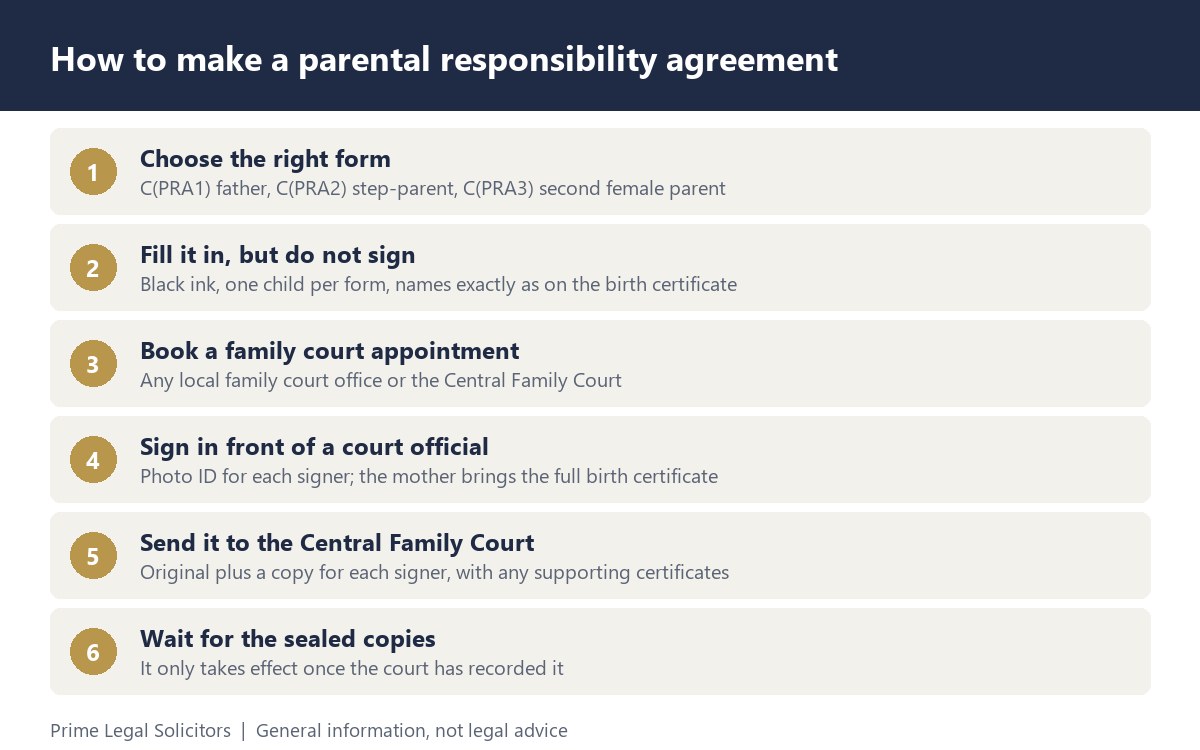
1. Take advice and check the agreement is right for you
The notes printed on the form tell both parents to take legal advice first, because the agreement changes the legal position of each of you permanently. Advice is especially important where there has been domestic abuse, where the relationship is unsettled, or where the father lives abroad. An agreement cannot be undone simply because the parents later fall out. If there are safety concerns, read our guide to domestic abuse and family law before signing anything.
2. Fill in the form, but do not sign it
Complete the form in black ink because it will be copied. You will need the child’s full name, gender, date of birth and the date of their 18th birthday, plus each parent’s full name and address. The names must match the birth certificate exactly. Do not sign the form at home. A signature not made in front of the witness makes the form invalid.
3. Book an appointment at a family court
You can take the form to any local office of the family court or to the Central Family Court. Many courts now witness agreements by appointment only, so phone ahead. You can attend together or at separate times, which helps if you are already separated. Each parent’s signature simply has to be witnessed by an authorised person.
4. Sign in front of the court official, with your ID
Your signature must be witnessed by a justice of the peace, a justices’ clerk, an assistant to a justices’ clerk, or a court officer authorised by a judge to administer oaths. The form itself says a solicitor cannot witness your signature, and neither can a friend or a notary acting informally. The witness completes the certificate, recording the evidence of identity you produced. Our London family solicitors can tell you which local courts offer appointments.
Each person signing must bring photo ID that also shows a signature, such as a passport or photocard driving licence. The mother must also bring the child’s full birth certificate to prove she is the mother. The birth certificate does not count as her identity document.
5. Copy the form and send it to the Central Family Court
Make enough copies of the completed agreement for each person who signed. Send the original with the copies to The Central Family Court, First Avenue House, 42-49 High Holborn, London, WC1V 6NP. Include copies of any supporting certificates, such as a marriage certificate, name deed or death certificate, where relevant. You do not need to copy the guidance notes. Keep your own photocopy and a proof of postage, because originals do occasionally go missing.
6. Wait for the sealed copies
The court records the agreement and keeps the original. It stamps the copies with the court seal and sends one to every person who signed. The agreement does not take effect until it has been received and recorded at the Central Family Court. Signing in front of the witness is not enough on its own. Keep the sealed copy safe. Schools, doctors and the passport office may ask to see it, and you may need it if you later apply for permission to relocate or to change the child’s surname.
What goes wrong: why forms get sent back
The process is simple, but a returned form can add weeks. Our Manchester family lawyers often check forms for clients first. These are the problems we see most often when parents come to us after doing it themselves.
| Mistake | What happens | How to avoid it |
|---|---|---|
| Signing at home before the appointment | The witness cannot certify the signature and the form is invalid | Leave the signature boxes blank until you are in front of the court official |
| Asking a solicitor or friend to witness | The court will not record it | Only a justice of the peace, justices’ clerk or authorised court officer can witness |
| Names that do not match the birth certificate | The court queries or returns the form | Copy names exactly, including middle names, and include a name deed if a name has changed |
| Several children on one form | The form is rejected | Use a separate form for each child |
| Using C(PRA1) for a step-parent | Wrong legal basis, so it is returned | Step-parents use C(PRA2), and every parent with parental responsibility must sign it |
| Assuming it is effective once signed | The father acts as if he has parental responsibility before it is recorded | Wait for the sealed copy before relying on it with schools or doctors |
If a form comes back, the court usually explains why. Some faults can be corrected, but a form signed without a valid witness has to be done again from the start. A first meeting with a family lawyer to check the paperwork costs far less than a second round of appointments.
Agreement or court order: which route fits?
If the mother agrees, the agreement is almost always the better route. It is free, private and quick, and it involves no hearing. If she refuses, or cannot be found, the father can apply to the family court for a parental responsibility order under section 4(1)(c) on form C1. Step-parents can apply under section 4A(1)(b) in the same way. Before applying, you normally have to attend a mediation information and assessment meeting (MIAM) unless an exemption applies. Our comparison of mediation and court explains how that step works.
| Factor | Agreement (C(PRA1), C(PRA2) or C(PRA3)) | Court order (form C1) |
|---|---|---|
| Needs the mother’s consent | Yes | No |
| Court fee | None | £270 from 13 July 2026 (previously £263). Help with Fees may reduce it |
| Hearing | No. A court official witnesses the signatures | Usually at least one hearing, with Cafcass safeguarding checks |
| MIAM required first | No | Yes, unless an exemption applies |
| Who decides | The parents | A judge, applying the child’s welfare as the paramount consideration |
| Effect once made | Full parental responsibility, shared with the mother | The same |
| How it can end | Court order, or the child turning 18 | Court order, or the child turning 18 |
On an application for an order, the court looks at the father’s commitment to the child, the degree of attachment between them and his reasons for applying. Orders are granted in most cases where a father has been genuinely involved. The court refuses where there are serious welfare concerns, not simply because the mother objects. Our page on children applications covers the court process in more detail, and our pricing page shows our fees.
Worked example: an unmarried father not on the birth certificate
Daniel and Sarah were never married. Their daughter was born in Leeds in 2019. Sarah registered the birth alone, so Daniel is not on the birth certificate and has no parental responsibility. They separated amicably, and Daniel has the girl every other weekend under an informal child arrangement. She now needs a passport for a family holiday, and her school will only discuss her needs with a parent who has parental responsibility.
A joint re-registration of the birth would also give Daniel parental responsibility. But Sarah has changed her surname since the birth, and they would rather not have a new certificate issued. So they use form C(PRA1).
- Week 1: they complete the form in black ink and book a slot at Leeds family court. Sarah brings her passport, the full birth certificate and her marriage certificate showing the name change. Daniel brings his photocard licence.
- Week 1: both sign in front of an authorised court officer, who completes the witness certificates.
- Week 2: they post the original, two copies and a copy of Sarah’s marriage certificate to the Central Family Court.
- Weeks 3 to 6: the court records the agreement and posts sealed copies to both of them. From the recording date, Daniel has parental responsibility and can deal with the school and the passport application alongside Sarah.
The total court cost is nil. Had Sarah refused, Daniel’s route would have been a MIAM, then a C1 application with a £270 fee. That would usually take several months, with at least one hearing and Cafcass checks. For a family in Yorkshire or elsewhere, early advice usually saves time.
Evidence checklist: what to bring to the court
- The completed but unsigned form, one per child, in black ink.
- Photo ID showing a signature for each person signing, such as a passport, photocard driving licence or official pass.
- The child’s full birth certificate. The short version is not enough, and the mother must produce it.
- A marriage certificate, civil partnership certificate or name deed if anyone’s name differs from the birth certificate.
- For C(PRA2): proof of the step-parent’s marriage or civil partnership to the parent, and attendance or witnessed signatures from every parent with parental responsibility.
- For C(PRA3): evidence that the second female parent is a parent under the 2008 Act. If unsure, take advice first.
- Copies of everything for your own records, and a stamped addressed envelope if the court asks for one.
If your situation is different
The standard route above suits most parents. These are the situations where the answer changes, and where a short call with our Lancashire family team or another office can save a wasted trip.
If you are a step-parent
You must be married to, or in a civil partnership with, a parent who has parental responsibility. Living together is not enough. Every parent with parental responsibility must sign C(PRA2), so if the child’s other parent has it too, they must agree. If they will not, you can apply to court instead. Parental responsibility for a step-parent falls short of adoption: it is shared, not exclusive, and the birth parents keep theirs.
If the mother will not sign
You cannot force anyone to sign an agreement. Your option is a court application for a parental responsibility order, usually after a MIAM. Many fathers apply for parental responsibility alongside a child arrangements order. Where a court makes a child arrangements order saying a child lives with an unmarried father, it must also give him parental responsibility. Where the order says he spends time with the child, the court decides whether to give it. Our guidance for fathers explains how courts approach these cases.
If the father lives abroad
The signature must still be witnessed by an authorised person. A father overseas may need to arrange witnessing through a court in England and Wales on a visit, or apply to court instead. Take advice before posting forms internationally, particularly if the child may later move country. The rules on international family cases can interact with parental responsibility in ways that matter later.
If you want to end an agreement
An agreement can only be ended by a court order. Any person with parental responsibility can apply, or the child can apply with the court’s permission. Courts end parental responsibility only rarely, usually where there is serious risk of harm. Falling out with the other parent, or a new relationship, is not a reason the court would accept. If you have concerns about the other parent’s behaviour, the more usual tools are a protective order or conditions in a child arrangements order.
If you are a grandparent
Grandparents cannot use these forms. A grandparent can only get parental responsibility through a court order, typically a child arrangements order saying the child lives with them, or a special guardianship order. Our guide to grandparents’ rights explains the options.
What changes once the agreement is recorded
From the recording date, the father, step-parent or second female parent shares parental responsibility equally with the mother. Neither has a veto over everyday decisions, which can be taken by whichever parent the child is with. Major decisions should be discussed and agreed. These include changing schools, serious medical treatment, a change of surname and moving abroad. If you cannot agree, either of you can ask the court to decide through a specific issue or prohibited steps order.
Parental responsibility does not create a right to contact, and it does not change child maintenance. The Child Maintenance Service works on parentage, not parental responsibility. It also does not affect inheritance. For the wider picture of how these pieces fit, see our overview of family law in England and Wales. If you and the other parent are separating at the same time, our co-parenting guidance may help.
Costs and how we can help
There is no court fee to record a parental responsibility agreement. Your only costs are copying, postage and any legal advice you choose to take. If you need a court order instead, the application fee is £270 from 13 July 2026, and Help with Fees may cover some or all of it if you are on a low income or certain benefits. Legal aid for private children cases is limited, mainly to cases with evidence of domestic abuse or child abuse.
We can check your form before your court appointment, advise on which route suits your family, and act for you if an application to court is needed. Our family lawyer costs guide explains how fees work, and we offer a free initial consultation. Call 0330 341 4757 or contact us online. We have teams in London, Manchester, Lancashire and Yorkshire.
Frequently asked questions
How do I get a parental responsibility agreement?
Download form C(PRA1) from GOV.UK, or C(PRA2) for a step-parent. Complete it without signing, then both sign in front of an authorised court official with photo ID. Send it to the Central Family Court. It takes effect when the court records it.
How much does a parental responsibility agreement cost?
Nothing in court fees. You only pay for copying, postage and any legal advice. A court application for a parental responsibility order costs £270 from 13 July 2026, so an agreement is far cheaper where the mother consents.
Who can witness a parental responsibility agreement?
Only a justice of the peace, a justices’ clerk, an assistant to a justices’ clerk or a court officer authorised by a judge to administer oaths. A solicitor cannot witness it, so you need to go to a family court.
How long does it take?
The witnessing appointment depends on your local court’s availability. After posting, the Central Family Court usually records the agreement and returns sealed copies within a few weeks, although times vary. The agreement is not effective until it is recorded, so do not book travel abroad on the strength of it until the sealed copy arrives.
Does the father need to be on the birth certificate?
No. An agreement can be made whether or not the father is named. If he is named on a birth registered in England and Wales from 1 December 2003, he probably already has parental responsibility and does not need one. Our parental responsibility guide explains how to check.
Can a parental responsibility agreement be cancelled?
Only by a court order on the application of someone with parental responsibility, or the child with permission, or automatically when the child turns 18. The mother cannot withdraw it on her own once it has been recorded.
Can I do one agreement for all my children?
No. Each form covers one child. You need a separate form, signed and witnessed, for each child.
What if the mother refuses to sign?
You can apply to the family court for a parental responsibility order on form C1, usually after attending a MIAM. The court decides based on the child’s welfare. Our Manchester family solicitors and other offices can advise on your chances.
Please note: This article is general information about the law of England and Wales as at November 2026. It is not legal advice and does not create a solicitor-client relationship. Speak to a solicitor before making a decision. Prime Legal Solicitors is authorised and regulated by the Solicitors Regulation Authority, SRA No. 834471.
Author

Suits You Media Dev