

An SJP notice gives you 21 days and three real options. Ignoring it is the most expensive choice on the form, and the section 172 request that often comes with it can cost more points than the offence itself.
Key takeaways
- You have 21 days from the date shown on the notice to respond. Work to that date, not to a count from the day you opened the envelope.
- No response means a single magistrate decides without you, you lose the reduction of up to 33% for a guilty plea, and the fine can be set on an assumed weekly income.
- Failing to answer a section 172 request is an offence under s.172(3) Road Traffic Act 1988 carrying 6 penalty points and endorsement code MS90, and it is often worse than the offence it replaced.
- Fines are a percentage of relevant weekly income, so the means section, or form MC100, changes the figure more than the mitigation does.
- Where you were convicted without knowing of the proceedings, a statutory declaration under s.14 Magistrates’ Courts Act 1980 makes the proceedings void — though the prosecution can start the case again.
- If the points would take you to twelve, ask to attend court before you send the form back.
The short answer: what an SJP notice is
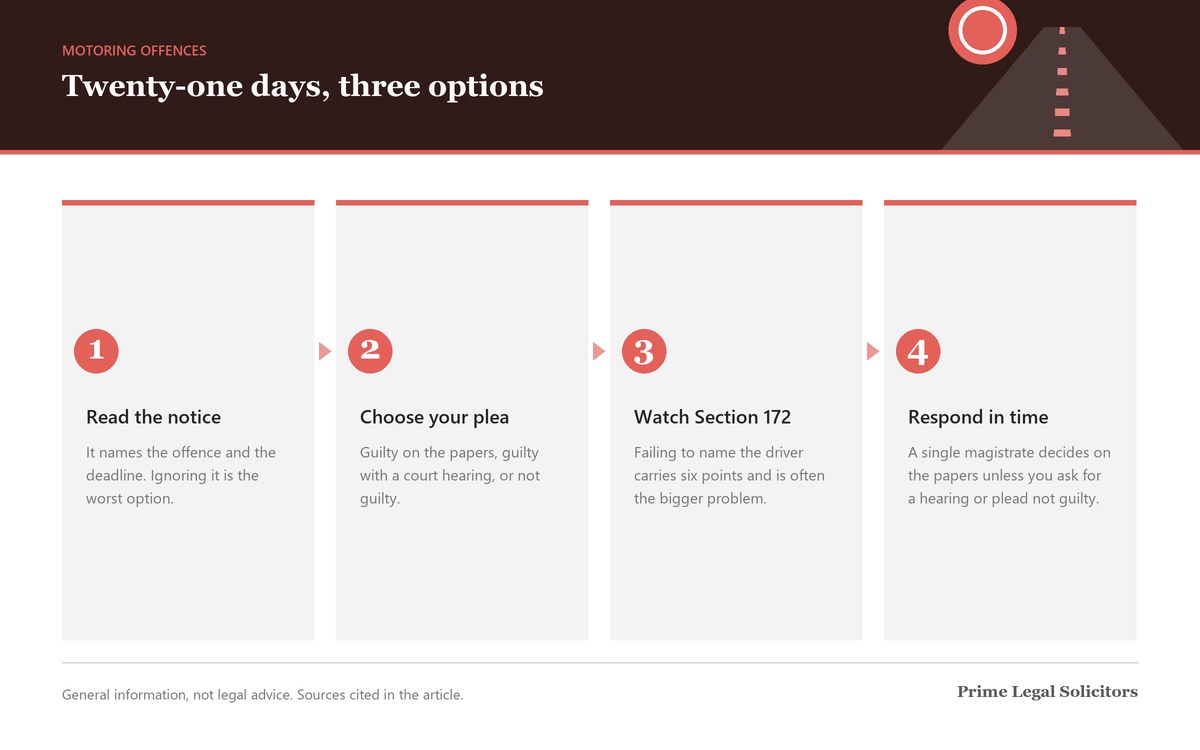
A Single Justice Procedure notice is a prosecution, not a fine or a reminder. You have 21 days from the date shown on the notice to respond. If you do not, a single magistrate decides the case on the papers without you, you lose the credit for a guilty plea, and the fine is assessed without your income figures. Work to the date printed on your own notice.
Three things to do before you read anything else:
- Find the date on the notice, count 21 days and write the deadline on the envelope. Not 21 days from when you opened it.
- Check what the offence is. A speeding allegation, a no-insurance allegation and a failure to give driver information are three different problems with three different answers, and one notice can carry more than one.
- Count your points. If this matter would take you to twelve, stop, tick the box asking to attend court, and get advice before you send anything.
GOV.UK puts the deadline plainly on its single justice procedure notices page: “You have 21 days from the date shown on the notice to respond.” Trust the date on your own paperwork.
The procedure is used for adults charged with summary-only offences that cannot be punished with prison: speeding, no insurance, no vehicle tax, failing to give driver information and similar. A single magistrate, with a legal adviser, reads the file. There is no prosecutor in the room and no hearing unless somebody asks for one.
Nothing dramatic happens on day 22, and that is the problem
No officer calls. No letter arrives for weeks. It feels as though the notice went away. It did not: GOV.UK states that “A magistrate will make a decision on your case without your say if you do not respond to your notice within 21 days”, and that responding with a guilty plea reduces the fine by up to 33%. Silence costs you that reduction and your means information at the same time.
Your options, and what each one means
Which option applies to you
The response form gives you three real choices. Doing nothing is a fourth outcome, not a choice.
| Your option | What it means | What the magistrate sees | When it is the right choice |
|---|---|---|---|
| Guilty, no hearing | You accept the offence and send written mitigation plus your financial details. A single magistrate sentences on the papers. | Your plea, your means figures, your mitigation, the prosecution file. Up to 33% off the fine for the plea. | The allegation is right, the points will not take you near twelve, and nothing needs explaining in person. |
| Guilty, and I want a hearing | You accept the offence but ask for an ordinary hearing so you can address the court yourself. | The same papers, then you in person at a listed hearing in open court. | Disqualification is in play, you are running special reasons or exceptional hardship, or your finances need questions asked. |
| Not guilty | You dispute the offence. The case leaves the SJP automatically and is listed for trial. | Nothing on the merits yet. A trial date is set, usually months away, with disclosure and witnesses. | You were not the driver, the notice is defective, the evidence is wrong, or you have a statutory defence. |
| No response | The 21 days expire and the case is decided in your absence. | The prosecution file only. No plea credit, no means information, no mitigation. | Never. This is the most expensive option on the form. |
You can normally respond online using the reference on the notice, or by post. Keep a copy of everything you send and the date you sent it. If you cannot complete one part in time, respond inside the 21 days with the plea you are sure about and contact the court office about the rest. An incomplete response sent on time beats a complete one sent late.
If the deadline has already passed
Respond anyway, immediately: if the case has not yet been decided, a late response may still be considered. If it has been decided and you never knew about the proceedings, the route back is the statutory declaration set out below.
The means form, and why it matters
Fines in the magistrates’ court are not flat charges. They are calculated as a percentage of relevant weekly income, which is why the financial section of the form matters more than the paragraph where you explain yourself. A speeding matter usually sits in Band A, B or C depending on the recorded speed against the limit.
| Band | Starting point | Range | Where it typically bites |
|---|---|---|---|
| Band A | 50% of relevant weekly income | 25–75% | Lower-range speeding, for example 31–40mph in a 30 limit |
| Band B | 100% | 75–125% | Mid-range speeding, for example 41–50mph in a 30 limit |
| Band C | 150% | 125–175% | Higher-range speeding (51mph and above in a 30 limit); the starting point for failing to give driver information |
| Band D | 250% | 200–300% | More serious offences |
| Bands E and F | 400% and 600% | 300–500% and 500–700% | The most serious end of the fine range |
Leave the means section blank and the court does not guess in your favour. The Sentencing Council guidance directs a court with insufficient information to proceed on the basis of an assumed relevant weekly income, a figure of £440 as at November 2026 under the Sentencing Council’s approach to the assessment of fines. If you earn less than that, saying nothing costs you money directly. Check the live figure on that page before relying on it, because it is reviewed rather than fixed in statute.
Where the court needs a fuller picture, HMCTS publishes form MC100, described on GOV.UK as a form “used to give a statement of assets and other financial circumstances”, and it is available in other languages. It puts income, outgoings, dependants and debts before the court in the format it is used to reading.
Your document checklist
| Document | What it is for | When to send it | What happens if you do not |
|---|---|---|---|
| SJP response form (online or postal) | Your plea, your means, your mitigation, and the request to attend court | Within 21 days of the date on the notice | Decided in your absence, no plea credit, income assumed |
| Means section / form MC100 | Statement of assets and financial circumstances so the fine is set on your actual income | With the response, or as soon as the court asks | The court may proceed on an assumed weekly income, which is often higher than your real one |
| Section 172 reply (driver identity) | Naming the driver, or setting out the enquiries you made | Within the period stated on the request, normally 28 days | A separate offence carrying 6 points and MS90 |
| Written mitigation | The one chance to speak if you are not attending | With the guilty plea | Sentencing on the bare facts of the file |
| Statutory declaration of ignorance of proceedings | Setting aside a case decided without your knowledge | Within 21 days of finding out, under s.14 Magistrates’ Courts Act 1980 | The conviction, fine and endorsement stand and enforcement continues |
| Proof of posting or online submission receipt | Evidence that you replied, and when | Keep from day one | Disputes about whether you responded are difficult to win without it |
The section 172 trap: naming the driver
Most speeding and red-light notices begin as a Notice of Intended Prosecution sent to the registered keeper. Under section 1 of the Road Traffic Offenders Act 1988 that notice generally has to be served within 14 days of the offence for the offences listed in Schedule 1. Alongside it comes a request under section 172 of the Road Traffic Act 1988 requiring the keeper to say who was driving. This is where people do the real damage to themselves.
Six points, MS90, and often worse than the offence it replaced
Failing to comply with a section 172(2) requirement is an offence under section 172(3). Part I of Schedule 2 to the Road Traffic Offenders Act 1988 sets the consequences: triable summarily only, a maximum fine of level 3 on the standard scale, endorsement obligatory, disqualification discretionary, and 6 penalty points. The endorsement code is MS90 and GOV.UK says MS codes stay on the driving record for four years from the date of the offence. The speeding matter the request related to might have cost you three points and a Band A fine. Putting the letter in a drawer can double the points and leave you halfway to a totting ban.
Level 3 on the standard scale is £1,000 as at October 2026, under section 122 of the Sentencing Act 2020. The Sentencing Council guideline for failing to give information of driver’s identity gives a starting point of a Band C fine, 150% of relevant weekly income, within a range running from a discharge to Band C. None of that tells you what any individual will receive: the band is a starting point and the court works from your circumstances.
If you genuinely do not know who was driving
Section 172(4) provides a defence where you did not know and could not with reasonable diligence have ascertained who the driver was. The bar is real, and a bare “I don’t know” almost never survives it. What a court looks for is the diligence: the diary, the work rota, fuel receipts, tracker or telematics data, insurance records, the household calendar, and a written note of what you checked and what it showed. Reply within the period stated even if the answer is incomplete, because silence is what creates the offence.
If the registered keeper is a company
A company cannot be endorsed, so the Sentencing Council guideline records that a fine is the only available penalty where the offender is a limited company. That is no reason to leave the request unanswered, and if the company then names you, the points land on your licence in the ordinary way. A keeper who runs a fleet is also expected to know who had which vehicle.
One thing never to do: do not nominate somebody else to take the points. That is perverting the course of justice, a Crown Court offence that can lead to an immediate prison sentence. It is far graver than anything printed on the notice.
A worked example: the keeper who was not driving
Imagine, hypothetically, a car registered to one person and driven by two. A camera records it at 38mph in a 30mph limit on 3 March. The keeper receives a Notice of Intended Prosecution and a section 172 request on 14 March, within the 14-day period.
Path A — the request is answered. The keeper checks the shared calendar and the fuel receipt for that morning, establishes that her partner had the car, and names him with his licence number inside the stated period. He receives the speeding notice. If the case goes to court and he pleads guilty on time, he faces three points and a Band A fine, reduced by up to 33% for the plea. Total exposure: three points, one fine.
Path B — the request is ignored. No reply goes back. The police cannot proceed against the driver, so they prosecute the keeper under s.172(3) instead. She now faces 6 points and an MS90 endorsement, with a Band C starting point, and disqualification is available to the court as a discretionary option. The three-point speeding matter has become a six-point matter with a higher fine band. If she already had six points, she is a totting case, and if this takes her to twelve points a totting-up ban of at least six months is the default position.
Path C — the honest “I don’t know”. The car was lent to a visiting relative and the keeper cannot be sure which of two people drove. Her reply, sent in time, lists what she checked: the dates the relative had the keys, the mileage, two text messages, and a note that neither person will confirm. That reply is a s.172(4) argument the court can test. A blank envelope is not.
The gap between Path A and Path B is one letter, and it is the single most expensive letter in motoring law.
When to ask for a court hearing instead
Asking to attend usually costs you a day. It is the right choice more often than people assume:
- The points would take you to twelve. A totting disqualification should not be decided on paper in your absence. Tick the box and say why.
- You are arguing special reasons, such as a genuine emergency. That argument has to be heard and tested, not read.
- Your finances need explaining. Irregular self-employed income, benefits, debt and dependants land better when a bench can ask questions.
- You dispute the facts. A not guilty plea takes the case out of the SJP automatically.
- The allegation may be more serious than it looks. If what is really being described shades into careless or dangerous driving, take advice before you put anything in writing.
Hearings are listed at the magistrates’ court for the area. Listing times vary, so expect to wait, and keep gathering documents while you do.
Writing mitigation a single magistrate will actually read
If you plead guilty on the papers, your written mitigation is your only voice, and the magistrate is reading a stack of files. What the court is looking for is narrow.
Include
- Your financial circumstances, with figures: weekly or monthly income, outgoings, dependants, benefits, debts. This is the part that changes the number.
- Anything affecting the band: the recorded speed against the limit, whether the limit was temporary, road and weather conditions.
- Whether disqualification is in prospect, and the consequences if it is.
- Genuine personal circumstances: caring responsibilities, a health condition, a dependant who relies on you.
- One line of acceptance. A short, unqualified acknowledgement reads far better than a page of explanation.
Leave out
- Complaints about the camera, the council or policing priorities. They do not reduce a sentence and they read badly.
- Long narrative accounts of the journey.
- Anything that contradicts the guilty plea. If you are saying you did not do it, plead not guilty instead. A letter that disputes the facts while recording a guilty plea is the most common self-inflicted wound on this form.
Keep it to one page. Attach payslips, a benefit award letter or bank statements rather than describing them.
If you were convicted without knowing
People move house, post goes astray, notices go to an old address on the DVLA record. If the first you heard of a case was an enforcement letter, a bailiff or a licence check, the route back is a statutory declaration of ignorance of proceedings, and it is a statutory right rather than a favour.
Section 14 of the Magistrates’ Courts Act 1980 is the provision. Where you make a statutory declaration that you did not know of the proceedings until a date after the court began to deal with the case, and it is served on the court within 21 days of that date, the proceedings are void. GOV.UK puts it simply: you usually need to act within 21 days of finding out. Section 14(3) lets the court accept a declaration served later where it was not reasonable to expect service within the 21 days, so a missed period is not automatically the end.
What that means in practice:
- Apply to the court to reopen the case. GOV.UK’s guidance on appealing a magistrates’ court decision has an online application, and asks where and when the hearing was held and how you found out about it.
- Make the declaration. A published form, “statutory declaration of ignorance of proceedings”, is available on GOV.UK. You can make it before a solicitor or commissioner for oaths, which you pay for, or make it at the court hearing, which GOV.UK says is free.
- Attend the hearing. This is not optional.
- Expect the case to start again. A successful declaration voids the proceedings; it does not end the allegation. The prosecution can begin afresh, and GOV.UK warns in terms that “you can still be guilty of the offence, even if you did not know about your case”. The gain is that you get to defend it, plead on time and have your means heard.
Take your address history: tenancy agreement, council tax bills, change-of-address confirmation, redirect paperwork. The declaration is about what you knew and when, so the evidence that matters is about where the post went.
What goes wrong most often
- Ignoring the notice. The single most expensive decision on this page: conviction in absence, no plea credit, an assumed income and points you never argued about.
- Leaving the means section blank. The court does not read a gap as poverty; the guidance points it to an assumed weekly income instead.
- Disputing the offence inside a guilty plea. It is treated as a guilty plea with a poor mitigation letter.
- Missing that the notice carries two offences, commonly no insurance plus a s.172 failure, which between them can produce twelve points from one incident.
- Answering the section 172 request late, or not at all. Six points for silence.
- Not asking to attend when disqualification is in play. There is no undo button once a bench has sentenced on the papers.
- Assuming nothing can be done after a conviction in absence. The s.14 period runs from when you found out, not from the hearing.
What to do in the next 21 days
- Day 1. Find the date on the notice, count 21 days, write the deadline on the envelope. Read the offence wording twice.
- Day 1. Identify whether a section 172 request is outstanding. If it is, that is the urgent one.
- Day 2. Check your driving record on GOV.UK’s View your driving licence service and list the offence dates, not just the points total.
- Day 2. Work out the totting risk. If this takes you to twelve or more, get advice before you respond at all.
- Days 3–10. Gather what you need: payslips or a benefit letter, bank statements, insurance documents, and any evidence of the enquiries you made about who was driving.
- By day 14. Decide the plea and draft either the mitigation or the not guilty response. Complete the means section in full.
- Before day 21. Submit, and keep the reference or proof of posting.
If you are unsure at any point, ask before the 21 days run out rather than after. Our motoring offence solicitors can read a notice quickly and say whether it is a form-filling exercise or a case that needs a hearing, and you can contact the team if the deadline is days away.
Where to get free help
Not every SJP notice needs a solicitor. If the allegation is correct, the points will not take you near twelve and you simply need help with the form, Citizens Advice and the court office may be all you need. We would rather say that than take instructions on a case that does not need us. No one can tell you what fine or how many points you will receive either: sentencing belongs to the court. What you control is whether it decides with your side of the story in front of it.
Frequently asked questions
What is a Single Justice Procedure notice?
It is a prosecution of an adult for a summary-only, non-imprisonable offence, dealt with by one magistrate sitting with a legal adviser rather than in open court. It sets out the allegation, the evidence relied on, and a response form for your plea, your financial circumstances and your mitigation. Speeding, no insurance, unpaid vehicle tax and failing to give driver information are commonly dealt with this way.
How long do I have to respond to an SJP notice?
GOV.UK says you have 21 days from the date shown on the notice, so work to the date printed on your own paperwork rather than the day it arrived. If you need longer for part of it, respond in time and contact the court office about the rest.
What happens if I ignore an SJP notice?
A single magistrate decides the case without you. You lose the reduction of up to 33% for a guilty plea, the court can assess the fine on an assumed weekly income rather than your real one, points are endorsed, and costs and the victim surcharge are added. Unpaid fines go to enforcement, which can reach wages or benefits. Nothing visible happens on day 22, which is why people miss it.
What is a Notice of Intended Prosecution?
It is the warning that a prosecution is being considered, sent to the registered keeper after a camera or police observation. Under section 1 of the Road Traffic Offenders Act 1988 it generally has to be served within 14 days of the offence for the offences listed in Schedule 1. It usually arrives with a section 172 request asking who was driving, which is a separate legal duty.
What if I do not know who was driving?
Section 172(4) of the Road Traffic Act 1988 provides a defence where you did not know and could not with reasonable diligence have found out. Courts expect to see the diligence: diaries, rotas, fuel receipts, tracker data, insurance records, and a written note of what you checked and what it showed. Reply within the stated period even if the answer is incomplete, because the offence is created by the failure to reply.
Can I ask for a court hearing instead?
Yes. The response form lets you plead guilty and still ask to attend, and a not guilty plea takes the case out of the Single Justice Procedure automatically. Asking to attend is sensible where disqualification is in prospect, where you are running special reasons, or where irregular income needs explaining. The hearing is listed at the magistrates’ court for the area and you may wait some weeks.
What is a statutory declaration?
It is a formal statement that you did not know about the proceedings until after the court had begun to deal with the case. Under section 14 of the Magistrates’ Courts Act 1980, served within 21 days of finding out, it makes the proceedings void. The court can accept a later declaration where serving in time was not reasonable. The prosecution can then start the case again.
Will I get points from an SJP case?
If the offence carries obligatory endorsement, yes: the single magistrate endorses the licence just as a court in open session would. That is why the totting arithmetic matters before you respond. Where the points would take you to twelve or more, ask to attend court so any exceptional hardship argument can be heard on evidence rather than decided on the papers.
What is the MC100 form?
MC100 is the HMCTS form described on GOV.UK as being used “to give a statement of assets and other financial circumstances”. It lets you put income, outgoings, dependants and debts before the court in the format it expects, which matters because magistrates’ court fines are calculated as a percentage of relevant weekly income. It is available in other languages.
Sources
- GOV.UK — Single justice procedure notices
- Road Traffic Act 1988, s.172 (duty to give information as to identity of driver)
- Road Traffic Offenders Act 1988, Schedule 2 (prosecution, punishment and endorsement)
- Magistrates’ Courts Act 1980, s.14 (proceedings invalid where accused did not know of them)
- Sentencing Council — Approach to the assessment of fines
- Sentencing Council — Speeding guideline
- Sentencing Council — Fail to give information of driver’s identity as required
- GOV.UK — Endorsement codes and penalty points
- GOV.UK — Form MC100: make sure you can pay your fine
- GOV.UK — Statutory declaration of ignorance of proceedings
- GOV.UK — Appeal a magistrates’ court decision: if you did not know about your case
Please note: This article is general information about the law in England and Wales as at 4 November 2026. It is not legal advice and does not create a solicitor-client relationship. Speak to a solicitor before making a decision. Prime Legal Solicitors is authorised and regulated by the Solicitors Regulation Authority, SRA No. 834471.
Author

Suits You Media Dev