

Yes, a non-molestation order can be extended, but only if you apply before it expires. You ask the court that made the order, on form FL403, and explain why you still need protection. Once an order has ended it cannot be revived, so you would have to start again with a fresh application. This guide explains how long orders last, how extension works and what happens on breach.
Key takeaways
- An extension must be applied for while the order is still in force. Use form FL403 and send it to the court that made the order. If the order has already expired, you need a new application.
- The Family Law Act 1996 lets the court make an order for a fixed period or until further order. Orders made without notice must have a fixed end date, often 6 or 12 months in abuse cases.
- The application is a civil one in the Family Court. Breaching the order without reasonable excuse is a criminal offence under section 42A, with a maximum of five years’ imprisonment.
- In an emergency the court can make an order the same day without telling the other person first. A return hearing then follows, normally within 14 days.
- There is no court fee to apply for a non-molestation order. Legal aid is available for protective orders, and the usual financial limits can be waived. Our guide to domestic abuse and family law covers the wider picture.
The short answer: yes, if you act before the end date
A non-molestation order is a court order under section 42 of the Family Law Act 1996. It stops the person named in it, the respondent, from molesting you or a relevant child. Molestation is not defined in the Act. It covers violence, threats, intimidation and harassment, and an order can ban particular acts as well as molestation in general.
The court can extend an order that is about to end. The application is made on form FL403, which is the form used to vary, extend or discharge an order in existing proceedings. The government’s own guidance is clear that the extension must be applied for before the injunction ends. It also says the court usually lists a hearing within about three weeks of receiving the application. That is why we tell clients to diarise the end date the day the order is made, and to speak to us at least a month before it.
The court will want to know why protection is still needed. Recent incidents help, but they are not essential. The court looks at all the circumstances, including the health, safety and well-being of you and any relevant child. A respondent who has kept to the order has not necessarily stopped being a risk.
How long does a non-molestation order last?
Section 42(7) of the Family Law Act 1996 says an order may be made for a specified period or until further order. No statutory maximum applies. The wider family law framework leaves the length to the judge.
Practice Guidance from the President of the Family Division says a without notice injunction must never be made without limit of time. It must state precisely when it expires and must fix a return day, normally no more than 14 days later. In personal protection cases the order itself can run for longer, such as 6 or even 12 months, provided that return day is listed. More than 6 months is likely only where long-term abuse is alleged or there is another good reason.
Orders made after a full hearing, or by agreement at the return hearing, can be for a fixed period or until further order. The judge decides the length on the evidence, so it is worth explaining clearly why a longer order is needed. If you are also dealing with child arrangements, the length of the order and the terms about contact need to fit together.
| Stage | Form or rule | Timing | What to know |
|---|---|---|---|
| First application | Form FL401 with a witness statement | Can be heard the same day in an emergency | No court fee. Your statement must explain why notice was not given if you apply without notice |
| Without notice order | Section 45, Family Law Act 1996 | Return day normally within 14 days | The order must say when it ends. The respondent can apply to set it aside or vary it before the return day |
| Service | Family Procedure Rules, Part 10 | As soon as possible after the order | You must not serve the papers yourself. The court or a process server can serve, and a copy goes to the police |
| Return hearing | Section 45(3) | The date fixed on the order | The respondent can contest it, agree it, or offer an undertaking. If they do not attend, the court can still continue the order |
| Extension | Form FL403 | Before the order expires | Send it to the court that made the order. A hearing is usually listed within about three weeks |
| Order has expired | Fresh form FL401 | Whenever protection is needed | An expired order cannot be extended. You start again with new evidence |
How to apply to extend the order
The process is short, but the evidence matters. Our family law team follows these steps.
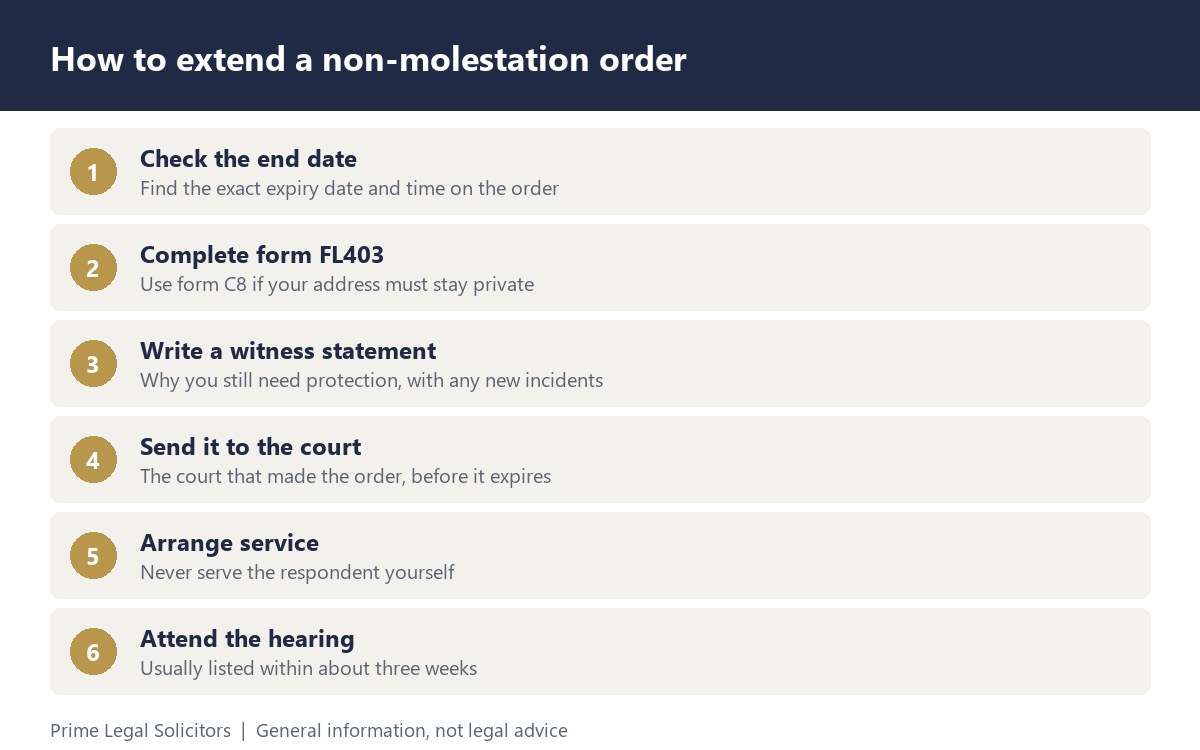
- Check the exact end date and time on the face of the order.
- Complete form FL403. If you want to keep your address private, leave those details blank and complete form C8 instead.
- Prepare a short witness statement explaining why you still need protection, including any incidents since the order.
- Send the application to the court that made the order, by email, post or in person.
- Arrange service on the respondent, under the same rules as the original order.
- Attend the hearing. The judge decides whether to extend, for how long, and whether to change the terms.
If the end date is close and the hearing cannot be listed in time, tell the court and ask for the application to be dealt with urgently.
What if my order has already expired?
Once the end date passes, there is nothing left to extend. You need a fresh application on form FL401 with a new witness statement. The court can consider the history, but it will want to know the current position.
If you fear further abuse, a fresh application can be made without notice in the same way as the first. If you are new to us, our note on a first meeting explains what to bring.
Is a non-molestation order criminal or civil?
Both, at different stages. The application is civil. It is made in the Family Court, by you, and the judge decides it on the civil standard of proof. The respondent does not get a criminal record just because an order is made.
Breach is different. Section 42A of the Family Law Act 1996 makes it a criminal offence to do anything the order prohibits without reasonable excuse. The maximum sentence on indictment is five years’ imprisonment, a fine, or both. In the magistrates’ court the maximum is the general limit for imprisonment, a fine, or both.
A breach can also be dealt with as contempt of court in the Family Court. The Act prevents double punishment. If conduct has been punished as contempt it cannot also be prosecuted under section 42A, and the reverse also applies. Where the order was made without notice, a person can only commit the criminal offence for conduct after they knew the order existed. That is one reason prompt service matters. Our non-molestation solicitors can advise on which route suits your case.
If the order is breached
- If you are in immediate danger, call 999.
- Keep every message, screenshot, call log and photograph, with dates.
- Report the breach to the police and give them a copy of the order.
- Tell your solicitor, particularly if the order is due to expire soon. A breach is strong evidence for an extension.
How quickly can I get a non-molestation order?
In an urgent case, the same day. Section 45 of the Act allows the court to make an order without notice to the respondent where it is just and convenient. The court considers any risk of significant harm if an order is not made immediately, and whether you would be deterred from applying if the respondent were told first.
A without notice order is not the end of the matter. The respondent must have the chance to put their side at a full hearing as soon as just and convenient. They are also entitled to apply to set aside or vary the order before the return day. If you are not in immediate danger, the court may list the application on notice instead, in which case the respondent must be served at least two days before the hearing.
We act for applicants in Manchester, London, Yorkshire and Lancashire.
Does it cover online harassment and social media?
Yes. Because molestation is not defined narrowly, an order can prohibit contact by any means. That includes calls, texts, email, messaging apps and social media. It can also cover posting about you, contact through friends or family, and fake accounts. The wording should fit how the abuse actually happens.
Online conduct leaves a record. Save screenshots showing the date, time and account name, and note every new account the respondent uses.
Varying, discharging and undertakings
Either party can apply to vary or discharge an order on form FL403. The respondent might ask to change the terms so that contact with children can take place safely.
An undertaking is a formal promise to the court instead of an order. It is enforceable as if it were an order, but only through the Family Court as contempt. Breach of an undertaking is not the criminal offence under section 42A. For that reason, section 46 says the court must not accept an undertaking instead of an order where the respondent has used or threatened violence and an order is needed so that any breach can be punished as a crime. Think carefully before agreeing to an undertaking, and get advice first.
Who can apply: associated persons
You can apply if you are associated with the respondent under section 62 of the Act. That includes people who:
- are or were married or in a civil partnership with each other, or agreed to marry;
- live or have lived together, or in the same household other than as tenant, lodger or employee;
- are relatives;
- have or had an intimate personal relationship of significant duration;
- are both parents of, or have had parental responsibility for, the same child; or
- are parties to the same family proceedings.
A child under 16 needs the court’s permission to apply. A court hearing other family proceedings, such as a divorce or children case, can also make a non-molestation order of its own motion.
Non-molestation orders and occupation orders
A non-molestation order controls behaviour. An occupation order controls the home. It can decide who lives in the property, exclude the respondent from it, or keep them away from the area around it. Occupation orders fall under sections 33 to 38 of the Act and the tests are stricter. The two orders are often applied for together on form FL401, and the same form FL403 is used to extend either.
Domestic abuse protection orders under the Domestic Abuse Act 2021 are currently available only where the respondent lives in certain pilot areas, including Greater Manchester, Croydon, Bromley, Sutton, Cleveland and North Wales. Breach of one is also a criminal offence with a maximum of five years. Our article on abuse and family law explains how these protections interact.
Court fees, legal aid and costs
There is no court fee to apply for a non-molestation order or an occupation order. Legal aid is available for protective injunctions in domestic abuse cases, subject to a means and merits assessment. Regulation 12 of the Civil Legal Aid (Financial Resources and Payment for Services) Regulations 2013 lets the Legal Aid Agency disapply the usual financial eligibility limits where it considers it equitable. That is a discretion, not an automatic right.
If you are paying privately, our published fee for applicant representation at court starts from £1,500 plus VAT. Our pricing page sets out what is included. To discuss an extension or a new application, call 0330 341 4757.
Frequently asked questions
Can a non-molestation order be extended?
Yes, as long as you apply before it expires. Use form FL403 and send it to the court that made the order, with a statement explaining why you still need protection. The court usually lists a hearing within about three weeks, so do not leave it to the last few days.
How long does a non-molestation order last?
As long as the court says. The Act allows a fixed period or until further order. Orders made without notice must have a fixed end date, and in abuse cases this is often 6 or 12 months, with a return hearing normally within 14 days. Our specialist team can check your order.
What happens if a non-molestation order is breached?
Breach without reasonable excuse is a criminal offence under section 42A of the Family Law Act 1996, with a maximum of five years’ imprisonment on indictment. It can instead be dealt with as contempt in the Family Court, but not both. Report breaches to the police and keep the evidence.
Can I extend a non-molestation order after it has expired?
No. Once the end date has passed there is nothing to extend, so you make a fresh application on form FL401. The court can take the history into account and can act without notice if it is urgent.
Is there a court fee for a non-molestation order?
No. The family court fees guide lists applications for non-molestation orders and occupation orders as having no fee. Legal aid may cover your legal costs.
Will the respondent know I have applied?
Yes, eventually. Even if the order is made without notice, it must be served and the respondent can ask to be heard. You can keep your address private by using form C8. If you live in Lancashire or elsewhere, we can arrange service so you never have to deal with the respondent directly.
Do I need a solicitor to extend an order?
No, you can apply yourself. A solicitor helps with the evidence, the wording and the timing. Our London family solicitors and regional teams can act quickly.
Please note: This article is general information about the law of England and Wales as at November 2026. It is not legal advice and does not create a solicitor-client relationship. Speak to a solicitor before making a decision. Prime Legal Solicitors is authorised and regulated by the Solicitors Regulation Authority, SRA No. 834471.
Author

Suits You Media Dev