

A Property and Financial Affairs LPA lets your attorneys deal with your money and property, and it can be used with your consent while you still have capacity. A Health and Welfare LPA lets them make decisions about your care, treatment and daily life, and it can only be used once you lack capacity to make the decision yourself. They are separate legal documents, registered separately, and most people need both.
Key takeaways
- There are two types of lasting power of attorney under the Mental Capacity Act 2005. One covers property and financial affairs. The other covers health and welfare. Neither covers the other’s decisions.
- A financial LPA can be used as soon as it is registered, if you allow that. A health and welfare LPA only works when you lack capacity to make the particular decision.
- Your attorneys can only refuse life-sustaining treatment on your behalf if your health and welfare LPA expressly gives them that power.
- You can appoint more than one attorney, and choose whether they act jointly, jointly and severally, or jointly for some decisions only. Our lasting power of attorney solicitors can help you choose.
- The Office of the Public Guardian charges £92 to register each LPA, so £184 for both. The main reforms in the Powers of Attorney Act 2023 are not yet in force.
- Without an LPA, your family may have to apply to the Court of Protection for a deputyship order, which is slower and more expensive.
The short answer: two documents, two kinds of decision
A lasting power of attorney (LPA) is a legal document in which you, the donor, appoint people you trust, your attorneys, to make decisions for you. The Mental Capacity Act 2005 creates two types. Each is made, signed and registered on its own, and each gives power over a different part of your life.
The Property and Financial Affairs LPA covers money and assets. The Health and Welfare LPA covers your body, your care and where you live. If you are also putting a will in place, our wills solicitors usually deal with both at the same appointment.
Side-by-side comparison
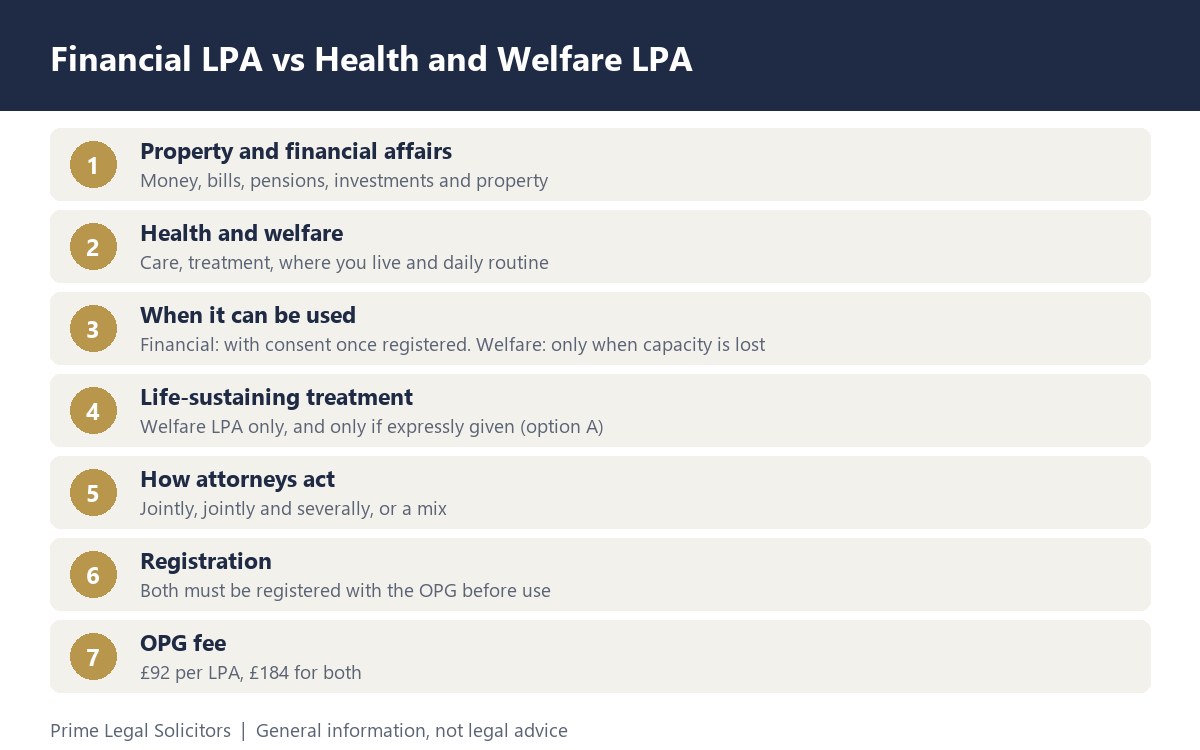
The rules on attorneys, certificate providers and registration are the same for both. The table shows where they differ.
| Feature | Property and Financial Affairs LPA | Health and Welfare LPA |
|---|---|---|
| What it covers | Bank and building society accounts, bills, pensions and benefits, investments, tax, and buying, selling or letting property | Medical treatment, care arrangements, where you live, daily routine such as diet and dress, and contact with others |
| When it can be used | Once registered. You choose whether it can be used while you have capacity, with your consent, or only when you lack capacity | Only once registered and only when you lack capacity to make the decision in question |
| Life-sustaining treatment | Not applicable | Only if the LPA expressly gives your attorneys this power |
| Who can be an attorney | Anyone aged 18 or over with capacity, but not an undischarged bankrupt or a person subject to a debt relief order. A trust corporation can act | An individual aged 18 or over with capacity |
| OPG registration fee | £92 | £92 |
The Property and Financial Affairs LPA
This LPA lets your attorneys manage your finances. In practice that means paying bills and care fees, dealing with your bank, collecting your pension, managing investments, filing tax returns, and selling or letting your home if that becomes necessary. Our private client team can advise on what to include.
The key feature is timing. On the form, you choose whether your attorneys can act as soon as the LPA is registered, or only once you lack mental capacity. Many choose the first, so an attorney can help with your consent, for example while you are in hospital or abroad. You stay in charge while you have capacity. If you choose the second, banks may ask for evidence of incapacity, which causes delay. If the home may need to be sold, read our guide to inheritance tax planning too.
The Health and Welfare LPA
This LPA covers personal decisions. Your attorneys can decide where you live, whether you move into a care home, what care you receive, your daily routine, and whether you consent to or refuse medical treatment. Section 11(7)(a) of the Mental Capacity Act 2005 says it can only be used where you lack capacity, or the attorney reasonably believes you lack capacity, to make the decision yourself.
Capacity is decision-specific. Someone with early dementia may be unable to decide about an operation but still able to choose who visits them. The attorney only steps in on the decisions you cannot make. Every decision must be made in your best interests, as section 4 of the Act requires. Our guide to LPAs explains why this document is often left too late.
Life-sustaining treatment: the decision you must make on the form
Under section 11(7)(c) and 11(8) of the Mental Capacity Act 2005, your attorneys can only give or refuse consent to life-sustaining treatment if your LPA contains express provision to that effect. The health and welfare form asks you to sign either option A, giving your attorneys that authority, or option B, leaving the decision to the doctors treating you, who will take your attorneys’ views into account. You can only sign one.
If you already have an advance decision to refuse treatment, the order in which the documents were made matters. A later health and welfare LPA that covers the same treatment can override an earlier advance decision. Ask us to check how your documents fit together.
Can I appoint more than one attorney?
Yes. Section 10(4) of the Act lets you choose how they act, separately for each LPA.
- Jointly and severally. Each attorney can act alone, or they can act together. It is the most flexible option, and if one attorney stops acting the others carry on.
- Jointly. All attorneys must agree and act together on every decision. It is the strongest check but slow, and if one attorney can no longer act the LPA usually stops working unless a replacement is named.
- Jointly for some decisions, and jointly and severally for others. You list the decisions that need everyone’s agreement, such as selling your home or deciding on a care home move. Unclear wording can stop the OPG registering it.
If the form does not say how your attorneys are to act, section 10(5) treats them as appointed jointly. Our LPA team will check that the wording does what you want.
Replacement attorneys
You can name replacement attorneys under section 10(8). A replacement steps in only if an original attorney dies, loses capacity, disclaims the role, becomes bankrupt (for the financial LPA), or was your spouse or civil partner and the marriage or partnership ends. A replacement cannot stand in temporarily, for example during a holiday. Couples often make mirror wills and LPAs together.
The certificate provider and people to notify
Every LPA needs a certificate provider. This is an independent person who signs to confirm that you understand the LPA and that no one is pressuring you or acting fraudulently. Schedule 1 to the Act requires it. The certificate provider must be 18 or over and must either have known you personally for at least two years, or be a person with relevant professional skills, such as your GP or a solicitor. Family members and your attorneys cannot do it.
You can also name up to five people to notify. They are told when the LPA is about to be registered, which gives them a chance to object. It is optional, but it guards against pressure and suits families in second marriages or with unmarried partners.
Registration with the Office of the Public Guardian
An LPA cannot be used until it has been registered with the Office of the Public Guardian (OPG). Section 9(2)(b) of the Act says so. Register it straight away, while you can still sign a new form if the OPG finds an error.
The OPG registration fee is £92 for each LPA, so £184 for both. It rose from £82 on 17 November 2025. You may be able to pay half the fee if your income is under £12,000, or nothing if you receive certain means-tested benefits. If an application is rejected and resubmitted within three months, a reduced fee applies. Our own fees for preparing the documents are on our pricing page.
The OPG currently says registration takes 8 to 10 weeks if there are no mistakes. That includes a statutory four-week waiting period, which gives the people to notify time to object.
The Powers of Attorney Act 2023 and the move online
The Powers of Attorney Act 2023 will change how LPAs are made and registered. It allows for a largely digital process, identity checks on the people involved, and a new way to object to registration. As at November 2026, the main provisions in section 1 and the Schedule to that Act are not yet in force. Only the section on certified copies of powers of attorney is in force.
For now, the existing system applies. You can prepare your LPA using the government’s online service or on paper, but it must still be signed and witnessed in the required order. Do not delay making an LPA to wait for the change. Our wills and probate team keeps track of these changes.
What happens if you do not have an LPA
If you lose capacity without an LPA, no one has automatic authority to manage your affairs. That includes your spouse or civil partner. Accounts and property in your sole name can be frozen. The common-law marriage myth catches out many cohabiting couples here as well.
Your family would then have to apply to the Court of Protection under section 16 of the Mental Capacity Act 2005 for an order appointing a deputy. That involves court fees, a capacity assessment, supervision fees, annual reports to the OPG and often a security bond. The court, not you, decides who the deputy is. Welfare deputies are rarely appointed, so families often have no standing authority over care.
Enduring powers of attorney
Enduring powers of attorney (EPAs) were replaced by LPAs on 1 October 2007. An EPA validly made before then still works. It covers property and financial affairs only, never health and welfare. Once the attorney believes the donor is losing capacity, it must be registered with the OPG. An EPA holder may still want a health and welfare LPA. Clients in Greater Manchester and West Yorkshire, including Bolton, Rochdale and Huddersfield, often bring an old EPA to us for review.
Do you need both LPAs?
For most adults, yes. A stroke can leave someone unable to manage their bank account and unable to decide about rehabilitation at the same time. With only a financial LPA, your attorney can pay the care home but cannot decide whether you should move into one.
Making both together usually saves professional time and means one set of signatures. You can choose different attorneys for each, such as a financially capable child for money and a child who lives nearby for welfare.
Review your LPAs alongside your will. Our guide to estate planning covers the wider picture.
Cost considerations
There are two layers: the OPG fee of £92 per LPA, and any professional fee. You can make an LPA yourself, but a solicitor adds value where your family is complex, you want restrictions, a challenge is possible or capacity may be questioned. A badly worded restriction can make an LPA unworkable. See our published fees before you decide.
What to do next
- Decide who your attorneys will be for each LPA.
- Choose how they will act: jointly and severally, jointly, or a mix. Name at least one replacement.
- Decide on life-sustaining treatment for the welfare LPA.
- Choose a certificate provider and, if you wish, up to five people to notify.
- Sign in the correct order, then register both LPAs with the OPG straight away.
- Get advice if your family or finances are complicated. You can contact our team or call 0330 341 4757.
Frequently asked questions
What is the difference between a health and financial lasting power of attorney?
A Property and Financial Affairs LPA covers money, bills, investments and property, and can be used with your consent while you have capacity. A Health and Welfare LPA covers care, treatment and where you live, and can only be used once you lack capacity to make the decision. They are separate documents with separate fees.
Do I need both lasting powers of attorney?
Most people do. Loss of capacity usually affects both money and care, and neither LPA covers the other’s decisions. Our LPA solicitors can prepare both at one appointment.
Can I appoint more than one attorney?
Yes. You can choose whether they act jointly, jointly and severally, or jointly for some decisions and jointly and severally for others. If you do not say, the law treats them as acting jointly. You can also name replacements.
Can my attorney use my financial LPA while I still have capacity?
Yes, if you chose that option on the form and the LPA is registered. Your attorney should act with your consent, and you can revoke the LPA while you have capacity.
Can a health and welfare attorney refuse life-sustaining treatment?
Only if your LPA expressly gives them that power. On the form you choose option A to give it, or option B to leave the decision with your doctors.
How much does it cost to register an LPA?
The Office of the Public Guardian charges £92 for each LPA, so £184 for both. Reductions and exemptions are available for people on low incomes or certain benefits. Professional fees are separate; ours are on our pricing page.
How long does LPA registration take?
The OPG says 8 to 10 weeks if there are no mistakes. That includes a four-week statutory waiting period. Mistakes on the form are the most common cause of delay or rejection.
What happens if I lose capacity without an LPA?
Your family may need to apply to the Court of Protection to appoint a deputy. That takes longer, costs more, involves ongoing supervision, and the court decides who acts for you. If you are in or near Huddersfield, we can help you put LPAs in place before that happens.
Please note: This article is general information about the law of England and Wales as at November 2026. It is not legal advice and does not create a solicitor-client relationship. Speak to a solicitor before making a decision. Prime Legal Solicitors is authorised and regulated by the Solicitors Regulation Authority, SRA No. 834471.
Author

Suits You Media Dev