
Family law
Cohabitation Agreement UK: What It Covers, Is It Binding, and When One of You Owns the House
A cohabitation agreement sets out who owns what if an unmarried couple separates. Whether it is legally binding, what to include, how to protect yourself when one partner owns the home, and what it cannot do.

A cohabitation agreement is a written contract between an unmarried couple who live together. It sets out who owns what, who pays for what, and what happens to the home, money and belongings if you separate. Courts in England and Wales will generally uphold one that is properly made. This guide explains what to include, how to make it binding, what happens when only one of you owns the house, and where an agreement cannot help.
Key takeaways
- Unmarried couples have no automatic right to maintenance, pension sharing or a fair share of the home on separation. There is no common law marriage. Our guide to cohabitation rights explains the gaps.
- A cohabitation agreement is an ordinary contract. It is enforceable if it is clear, entered freely, and made with full disclosure, ideally as a deed with independent legal advice for each partner.
- For the home, pair the agreement with a declaration of trust. A signed declaration of how you own the property is normally conclusive.
- An agreement cannot stop either parent applying to the court about the children, or to the Child Maintenance Service for child maintenance.
- The Government consulted on new rights for cohabitants from 5 June to 14 August 2026. As at November 2026, none of the proposals is law.
What a cohabitation agreement is, and why couples make one
When a married couple divorce, the court has wide powers to divide property, pensions and income according to need and fairness. When an unmarried couple separate, it has none of those powers. The home is divided according to property and trust law, savings go to whoever holds them, and neither partner can claim maintenance for themselves, however long the relationship lasted.
That gap catches out many couples. A partner who gave up work to care for children (unlike a spouse in financial remedy proceedings), or who paid the bills while the other paid the mortgage, can leave a long relationship with very little. A cohabitation agreement, sometimes called a living together agreement, lets you decide in advance what is fair for your circumstances and put it in writing. It works in a similar way to a prenuptial agreement for married couples, but it is treated as an ordinary contract rather than something the court can override.
Couples typically make one when they move in together, when one partner moves into a home the other already owns, when they buy a property with unequal deposits, or when a child is born. Many also make one when they decide not to marry, having learned from the family law basics how little the law protects them.
Is a cohabitation agreement legally binding?
Yes, if it is properly made. There is no special statute for cohabitation agreements in England and Wales, so they are governed by the ordinary law of contract. In Sutton v Mischon de Reya [2003] the High Court accepted that agreements between cohabiting couples about property and money can be enforced. The one exception is an agreement whose real purpose is a sexual relationship, which the court will not enforce.
To give your agreement the best chance of being upheld, follow these rules, which mirror the safeguards courts look for in consent orders:
| Requirement | Why it matters | How to meet it |
|---|---|---|
| Made as a deed | Removes any argument that one side gave nothing in return | Sign as a deed, with each signature witnessed |
| Independent legal advice | Shows each partner understood what they were agreeing to | Each partner sees a different solicitor, and the agreement records it |
| Full disclosure | An agreement based on hidden assets or debts can be challenged | Attach a schedule of each partner’s income, savings, debts and property |
| No pressure | An agreement signed under duress or undue influence can be set aside | Sign well before any move or purchase deadline, not the night before |
| Clear wording | Vague terms are hard to enforce and invite dispute | Use specific percentages, sums, dates and notice periods |
| Regular review | An agreement that no longer fits your lives may be argued to be unfair | Review it on a birth, a purchase, a big change in income or every few years |
A homemade agreement or an online template can still be a valid contract. But it is far easier to challenge if one partner did not take advice or the terms are unclear. The cost of drafting it properly is small next to the cost of a property dispute, which our guide to family lawyer costs sets out.
What to include in a cohabitation agreement
Each agreement is tailored, but most cover the same core areas. Our financial team sees the same issues on divorce. The table below is a checklist to work through together before you see a solicitor.
| Area | Questions to agree |
|---|---|
| The home | Who owns it and in what shares? Who pays the mortgage or rent? What happens to it if you separate? Who can stay, and for how long? |
| Contributions | Will payments towards the mortgage, improvements or an extension change the shares? Will either of you be repaid a deposit first? |
| Bills and living costs | How are bills split? Will you have a joint account, and who owns the money in it? |
| Savings, investments and pensions | Do these stay separate? Will either partner nominate the other for death benefits? |
| Debts | Who is responsible for existing debts and any new joint borrowing? |
| Possessions | Who keeps the car, furniture, gifts and inheritances? What about pets? |
| Children | How will you share the costs of raising them? What arrangements do you intend if you separate? |
| Separation | How much notice must be given? How will the home be valued and sold, or one partner bought out? Will you try mediation first? |
| Death | The agreement should say you will each make a will reflecting it, because the agreement alone does not pass property on death |
| Review | When will you look at it again? |
Be realistic, especially about pensions, which are often the largest asset after the home. Courts are more likely to uphold an agreement that was fair when it was made and still roughly fits your lives. If the terms would leave one partner and your children badly off, take advice about whether the agreement achieves what you want.
A cohabitation agreement when one person owns the house
This is the situation where an agreement matters most. If you move into a home your partner owns in their sole name, you start with no share in it. Paying bills, buying furniture or decorating rarely gives you a share. To claim one later, you would usually have to prove a shared intention that you would own part of the home, and that you relied on that to your detriment, for example by paying towards the mortgage. Those claims are slow, expensive and uncertain. Our guide to cohabitation rights in London explains how they are argued.
A cohabitation agreement lets you choose one of three clear positions instead:
- The home stays the owner’s alone. The non-owner pays a contribution to living costs, like rent, and acquires no share whatever they pay. The agreement can still give them a notice period to find somewhere else if you separate.
- The non-owner builds up a share. For example, a share that reflects their payments towards the mortgage or the value they add with an extension. This should be recorded in a declaration of trust as well as the agreement.
- The home becomes jointly owned. The owner transfers the property into joint names, with the shares set out in a declaration of trust. This needs the mortgage lender’s consent and may have tax consequences, so take advice first.
If a mortgage lender is involved, it may ask the non-owner to sign a form agreeing that their rights come second to the mortgage. Read it with advice before signing.
The declaration of trust: protecting your share of the home
A declaration of trust is a separate deed that records how the beneficial ownership of a property is shared. It must be in writing and signed to be effective. Where there is a valid express declaration, the courts treat it as conclusive unless there was fraud or mistake, or it was later varied. That is the most reliable protection either of you can have.
Without one, as many family law clients discover, ownership disputes between unmarried couples are decided under the Trusts of Land and Appointment of Trustees Act 1996, applying the principles in Stack v Dowden [2007] and Jones v Kernott [2011]. A home in joint names starts from equal shares, and a home in one name starts from 100% to that owner. Either partner can try to show that the parties intended something different, but that means looking back over the whole relationship, and the outcome is hard to predict.
If you buy together, also check how you hold the legal title. Joint tenants own the whole together, and the survivor inherits automatically. Tenants in common own separate shares, which pass under each partner’s will. A declaration of trust usually goes with a tenancy in common. If you are unsure which applies, a first meeting with a solicitor can check your title documents.
What a cohabitation agreement cannot do
An agreement is powerful, but it has limits that couples often miss:
- It cannot decide arrangements for children. You can record what you intend, but if you separate and disagree, either parent can apply for a child arrangements order, and the court decides on the child’s welfare alone.
- It cannot stop a child maintenance claim. Any term that tries to prevent either parent applying to the Child Maintenance Service is void. A parent can also apply to the court under Schedule 1 to the Children Act 1989 for housing or lump sums for a child.
- It does not act as a will. If a partner dies without a will, the other inherits nothing automatically under the intestacy rules, whatever the agreement says. Make matching wills.
- It does not give rights to the other’s pension. Pension sharing orders are only available on divorce or dissolution. An agreement can require a partner to keep a death-benefit nomination in place, but cannot split a pension.
- It may not survive marriage. If you later marry and then divorce, the court is not bound by the agreement. It will be treated like a prenuptial agreement and given weight if it is fair.
Worked example: moving into a partner’s flat
Hannah owns a flat in Huddersfield worth £220,000, with a £120,000 mortgage. Her partner Leo moves in and offers to pay half the mortgage, £450 a month, and to fund a new kitchen costing £12,000.
Without an agreement, if they separate after five years, Leo starts with no share. He has paid about £27,000 towards the mortgage plus the kitchen. To get anything back, he would have to prove that Hannah promised or intended him a share and that he paid because of it, in a claim under the 1996 Act. Hannah might argue the payments were rent. Disputes like this are a common reason couples end up in mediation or court. A contested claim like that could cost each of them more than the sum in dispute.
With an agreement and declaration of trust, they record that:
- Hannah keeps the first £100,000 of equity, which is her equity on the day Leo moves in.
- Leo’s £12,000 for the kitchen is repaid to him first on a sale or buy-out.
- Any equity above that is split according to their mortgage payments from the date Leo moved in.
- If they separate, Leo has three months to move out, and Hannah has six months to buy him out or sell.
If they separate when the flat is worth £250,000 and the mortgage is £100,000, the equity is £150,000. Hannah takes the first £100,000, Leo is repaid £12,000, and the remaining £38,000 is split equally because they paid the mortgage equally since Leo moved in. Hannah gets £119,000 and Leo £31,000. The figures are clear, and nobody has to go to court to establish them. Couples in Yorkshire and elsewhere use this kind of formula routinely.
How to make a cohabitation agreement, step by step
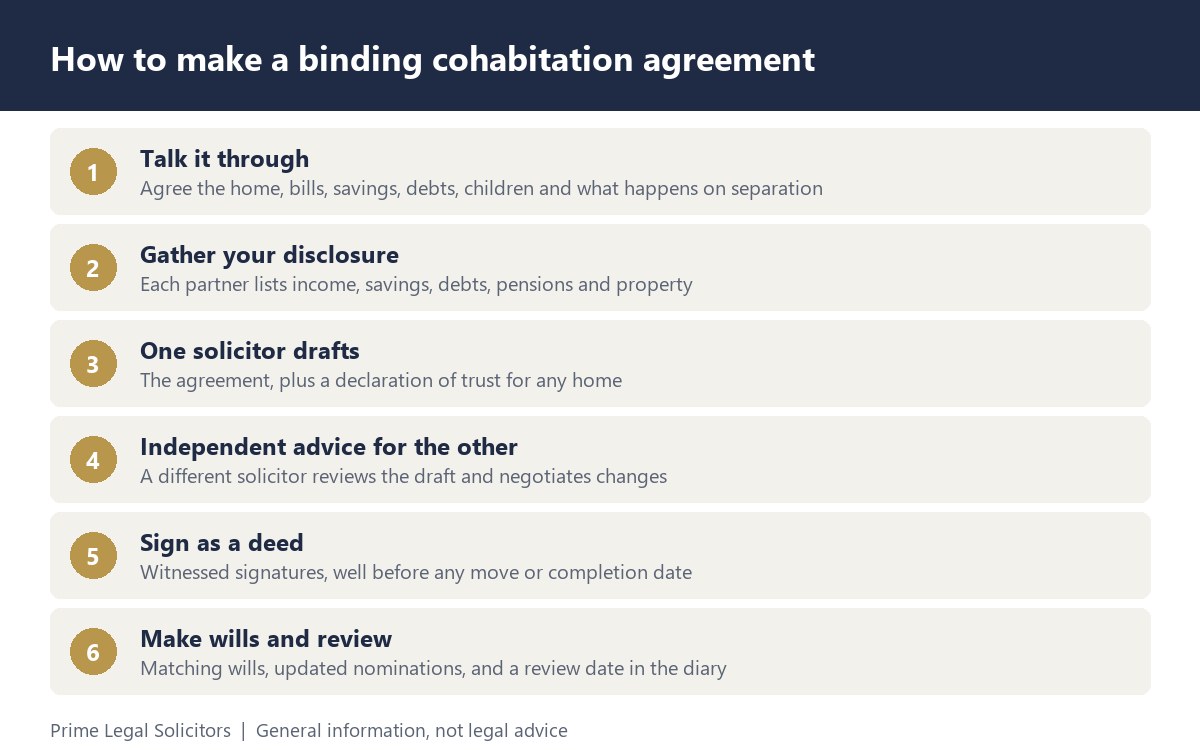
- Talk it through. Use the checklist above to agree the main terms. If you cannot agree, a mediator can help.
- Gather your disclosure. List each partner’s income, savings, debts, pensions and property, with values and statements.
- One solicitor drafts. One partner’s solicitor prepares the agreement and any declaration of trust.
- The other takes independent advice. The other partner has the draft reviewed by a different solicitor, and changes are negotiated.
- Sign as a deed. Both sign in front of witnesses, well before any move or completion date.
- Make matching wills and keep it under review. Update nominations, and diarise a review date.
If you are buying a property together, ask for the declaration of trust to be signed before completion. Our family law team works alongside your conveyancer to time it correctly.
What goes wrong
| Problem | Consequence | How to avoid it |
|---|---|---|
| Signed days before moving in or completing | Easier to argue it was signed under pressure | Agree and sign it weeks ahead |
| Only one partner took advice | The other may say they did not understand it | Separate solicitors for each partner |
| Agreement but no declaration of trust | Property shares may be argued under trust law | Sign a declaration of trust for any home |
| No wills | On death, intestacy overrides your plans | Make wills that match the agreement |
| Never reviewed after children arrive | The terms may look unfair years later | Review on each major life event |
| Trying to exclude child maintenance | That term is void | Deal with children’s costs in a way the law allows |
If your situation is different
If you are already separating
It is too late for a cohabitation agreement, but you can still make a separation agreement recording how the home, money and belongings will be divided. If you cannot agree, the remedies are a claim about the property under the 1996 Act and any claims for the children. Our guide to separation explains the first steps.
If you have children together
Make sure the unmarried father has parental responsibility. Fathers named on a birth certificate registered in England and Wales from 1 December 2003 already have it. Others can get it through a parental responsibility agreement. The cohabitation agreement can then deal with how you share the costs of raising your children.
If you are planning to marry
A cohabitation agreement can be replaced by a prenuptial agreement before the wedding. Our guide to pre-nups and post-nups explains the different rules that then apply.
If one of you becomes unwell
An unmarried partner has no automatic right to make decisions for the other. Lasting powers of attorney fix that. Our guide to the two types of LPA explains which you need.
What a cohabitation agreement costs, and how we can help
The cost depends on how complex your finances are and whether there is a property to deal with. We quote a fixed fee after a free initial consultation, so you know the price before we start. The other partner will need their own solicitor for independent advice. Matching wills start from £150 + VAT for a single will and £250 + VAT for mirror wills, and a single lasting power of attorney is £450 + VAT plus the registration fee. All our fees are on our pricing page.
Compared with a dispute after separation, an agreement is cheap. Property claims between former cohabitants often run to tens of thousands of pounds each, and each partner usually pays their own costs. To discuss an agreement, call 0330 341 4757 or contact us online. We have offices in Manchester, Rochdale, Huddersfield and London.
Frequently asked questions
Is a cohabitation agreement legally binding in the UK?
In England and Wales, yes, if it is properly made. It is a contract, so it will usually be enforced if it is clear, signed freely, based on full disclosure and, ideally, made as a deed with independent advice for each partner.
How does a cohabitation agreement work in the UK?
You agree in writing how property, money and belongings are owned and shared, and what happens if you separate. If you split up, you follow the agreement. If one partner refuses, the other can ask the court to enforce it as a contract.
Do I need a cohabitation agreement if one of us owns the house?
It is strongly advisable. Without one, the partner who moves in starts with no share, and any claim depends on proving a shared intention. An agreement and a declaration of trust record exactly what each of you owns.
Can we write our own cohabitation agreement?
You can, and it may be valid, but it is easier to challenge. Our London family guide explains when DIY documents go wrong. Independent legal advice for each partner and signing as a deed give it much stronger protection.
Does a cohabitation agreement cover children?
It can cover how you share children’s costs and what you intend for arrangements. It cannot stop either parent applying to court about the children or to the Child Maintenance Service.
What happens to a cohabitation agreement if we get married?
It does not bind the divorce court. If you marry, consider replacing it with a prenuptial agreement, which the court will take into account if it is fair.
How long does it take to make one?
Usually a few weeks, depending on how quickly you agree terms and gather disclosure. Allow enough time to sign it well before any move or property completion.
Has the law on cohabitation changed?
Not yet. The Government consulted on new rights for cohabiting couples from 5 June to 14 August 2026, but as at November 2026 none of the proposals is law. An agreement remains the best protection. Our Lancashire family team and other offices can advise.
Please note: This article is general information about the law of England and Wales as at November 2026. It is not legal advice and does not create a solicitor-client relationship. Speak to a solicitor before making a decision. Prime Legal Solicitors is authorised and regulated by the Solicitors Regulation Authority, SRA No. 834471.
Services and fees
Talk to a family solicitor
A full cost estimate before any work starts. Payment plans are available.
- Divorce and civil partnership dissolutionFrom £750 + VAT
- Child arrangements ordersFrom £1,500 + VAT
- Family law
Fees are a guide and exclude disbursements. See all our fees
Keep reading
More family law guides

How Much Does a Child Custody Case Cost in the UK? Fees at Every Stage
A child custody case can cost a few hundred pounds through mediation or over £10,000 if it goes to a final hearing. Court fees, mediation, our staged solicitor fees and legal aid, with worked examples.
Suits You Media Dev

Moving Abroad With Your Child After Separation: Getting Permission to Relocate
Want to move abroad with your child after separating? You need the other parent's consent or the court's permission. How to apply, what the court weighs up, and what the staying parent can do.
 Hassan Ansari
Parental Responsibility Agreement: How to Make One, Step by Step
A parental responsibility agreement gives a father or step-parent parental responsibility without going to court. Which form to use, how to sign it, and what to do if the mother refuses.
Hassan Ansari
Speak to a solicitor
Talk to our family law team
Your first consultation is free. Meet us in person, or talk by phone or video call.
Book a free consultation- Phone0330 341 4757
- WhatsApp07918 328638 (opens WhatsApp)
- Emailinfo@
primelegalsolicitors .co.uk - Opening hoursMonday to Friday, 9am to 5.30pm
Our offices
Prime Legal Group Ltd is authorised and regulated by the Solicitors Regulation Authority, SRA number 834471 (opens in a new tab)