
Family law
Domestic Abuse Protection Orders: National Rollout from 25 November 2026
From 25 November 2026, Domestic Abuse Protection Orders are available across England and Wales. What they can require, who can apply, the legal test and what happens on breach.


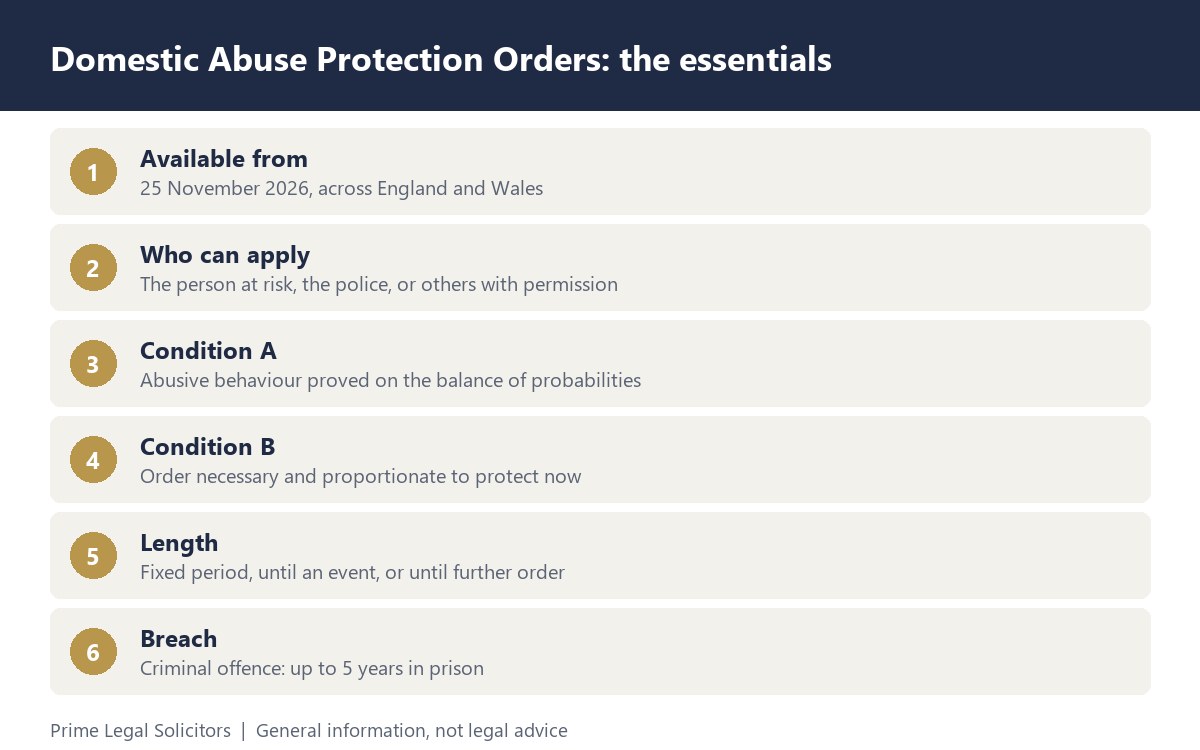
From 25 November 2026, Domestic Abuse Protection Orders (DAPOs) can be made by courts across England and Wales. Until now they have only been available in pilot areas, including Greater Manchester. A DAPO is a single, flexible order that can stop contact, keep someone away from a home, require electronic tagging and last for as long as the court decides it is needed. Breaching one is a criminal offence. This guide explains what is changing, who can apply, what the court has to be satisfied of, and where non-molestation orders now fit.
Key takeaways
- DAPOs come from Part 3 of the Domestic Abuse Act 2021. After a pilot that began in November 2024, they are now being rolled out nationally.
- They cover the full legal definition of domestic abuse, not just violence: coercive control, emotional, economic and threatening behaviour all count.
- The person protected, the police, or someone else with the court’s permission can apply. Family, civil and criminal courts can also make one without an application.
- There is no fixed maximum length. Electronic monitoring is capped at 12 months at a time.
- Breach without reasonable excuse is a crime, with up to five years in prison. Existing non-molestation orders have not been abolished.
What is changing on 25 November 2026
For two years, DAPOs have been tested in a small number of areas. Greater Manchester was one of them, alongside several London boroughs and, later, other regions. The pilot period ends on 24 November 2026. From the next day, the regime becomes available across England and Wales, in family, civil and criminal courts.
There is one important caveat. The national rollout is not switching on every power everywhere at once. The commencement rules hold some of the new provisions back from family and civil proceedings at first, and the government has said further phases will follow. In practice, that means behaviour-change programme requirements may not be available in every family or civil case straight away. If you are applying, or responding to an application, it is worth checking exactly what the court dealing with your case can order.
The change matters because, until now, most people seeking protection have used the remedies in the Family Law Act 1996. Our guide to domestic abuse and family law explains how those orders work. DAPOs do not replace them overnight, but they give the courts a much wider toolkit.
What is a Domestic Abuse Protection Order?
A DAPO is a civil order made to protect someone aged 16 or over from domestic abuse, or the risk of it, by a person they are “personally connected” to. That covers partners and ex-partners, people who are or were married or in a civil partnership, relatives, and people who share parental responsibility for a child.
The Act’s definition of abuse is deliberately broad. It includes:
- physical or sexual abuse;
- violent or threatening behaviour;
- controlling or coercive behaviour;
- economic abuse, such as controlling someone’s money or stopping them working;
- psychological, emotional or other abuse.
Nobody has to be charged or convicted for a DAPO to be made. The court decides the facts on the civil standard, the balance of probabilities. Where children are affected, the court must also consider their welfare, which often links DAPO cases with child arrangements proceedings.
What a DAPO can require
The court can impose any requirement it considers necessary to protect the person from abuse. “Requirement” includes prohibitions and restrictions. Common examples are:
| Type of requirement | Example |
|---|---|
| No contact | No direct or indirect contact with the protected person, including by message or through friends |
| Distance from places | Not coming within a set distance of the protected person’s home, workplace or a child’s school |
| The shared home | Leaving a shared home, not entering it, or not excluding the protected person from it |
| Electronic monitoring | Wearing a tag to check compliance, for no more than 12 months at a time |
| Positive requirements | Attending a behaviour-change programme, where available in that court |
On top of anything the court orders, the law itself requires anyone subject to a DAPO to give the police their name and home address within three days, and to report any change within three days. Failing to do so is a separate offence.
Requirements should, as far as practicable, avoid clashing with the person’s work, education, religious beliefs or other court orders. The order can run for a fixed period, until a specified event, or “until further order”, so there is no automatic end date. That is a real difference from many non-molestation orders, which are usually made for a set period.
Who can apply?
An application can be made by:
- the person who needs protection;
- the police;
- certain bodies specified in regulations;
- anyone else, such as a relative or friend, with the court’s permission.
Courts can also make a DAPO of their own accord. A family court can do so in family proceedings between the two people, a county court in civil proceedings, and a criminal court when sentencing someone, or even after an acquittal. For anyone who feels unable to start proceedings themselves, this wider approach can make a real difference. Applying in the family court costs nothing, and you can read more about funding in our guide to the cost of a family lawyer.
What the court must be satisfied of
Under section 32 of the Act, two conditions must both be met:
- Condition A: on the balance of probabilities, the respondent has been abusive towards a person aged 16 or over to whom they are personally connected.
- Condition B: the order is necessary and proportionate to protect that person from domestic abuse, or the risk of it, by the respondent.
The respondent must be 18 or over. It does not matter whether the abuse happened in England and Wales or abroad, or before the law came into force.
Condition B is where many cases are won or lost. Proving that abuse happened in the past is not enough on its own. The court must look at the risk now, and the restrictions must be in proportion to it. Before deciding, the court must also consider the welfare of any children involved and the views of the person to be protected, if it knows them. These are the same principles that run through how family courts approach children cases.
Can a DAPO be made without the other person knowing?
Yes. Section 34 lets the court make an order without notice where that is “just and convenient”. The court looks at all the circumstances, including:
- whether there is a risk of significant harm if the order is not made straight away;
- whether the applicant might be deterred or prevented from going ahead if they had to wait;
- whether the respondent knows about the case and is deliberately avoiding being served.
A without-notice order is not the end of the matter. The respondent must be given the chance to make representations at a hearing as soon as is just and convenient. Because these orders can affect someone’s home, family life and liberty, the court scrutinises them carefully, and anyone served with one should get advice quickly. Our Manchester family team deals with urgent hearings of this kind.
What happens if a DAPO is breached?
Although a DAPO is a civil order, breaking any of its requirements without reasonable excuse is a criminal offence. The maximum sentence is five years’ imprisonment if the case goes to the Crown Court. Where an order was made without notice, a person can only commit the offence once they are aware the order exists.
The protected person contacting the respondent does not suspend the order. It stays in force, and must be obeyed in full, until a court varies or discharges it or it expires.
Can a DAPO be challenged or discharged?
Yes. Under section 44, either party, the police or the original applicant can ask the court to vary or discharge an order. The court can only discharge it if satisfied that it is no longer necessary to protect the person from domestic abuse. Grounds that may be relevant include:
- insufficient evidence to meet the legal test in the first place;
- no continuing risk, for example after a long period with no incidents;
- restrictions that go further than the risk justifies;
- important information withheld at a without-notice hearing;
- procedural unfairness.
An appeal may also be possible where the court got the law wrong. Until an order is changed, it must be followed. If you have been served with a DAPO, our family law solicitors can advise on the options and deadlines.
Will DAPOs replace non-molestation orders?
Not yet. DAPOs are designed to become the main route to protection from domestic abuse, but the rollout does not abolish non-molestation orders or occupation orders under the Family Law Act 1996. Both remain available. Which order is right depends on the facts: who needs protecting, what restrictions are needed, how long for, and whether the police are already involved. A short conversation with a solicitor usually makes the choice clear.
What this means in practice
The national rollout is the biggest change to protective orders in decades. Whether it works will depend on how consistently judges apply the test, how well breaches are enforced, and whether people on both sides can get proper legal advice. The system has to protect people at risk while staying fair to those facing allegations, and both of those matter.
How Prime Legal Solicitors can help
We act for people seeking protection and for people responding to applications. Our work includes:
- applying for DAPOs, including urgent and without-notice applications;
- defending and challenging DAPO applications;
- applications to vary or discharge an existing order;
- non-molestation and occupation order proceedings;
- related children and family proceedings;
- advocacy at contested hearings.
Our team handled DAPO cases during the Greater Manchester pilot, so we know how these hearings run in practice. Whether you need protection or are responding to an application, early advice makes a difference. You can reach us through our Manchester, Yorkshire and London offices, on 0330 341 4757, or by email at ha@primelegalsolicitors.co.uk.
Frequently asked questions
When do DAPOs start across England and Wales?
From 25 November 2026. Before that, they were only available in pilot areas, including Greater Manchester, from November 2024.
Do you need a criminal conviction for a DAPO?
No. The court decides on the balance of probabilities. An order can be made even if there has been no arrest, charge or conviction.
How long does a DAPO last?
As long as the court orders: for a fixed period, until a specified event, or until further order. There is no statutory maximum, but electronic monitoring cannot last more than 12 months at a time without the court extending it.
Does it cost anything to apply for a DAPO in the family court?
There is no court fee. Legal fees are separate, and legal aid may be available to people seeking protection. See our pricing page for how we charge.
Can I still get a non-molestation order?
Yes. Non-molestation and occupation orders remain available alongside DAPOs.
Please note: This article is general information about the law of England and Wales as at November 2026. It is not legal advice. If you are in immediate danger, call the police on 999. Prime Legal Solicitors is authorised and regulated by the Solicitors Regulation Authority, SRA No. 834471.
About the author

Hassan Ansari
Partner Solicitor and Solicitor Advocate
SRA ID 272725, listed on the SRA register (opens in a new tab)Hassan is a solicitor advocate specialising in family law, general litigation, and motoring offences. He represents clients in complex private law children cases, financial remedy proceedings, and contested hearings.
Prime Legal Group Ltd is authorised and regulated by the Solicitors Regulation Authority, SRA number 834471.
Services and fees
Talk to a family solicitor
A full cost estimate before any work starts. Payment plans are available.
- Divorce and civil partnership dissolutionFrom £750 + VAT
- Child arrangements ordersFrom £1,500 + VAT
- Family law
Fees are a guide and exclude disbursements. See all our fees
Keep reading
More family law guides

How Much Does a Child Custody Case Cost in the UK? Fees at Every Stage
A child custody case can cost a few hundred pounds through mediation or over £10,000 if it goes to a final hearing. Court fees, mediation, our staged solicitor fees and legal aid, with worked examples.
Prime Legal Solicitors

Moving Abroad With Your Child After Separation: Getting Permission to Relocate
Want to move abroad with your child after separating? You need the other parent's consent or the court's permission. How to apply, what the court weighs up, and what the staying parent can do.
 Hassan Ansari
Parental Responsibility Agreement: How to Make One, Step by Step
A parental responsibility agreement gives a father or step-parent parental responsibility without going to court. Which form to use, how to sign it, and what to do if the mother refuses.
Hassan Ansari
Speak to a solicitor
Talk to our family law team
Your first consultation is free. Meet us in person, or talk by phone or video call.
Book a free consultation- Phone0330 341 4757
- WhatsApp07918 328638 (opens WhatsApp)
- Emailinfo@
primelegalsolicitors .co.uk - Opening hoursMonday to Friday, 9am to 5.30pm
Our offices
Prime Legal Group Ltd is authorised and regulated by the Solicitors Regulation Authority, SRA number 834471 (opens in a new tab)