
Family law
Parents’ Rights After Separation: What Mothers and Fathers Can and Cannot Do
What rights do mothers and fathers have after separation in England and Wales? Parental responsibility, time with your child, major decisions and what the court looks at.


In England and Wales, mothers and fathers do not have “rights” over a child in the way most people expect. The law talks about parental responsibility, and the court’s only concern in a dispute is the child’s welfare. A mother automatically has parental responsibility. A father has it if he was married to the mother at the birth or is named on a birth certificate registered after 1 December 2003. Either parent can ask the court to decide where a child lives and how much time they spend with each parent. This guide explains what each parent can and cannot do after separation, and what to do if you are being kept from your child.
Key takeaways
- Parental responsibility (PR) gives you a say in major decisions about your child. It does not give you a set amount of time with them; that is agreed between you or decided by a child arrangements order.
- Mothers always have PR. Most fathers do too, through marriage or the birth certificate, and those who do not can get it by agreement or court order.
- No parent has a right to 50/50 care. The court decides what is best for the child, using the welfare checklist in the Children Act 1989.
- A parent with PR cannot stop the other seeing the child without good reason, and cannot take the child abroad, change their surname or move school without agreement or a court order.
- Child maintenance and time with the child are separate. Paying does not buy contact, and contact cannot be withheld because maintenance is unpaid.
Rights or responsibility? How the law actually works
The Children Act 1989 deliberately moved away from the idea of parents’ “rights”. Instead it gives parents parental responsibility: all the rights, duties, powers and authority a parent has in relation to a child. In practice that means a right to be involved in the big decisions, such as where the child goes to school, their religion, medical treatment, their name, and whether they live abroad.
Parental responsibility is not the same as time with your child. A father with PR who has not seen his children for a year still has PR. A mother whose children live with their father keeps hers. Where children live and who they see is decided by agreement between the parents, or by a child arrangements order if they cannot agree.
When a court decides any question about a child’s upbringing, the child’s welfare is its paramount consideration. That one principle shapes everything below. It is why judges do not start by asking what each parent is entitled to, but what this particular child needs. If you are about to take advice, our guide to your first meeting with a family lawyer explains what to bring.
Mothers’ and fathers’ rights compared
| Question | Mother | Father |
|---|---|---|
| Parental responsibility | Always, automatically from birth | If married to the mother at the birth, named on a birth certificate registered after 1 Dec 2003, or by agreement or court order |
| Can apply for a child arrangements order | Yes, without permission | Yes, without permission, whether or not he has PR |
| Say in major decisions (school, religion, medical, name) | Yes | Yes, if he has PR |
| Information from school | Yes | Generally yes, as a parent, unless a court order says otherwise |
| Duty to pay child maintenance if the child lives elsewhere | Yes | Yes, regardless of PR |
| Starting presumption about time with the child | None based on gender. No right to 50/50. The court decides on the child’s welfare. | |
The law treats mothers and fathers in the same way once both have PR. The only real difference is how PR is acquired. If you are an unmarried father who is not on the birth certificate, the simplest fix is a parental responsibility agreement signed with the mother, or re-registering the birth.
Fathers’ rights after separation
Most fathers worry about one thing: being shut out of their children’s lives. The law gives you several protections.
You can apply to court to see your child
Any parent can apply for a child arrangements order without asking the court’s permission first, even without PR. Before applying, you normally need to attend a Mediation Information and Assessment Meeting (MIAM), unless an exemption applies, such as domestic abuse or urgency. The court fee for a C100 application is £270. Our guide to the cost of a custody case sets out the full costs at each stage.
The court will look at involvement with both parents
At the moment, the Children Act requires the court to presume that each parent’s involvement in a child’s life will further the child’s welfare, unless the contrary is shown. “Involvement” means some kind of involvement, direct or indirect. It does not mean any particular split of time. The government is removing this presumption through the Courts and Tribunals Bill, which was still going through Parliament in November 2026. Our article on the presumption of parental involvement explains why. Even once it goes, a good relationship with both parents will remain something courts value, where it is safe.
You can get school and medical information
Schools are expected to treat all parents equally and share reports and information with both, unless a court order restricts it. With PR, you can also speak to your child’s GP and be consulted on medical treatment.
Paying maintenance is a separate issue
You must pay child maintenance whether or not you see your child. But the other parent cannot refuse contact because you are behind with payments, and you cannot stop paying because contact has been refused. Courts take a dim view of either.
Mothers’ rights after separation
A mother always has PR, so she never needs to apply for it. In most separations, children live mainly with their mother, and many mothers assume that gives them the final say. It does not.
- You cannot stop the father seeing the children without good reason. If there is a genuine safety concern, such as abuse, the right step is to raise it, and if necessary apply to court, rather than stopping contact unilaterally. Courts are increasingly alert to one parent turning a child against the other, which our guide to parental alienation explains.
- You cannot make major decisions alone where he has PR. Changing the children’s surname, moving them to a school far away or relocating abroad needs his agreement or a court order.
- You can apply to court for protection or for orders. That includes a child arrangements order, a prohibited steps order to stop a particular action, or protection from abuse, including the new Domestic Abuse Protection Orders.
- You can claim child maintenance from the other parent through the Child Maintenance Service or by private agreement.
Day-to-day decisions and major decisions
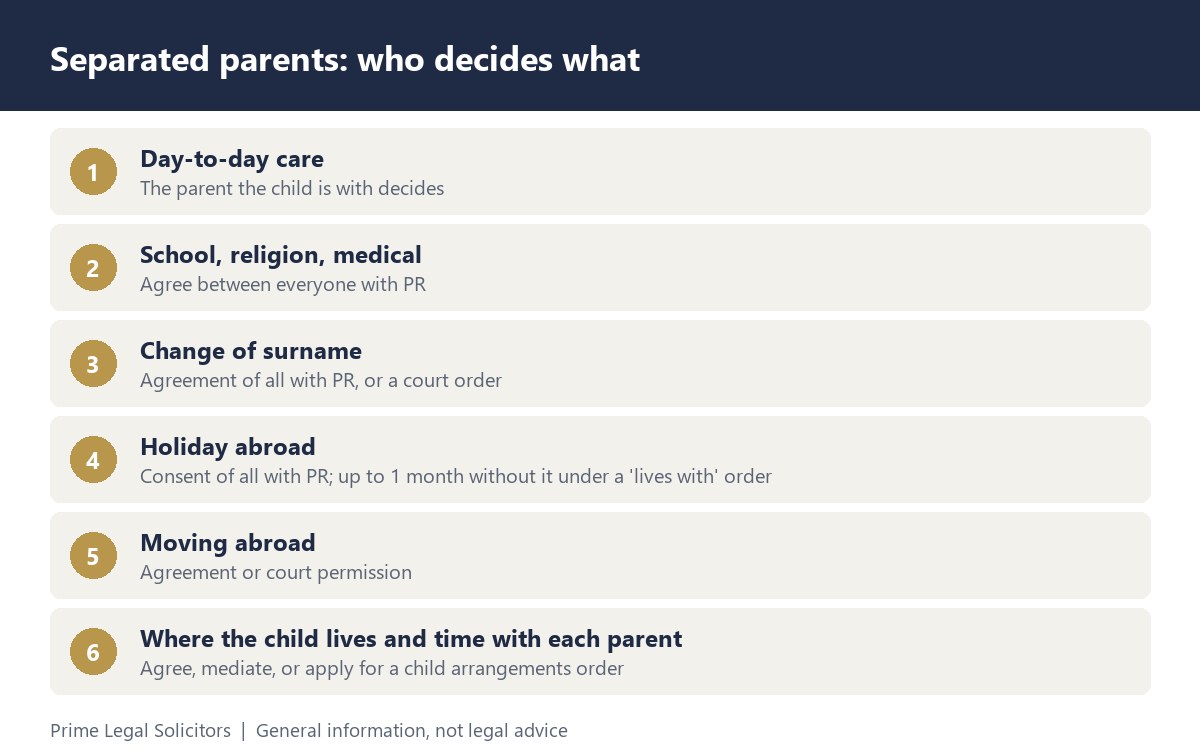
Where both parents have PR, each can act alone on everyday matters. The parent the child is with decides bedtimes, meals, homework and weekend plans. Major decisions are different. Each parent can technically act alone, but if one goes ahead without consulting the other, the other can ask the court to step in. In practice, you should agree on:
- which school the child attends;
- changing the child’s surname;
- non-urgent medical treatment;
- religious upbringing;
- moving a long distance away or abroad.
Taking a child out of the UK without the consent of everyone with PR, or a court order, can be a criminal offence under the Child Abduction Act 1984. There is one exception: a parent named in a child arrangements order as the person the child lives with can take the child abroad for up to a month without consent. Moving abroad permanently always needs agreement or the court’s permission. Our guide to moving abroad with a child covers that process.
When parents cannot agree on one issue, the court can make a specific issue order (deciding the question) or a prohibited steps order (stopping something happening). These use the same C100 form as a child arrangements application.
How the court decides
If parents cannot agree, the court works through the welfare checklist in section 1(3) of the Children Act 1989. It considers:
- the child’s wishes and feelings, in light of their age and understanding;
- their physical, emotional and educational needs;
- the likely effect of any change in their circumstances;
- their age, sex, background and any relevant characteristics;
- any harm they have suffered or are at risk of suffering;
- how capable each parent is of meeting their needs;
- the range of orders available.
The court will also only make an order if doing so is better for the child than making no order at all. Where domestic abuse is alleged, the court must follow Practice Direction 12J, which may mean deciding disputed allegations before deciding contact. For more detail, read what family courts focus on in children cases.
What to do if you are being kept from your child
- Keep communication calm and in writing. Propose specific arrangements and keep a record of what was offered and refused.
- Try mediation. It is quicker and cheaper than court, and usually required first. Our guide to mediation or court compares the two.
- Keep paying maintenance and keep showing up for any contact that is offered.
- Apply for a child arrangements order if agreement is not possible. Courts can order indirect contact, such as video calls, while a case progresses.
- Enforce an existing order if one is being ignored. The court can order unpaid work, compensation or change who the child lives with.
Arrangements that keep breaking down often need a firmer structure. Our guide to high-conflict co-parenting has practical steps.
Worked example
Ryan and Sophie were never married. Their daughter Ava, now 6, was born in 2020, and Ryan is named on her birth certificate. After they separated, Ava lived with Sophie and saw Ryan every other weekend. Then Sophie met a new partner and told Ryan she planned to move with Ava to Spain and change her surname.
Because he was registered on the birth certificate after December 2003, Ryan has parental responsibility. Sophie cannot change Ava’s surname or take her to live abroad without his agreement or a court order. Ryan’s first step is to set out his objections in writing and suggest mediation. If Sophie still intends to go, he can apply for a prohibited steps order to stop the move until the court decides. Sophie, in turn, can apply for permission to relocate. The court will weigh the reasons for the move, the plan for Ava in Spain, and the effect on her relationship with her father. Neither parent’s gender decides it. Ava’s welfare does.
Step-parents, grandparents and other family
A step-parent can get PR by agreement with every parent who has it, or by court order. Grandparents do not have automatic rights and usually need the court’s permission to apply, which our guide to grandparents’ rights explains. If you were never married, separation brings further issues around the home and money. Our guide to cohabitation rights covers them.
How we can help
Our family team advises mothers and fathers on parental responsibility, child arrangements, relocation and enforcement, and represents parents at contested hearings. Fees for negotiating child arrangements start from £1,500 + VAT, with a full estimate before any work begins. See our pricing page for details.
This guide was written by Hassan Ansari, Partner and Solicitor Advocate, who handles private law children cases. Speak to our child arrangements solicitors in Manchester, Yorkshire or London for a free initial consultation.
Frequently asked questions
Do fathers have equal rights in the UK?
Once a father has parental responsibility, he has the same legal standing as the mother. Neither parent has a right to equal time; the court decides what is best for the child.
Can a mother stop a father seeing his child?
Not without good reason. If there are genuine safety concerns, she should raise them and, if needed, ask the court to decide. Stopping contact unilaterally can count against a parent in later proceedings.
Does a father have rights if he is not on the birth certificate?
He does not have PR, but he can still apply for a child arrangements order without permission, and he must pay child maintenance. He can get PR by agreement with the mother, by re-registering the birth, or by court order.
Is there a presumption of 50/50 care?
No. The law has never presumed equal time. Shared care is common where it suits the child, but it is a welfare decision in every case.
At what age can a child decide which parent to live with?
There is no fixed age. The court gives more weight to a child’s wishes as they get older, and a teenager’s views will often be decisive, but the court still decides based on welfare. Our family law team can advise on how a child’s views are put to the court.
Please note: This article is general information about the law of England and Wales as at November 2026. It is not legal advice and does not create a solicitor-client relationship. Speak to a solicitor before making a decision. Prime Legal Solicitors is authorised and regulated by the Solicitors Regulation Authority, SRA No. 834471.
About the author

Hassan Ansari
Partner Solicitor and Solicitor Advocate
SRA ID 272725, listed on the SRA register (opens in a new tab)Hassan is a solicitor advocate specialising in family law, general litigation, and motoring offences. He represents clients in complex private law children cases, financial remedy proceedings, and contested hearings.
Prime Legal Group Ltd is authorised and regulated by the Solicitors Regulation Authority, SRA number 834471.
Services and fees
Talk to a family solicitor about child arrangements
A full cost estimate before any work starts. Payment plans are available.
- Child arrangements ordersFrom £1,500 + VAT
- Divorce and civil partnership dissolutionFrom £750 + VAT
- Family law
Fees are a guide and exclude disbursements. See all our fees
Keep reading
More family law guides

How Much Does a Child Custody Case Cost in the UK? Fees at Every Stage
A child custody case can cost a few hundred pounds through mediation or over £10,000 if it goes to a final hearing. Court fees, mediation, our staged solicitor fees and legal aid, with worked examples.
Prime Legal Solicitors

Moving Abroad With Your Child After Separation: Getting Permission to Relocate
Want to move abroad with your child after separating? You need the other parent's consent or the court's permission. How to apply, what the court weighs up, and what the staying parent can do.
 Hassan Ansari
Parental Responsibility Agreement: How to Make One, Step by Step
A parental responsibility agreement gives a father or step-parent parental responsibility without going to court. Which form to use, how to sign it, and what to do if the mother refuses.
Hassan Ansari
Speak to a solicitor
Talk to our family law team
Your first consultation is free. Meet us in person, or talk by phone or video call.
Book a free consultation- Phone0330 341 4757
- WhatsApp07918 328638 (opens WhatsApp)
- Emailinfo@
primelegalsolicitors .co.uk - Opening hoursMonday to Friday, 9am to 5.30pm
Our offices
Prime Legal Group Ltd is authorised and regulated by the Solicitors Regulation Authority, SRA number 834471 (opens in a new tab)