
Family law
How to Defend a Domestic Abuse Protection Order (DAPO) and Apply for Its Discharge
Served with a Domestic Abuse Protection Order? How to defend a DAPO, challenge a without-notice order, and apply to vary or discharge it under section 44.


If you have been served with a Domestic Abuse Protection Order (DAPO), or someone has applied for one against you, you have the right to defend it, to challenge an order made without notice, and to ask the court to vary or discharge it later. A DAPO is not a criminal conviction, but breaching one is a crime carrying up to five years in prison, so you must obey it while you challenge it. This guide sets out the legal test, the main grounds of defence, and the step-by-step process for getting an order changed or removed.
Key takeaways
- The court can only make a DAPO if it finds, on the balance of probabilities, that you were abusive and that an order is necessary and proportionate now. Both parts can be challenged.
- A without-notice order is not the final word. You are entitled to a hearing where you can respond.
- Under section 44 of the Domestic Abuse Act 2021, the court can discharge an order only if it is no longer necessary to protect the person.
- In the family court, you apply on Form DA3 to the court that made the order. There is no court fee.
- Keep obeying every requirement until the court changes the order, even if the other person contacts you.
DAPOs from 25 November 2026
DAPOs have been piloted since November 2024 and become available across England and Wales from 25 November 2026. Our guide to the national DAPO rollout explains the new regime in full.
A DAPO can have a serious impact on the person it is made against. It may ban contact with a former partner, keep you out of the family home, stop you going near certain places and, in some cases, require you to wear an electronic tag. It can last indefinitely if the court orders it “until further order”. You must also give the police your name and address within three days of the order and keep them updated.
But a DAPO is a civil order. Being subject to one does not mean a criminal court has found the allegations proved. The law gives you real safeguards, and using them early tends to produce the best outcome. For the wider picture, see our overview of family law in England and Wales.
1. Can you defend a DAPO application?
Yes. Under section 32 of the Domestic Abuse Act 2021, the court can only make a DAPO if two conditions are both met:
- On the balance of probabilities, you have been abusive towards a person aged 16 or over to whom you are personally connected.
- The order is necessary and proportionate to protect that person from domestic abuse, or the risk of it, by you.
These are separate questions. Even if the court accepts that something happened in the past, it must still decide whether an order is needed now, and whether each restriction is proportionate to the risk. A relationship breaking down, or an allegation being made, is not enough on its own. Before deciding, the court must also consider the welfare of any children and the views of the person to be protected. This is why DAPO cases often overlap with child arrangements disputes.
2. What if the order was made without your knowledge?
Section 34 allows a court to make a DAPO without telling you first, where it is “just and convenient”. These are called without-notice orders. The court has to consider all the circumstances, including:
- whether there is a risk of significant harm if an order is not made immediately;
- whether the applicant could be deterred or prevented from continuing if they had to wait;
- whether you know about the case and are deliberately avoiding being served.
A without-notice order is usually a holding position, not a final decision. You must be given the chance to put your side at a hearing as soon as is just and convenient, often called the return hearing.
If you have received one, get advice straight away and prepare for that hearing. A solicitor will check whether the application was supported by proper evidence, whether anything important was left out, and whether the legal test was actually met. An applicant who obtains an order without notice must be frank with the court, and failing to disclose important facts can be a strong ground to challenge it. Our Manchester family solicitors regularly act at urgent return hearings.
3. Grounds for defending a DAPO
Every case turns on its facts, but these are the grounds that come up most often.
| Ground | What it means | Evidence that helps |
|---|---|---|
| Insufficient evidence | The abuse alleged is not proved on the balance of probabilities | Messages, emails, witness statements, police records, timelines |
| No continuing risk | Even if something happened, an order is not necessary now | Long separation, no further incidents, compliance with earlier conditions |
| Disproportionate terms | Specific restrictions go further than needed | Impact on work, housing, children or travel; less restrictive alternatives |
| Inaccurate or incomplete account | Key allegations are disputed or missing context | A detailed witness statement backed by documents |
| Procedural unfairness | Documents not served, information withheld, no fair chance to respond | The court file, the order, correspondence about service |
A few points are worth knowing. The absence of recent incidents does not automatically mean there is no risk, so the court will look at the whole history. Procedural errors do not cancel an order by themselves, but they can justify a rehearing, further directions or an appeal. And where the facts are disputed, the court may need to hold a hearing to decide them, which makes a carefully prepared witness statement central to your defence, as it is throughout the family court process. You can read about how these hearings are run in our guide to domestic abuse in family law.
4. What if the police have taken no further action?
DAPO cases often run alongside a police investigation. Sometimes the police decide to take no further action, or the Crown Prosecution Service drops the case.
That does not automatically end a DAPO. Criminal courts need proof beyond reasonable doubt, whereas a DAPO only needs the balance of probabilities. Even so, the outcome of the investigation, the evidence gathered, and the reasons the case was dropped can all be relevant, both to challenging the allegations and to whether continued protection is necessary. A criminal court can even make a DAPO after acquitting someone, so it is wise not to treat a “no further action” letter as the end of the matter.
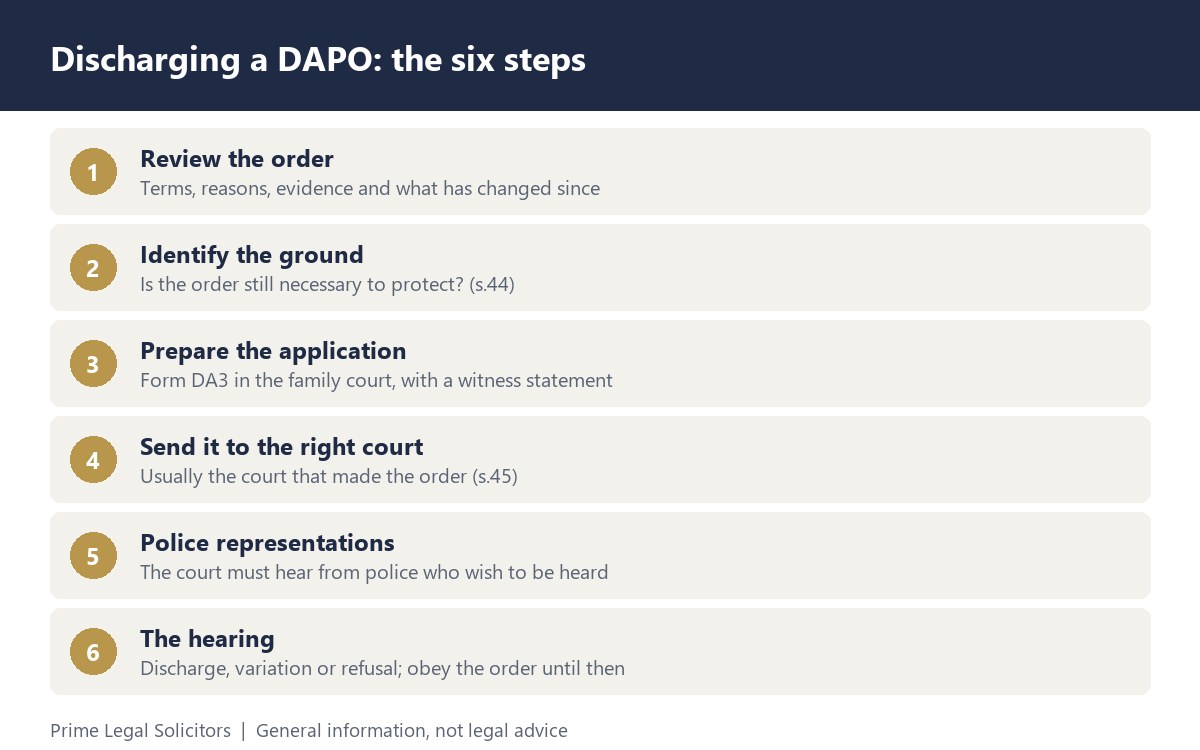
5. How to apply to discharge a DAPO, step by step
Section 44 allows the person subject to the order to apply for it to be varied or discharged. Discharge ends the order. Variation changes some of its requirements while the rest stay in force.
Step 1: Get and review the order
Your solicitor will need the original order and any later variations, the allegations relied on, the court’s reasons, the length and exact terms of each restriction, the evidence used when it was made, and a clear account of what has changed since. It is the same kind of review we carry out when someone faces an application to extend a non-molestation order.
Step 2: Identify the legal ground
Under section 44(13), the court can discharge a DAPO only if it is satisfied that the order is no longer necessary to protect the person from domestic abuse, or the risk of it. Evidence of change is often what persuades the court: a permanent separation, a long period with no incidents, a reduced risk, or other arrangements that now give adequate protection. The court can also remove or soften individual requirements if they are no longer necessary.
Step 3: Prepare the application
If the order was made in the family court, you apply on Form DA3, with a witness statement and supporting evidence. There is no court fee, although you will still need to consider legal costs for preparation and representation. The statement should explain why the order is no longer necessary and deal head-on with any risk the other side is likely to raise. Different forms and rules apply if the order was made in a civil or criminal court.
Step 4: Send it to the right court
Under section 45, the application generally goes to the court that made the order. There are limited exceptions, for example for orders made by magistrates’ courts or on sentence. The court will then give directions about service, evidence and a hearing.
Step 5: Expect the police to be involved
Unlike a non-molestation order, a DAPO gives the police a formal role. Before varying or discharging an order, the court must hear from any relevant chief officer of police who wants to be heard. This lets the police raise any ongoing safeguarding concerns, so your evidence should anticipate them.
Step 6: Attend the hearing
At the hearing, the court decides whether the order is still necessary. Your solicitor or advocate can make submissions, deal with the evidence and challenge the case for keeping it. If you need representation at that hearing, contact our team as early as you can. The court can discharge the order, vary it, or refuse the application. Until it does one of those things, or the order expires, you must keep obeying it.
6. Should you apply to vary instead?
Sometimes asking for a change is more realistic than asking for the whole order to go. Examples include allowing communication through solicitors, adjusting a geographical restriction that stops you getting to work, or changing terms that affect time with your children.
The court will ask whether the particular restriction is still necessary and whether the change is safe for the protected person. Ongoing children proceedings do not, on their own, justify relaxing the order. If you share children, our guide to what family courts focus on explains how the two sets of proceedings interact.
7. Can a DAPO be discharged if both of you agree?
Agreement helps, but it does not guarantee anything. The court has its own duty to decide whether the order is still needed, and it must still hear from the police if they want to be heard. Where the protected person is the one asking to discharge or relax the order, the court must hear from them directly. That safeguard exists because agreement can sometimes be the result of pressure, the same concern that makes mediation unsuitable in some abuse cases. Never contact the protected person to discuss ending the order if the order bans contact: that is itself a breach.
8. Can you appeal a DAPO?
Yes. Sections 46 and 47 of the Act set out the appeal routes. An appeal may be right if the court made an error of law, applied the wrong test, ignored relevant evidence, or the hearing was seriously unfair.
An appeal and a discharge application are different things. An appeal says the original decision was wrong. A discharge application says the order should not continue now, applying the section 44 test. Which route fits depends on your circumstances, and appeal deadlines can be very short, so take advice promptly. Our family law team can tell you quickly which applies.
9. How long does it take to discharge a DAPO?
There is no set timescale. It depends on how busy the court is, how urgent the application is, whether the police want to make representations, and whether there are factual disputes that need a contested hearing. If the order is causing serious and disproportionate problems, for example with your job or housing, you can ask for an expedited hearing, but the court does not have to grant one.
10. What to do if you have been served with a DAPO
- Read the order carefully and comply with every requirement.
- Avoid any contact the order prohibits, including indirect contact through friends, family or social media.
- Give the police your name and address within three days.
- Get copies of the application and the evidence relied on.
- Keep relevant messages, emails and documents safe.
- Write down an accurate timeline of events while it is fresh.
- Get specialist advice before the next hearing. Our guide to legal fees and disbursements explains what you would pay for.
- Decide, with your solicitor, whether to contest, seek a variation or apply to discharge.
Do not assume the order has stopped applying because the protected person has contacted you, the police have closed their investigation, or you have got back together. Only the court can end it early.
11. Specialist DAPO defence solicitors
A DAPO can affect your family life, home, job and reputation, and the criminal consequences of breach make it essential to understand both your obligations and your rights. Our work includes:
- defending DAPO applications;
- representation at urgent and without-notice return hearings;
- applications to discharge or vary existing orders;
- challenging disputed allegations and preparing witness evidence;
- advice on appeals;
- related non-molestation, occupation order and children proceedings.
We handled DAPO proceedings during the Greater Manchester pilot, so we know how these cases run as the scheme goes national. This guide was prepared by Hassan Ansari, Partner and Solicitor Advocate. For confidential advice, contact our Manchester, Yorkshire or London offices on 0330 341 4757, or email ha@primelegalsolicitors.co.uk.
Frequently asked questions
Is a DAPO a criminal record?
No. A DAPO is a civil order, not a conviction. Breaching it is a criminal offence, and a conviction for breach would appear on your record.
What form do I use to discharge a DAPO?
In the family court, Form DA3, sent to the court that made the order. There is no court fee. Orders made in civil or criminal courts use different forms.
Can the police object to my discharge application?
Yes. The court must hear from any relevant chief officer of police who wishes to be heard before varying or discharging the order.
Can I contact my ex to ask them to support discharge?
Not if the order bans contact. That would be a breach. Any approach should go through solicitors or the court.
Does dropping a criminal case end the DAPO?
No. A “no further action” decision does not discharge the order, though it may help an application to discharge or vary it. See our pricing page for how we charge for this work.
Please note: This article is general information about the law of England and Wales as at November 2026. It is not legal advice, and every case depends on its own facts. If you are in immediate danger, call the police on 999. Prime Legal Solicitors is authorised and regulated by the Solicitors Regulation Authority, SRA No. 834471.
About the author

Hassan Ansari
Partner Solicitor and Solicitor Advocate
SRA ID 272725, listed on the SRA register (opens in a new tab)Hassan is a solicitor advocate specialising in family law, general litigation, and motoring offences. He represents clients in complex private law children cases, financial remedy proceedings, and contested hearings.
Prime Legal Group Ltd is authorised and regulated by the Solicitors Regulation Authority, SRA number 834471.
Services and fees
Talk to a family solicitor
A full cost estimate before any work starts. Payment plans are available.
- Divorce and civil partnership dissolutionFrom £750 + VAT
- Child arrangements ordersFrom £1,500 + VAT
- Family law
Fees are a guide and exclude disbursements. See all our fees
Keep reading
More family law guides

How Much Does a Child Custody Case Cost in the UK? Fees at Every Stage
A child custody case can cost a few hundred pounds through mediation or over £10,000 if it goes to a final hearing. Court fees, mediation, our staged solicitor fees and legal aid, with worked examples.
Prime Legal Solicitors

Moving Abroad With Your Child After Separation: Getting Permission to Relocate
Want to move abroad with your child after separating? You need the other parent's consent or the court's permission. How to apply, what the court weighs up, and what the staying parent can do.
 Hassan Ansari
Parental Responsibility Agreement: How to Make One, Step by Step
A parental responsibility agreement gives a father or step-parent parental responsibility without going to court. Which form to use, how to sign it, and what to do if the mother refuses.
Hassan Ansari
Speak to a solicitor
Talk to our family law team
Your first consultation is free. Meet us in person, or talk by phone or video call.
Book a free consultation- Phone0330 341 4757
- WhatsApp07918 328638 (opens WhatsApp)
- Emailinfo@
primelegalsolicitors .co.uk - Opening hoursMonday to Friday, 9am to 5.30pm
Our offices
Prime Legal Group Ltd is authorised and regulated by the Solicitors Regulation Authority, SRA number 834471 (opens in a new tab)